

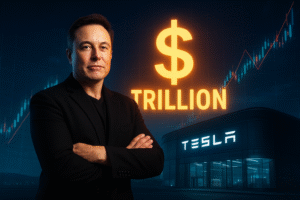

This article breaks down everything: Musk’s current wealth, Tesla’s trillion-dollar compensation plan, how market cap determines this future valuation, and what challenges stand in the way.
A Billionaire vs. 170 Countries: The Scale of $1 Trillion
The video referenced in this topic highlights a stunning comparison — the idea of a single individual holding $1 trillion in personal wealth.
To understand the scale:
-
$1 trillion is more than the GDP of over 170 countries.
-
It is larger than the annual economic output of nations such as the Netherlands, Switzerland, and Saudi Arabia.
-
Only a handful of countries, including the U.S., China, Japan, and Germany, operate at economies many trillions in size.
This comparison shows that Musk’s potential wealth would not just be personal wealth — it would be national-level economic power concentrated in the hands of one individual.
Elon Musk Already Crossed $500 Billion
As of now, Musk’s net worth has exceeded $500 billion, making him the first individual in history to cross the half-trillion mark.
His wealth primarily comes from:
-
Tesla (TSLA) — still his biggest asset
-
SpaceX — valued at over $200 billion
-
X (formerly Twitter)
-
The Boring Company and Neuralink
But the biggest push toward $1 trillion is coming from a single factor:
Tesla’s newly approved $1 trillion compensation plan.
The $1 Trillion Tesla Compensation Plan: What It Means
Shareholders recently approved a historic compensation package for Elon Musk — one that could make him the world’s first trillionaire if Tesla achieves massive growth.
Key points about the compensation plan:
-
The package is performance-based.
-
Musk will not receive any salary or cash bonus.
-
He only gets compensated if Tesla meets aggressive milestones in market cap, revenue, and profitability.
-
The total value of this plan is estimated at over $1 trillion, depending on future stock price movements.
This plan isn’t guaranteed riches — it is conditional wealth tied to extraordinary corporate performance.
The Path to $1 Trillion: Tesla Must Reach $8.5 Trillion Market Cap
For Musk to hit the trillionaire milestone, Tesla itself must achieve something nearly unimaginable for an automaker today:
✅ Tesla needs to reach a market capitalization of $8.5 trillion.
To put this in perspective:
-
Apple is worth around $3 trillion.
-
Microsoft is worth around $3.5 trillion.
-
Saudi Aramco is valued at about $2 trillion.
So for Tesla to hit $8.5 trillion, it would need to become more valuable than Apple + Microsoft combined, and then go even higher.
This is where Musk’s compensation plan becomes a monumental challenge.
How Market Capitalization Determines Musk’s Wealth
The video explains a key financial concept: net worth for billionaires is tied to the market value of their companies.
Market Cap = Stock Price × Number of Shares
So for Tesla to grow to $8.5 trillion:
-
Its stock price would need to multiply several times.
-
Investors must remain confident in Tesla’s long-term future.
-
Production capacity, margins, and technology leadership must reach unprecedented heights.
This means Musk’s pathway to $1 trillion is not random — it is mathematically tied to Tesla’s performance on the stock market.
Tesla’s Production Targets Must Skyrocket
For Tesla to justify becoming an $8.5 trillion company, analysts predict it must:
✅ Produce tens of millions of vehicles per year
✅ Dominate autonomous driving and AI mobility
✅ Expand global Gigafactory capacity
✅ Lead the EV market with unmatched margins
✅ Possibly launch robotaxis and full autonomy at scale
This would push Tesla far beyond just being a car company. It would have to become:
-
The global leader in AI mobility
-
A robotics powerhouse
-
An energy giant producing storage systems and solar solutions
-
A key player in autonomous transport
Only then would investors push the company’s value to trillions.
Legal Challenges Around the Compensation Plan
The video also discusses the legal battles that Tesla faced over this compensation package.
A court previously struck down Tesla’s 2018 pay plan, arguing that:
-
The board’s approval process lacked full independence
-
Shareholders needed more clarity
-
Musk had too much influence over board decisions
In response, Tesla:
✅ Reworked the plan
✅ Improved transparency
✅ Gained stronger, clearer shareholder approval
This new vote gives Tesla solid legal ground, making it harder for future lawsuits to challenge the compensation structure.
Why Shareholders Still Support Musk’s Massive Pay Package
Shareholders know that:
-
Musk’s leadership transformed Tesla from a tiny startup to the world’s most valuable automaker.
-
His personal involvement drives investor confidence.
-
Without Musk, Tesla might lose its innovation pace.
So the compensation plan is designed not just to reward Musk — but to ensure he remains committed to Tesla’s long-term future.
Could Musk Really Become the First Trillionaire?
Experts believe it is possible, but extremely difficult.
Here’s what must go right:
✅ Tesla must massively scale global production
✅ Autonomous driving must become commercial reality
✅ Tesla AI and robotics must dominate the market
✅ Tesla Energy must grow into a major revenue source
✅ Investors must maintain confidence for years
If these factors align, Musk could reach the milestone by:
2032–2035 (optimistic timeline)
If Tesla falls short, the trillionaire target becomes unlikely.
Why the World Is Watching Closely
A person reaching $1 trillion wealth raises major global questions:
-
Economic inequality: Should one individual control wealth equivalent to a country’s GDP?
-
Corporate power: Could Tesla’s dominance reshape global industries?
-
Geopolitics: Would Musk’s businesses influence national decisions and technological leadership?
This is not just a business story — it’s a global economic chapter unfolding in real time.
Conclusion
Tesla’s newly approved $1 trillion compensation plan has put Elon Musk on a potential path to becoming the world’s first trillionaire — a milestone beyond anything seen in economic history. But reaching this goal requires Tesla to hit extraordinary targets, grow its market value to $8.5 trillion, and remain a leader in EVs, AI, robotics, and energy.
Whether this future becomes reality or remains an ambitious dream, one thing is certain: