

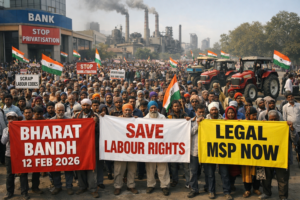

An estimated 30 crore (300 million) people are expected to participate. The strike may impact more than 600 districts across India.
In this article, we will explain in simple language:
-
Why has Bharat Bandh been called?
-
What are the new Labour Codes?
-
Why is banking privatization controversial?
-
What is the MSP issue?
-
How will it affect common citizens?
What Will Happen on 12 February 2026?
This is a nationwide strike supported by several major organizations.
Which sectors may be affected?
-
Banking
-
Insurance
-
Transport
-
Government offices
-
Industrial sector
-
Farmer organizations
Many trade unions and farmer groups are supporting this shutdown. It is seen as a major protest against recent labor reforms and economic policies.
Why Has Bharat Bandh Been Called?
The main reasons behind this strike are:
-
Four new Labour Codes
-
Banking privatization
-
Demand for legal guarantee of MSP
-
Concerns over privatization and workers’ rights
Let’s understand each issue.
1. What Are the Labour Codes?
The government has merged 29 old labor laws into four new Labour Codes.
The stated objectives were:
-
Simplify labor laws
-
Promote industries
-
Increase job creation
However, trade unions argue that these laws weaken workers’ rights.
Major Objections to Labour Codes
1. Easier Layoffs
Under the new rules:
-
Companies can lay off employees without prior government approval (in certain cases).
-
Large-scale retrenchment may become easier.
Unions argue that this may:
-
Reduce job security
-
Increase corporate power
-
Weaken workers’ bargaining position
This is one of the biggest points of controversy.
2. Right to Strike – But With Restrictions
The law technically grants the right to strike.
But in practice, it has become more difficult.
What are the conditions?
-
Mandatory notice period of 14 to 60 days
-
Strict compliance requirements in several sectors
The issue is:
If workers face sudden injustice, they cannot immediately strike.
This reduces their ability to respond quickly to grievances.
3. Reduced Role of Trade Unions?
Some provisions may limit the influence of trade unions.
Union leaders claim:
-
Collective bargaining could weaken
-
Management control may increase
2. Banking Privatization Controversy
Another major issue behind the strike is banking sector privatization.
The government has previously merged several public sector banks.
There are concerns that more banks may be privatized.
Why Are Bank Employees Protesting?
Their key concerns include:
-
Job security
-
Impact on rural banking services
-
Reduced focus on social banking
Public sector banks:
-
Provide loans to the poor
-
Support farmers
-
Run welfare schemes like Jan Dhan Yojana
Employees argue that private banks focus mainly on profits.
Impact on Common People
If banking becomes fully privatized:
-
Rural branches may close
-
Small account holders may face difficulties
-
Service charges may increase
This is why banking unions are part of the Bharat Bandh.
3. MSP (Minimum Support Price) Issue
Farmer organizations are also supporting the strike.
Their main demand:
Legal guarantee of MSP (Minimum Support Price).
What Is MSP?
MSP is the minimum price at which the government promises to purchase crops from farmers.
However:
-
Not every farmer gets MSP
-
Not all crops are purchased at MSP
Farmers want:
-
MSP to become a legal right
-
No trader to buy below MSP
Farmers and the Bharat Bandh
Farmers believe:
-
Recent policies favor big corporations
-
Small farmers may suffer losses
That is why they are standing with labor unions in this protest.
Why Are 30 Crore People Joining?
This is a massive number.
Participants may include:
-
Factory workers
-
Bank employees
-
Insurance staff
-
Transport workers
-
Farmers
-
Unorganized sector workers
This shows that dissatisfaction is not limited to one sector.
What Is the Government’s Stand?
The government argues that:
-
Labour Codes will boost employment
-
Industries will grow
-
The economy will strengthen
-
Investment will increase
According to the government, reforms are necessary to make India globally competitive.
Where Is the Real Conflict?
The key question is:
Can economic reforms and worker protection go hand in hand?
Unions say:
-
Reforms are important
-
But worker security is equally important
Finding this balance is the real challenge.
What May Remain Closed on 12 February 2026?
Possible disruptions include:
-
Banking services
-
Public transport
-
Some government offices
-
Industrial production
However, the full impact will depend on local participation.
Economic and Social Impact of the Strike
If 30 crore people go on strike:
-
Production may slow down
-
Banking transactions may be affected
-
Markets may see short-term pressure
On the other hand:
-
Government may face increased pressure
-
National debate on labor reforms may intensify
Is This Just a One-Day Protest?
It depends.
If demands are not addressed:
-
More large-scale protests may follow
This moment could shape the future of India’s labor policies.
Key Questions the Country Is Watching
-
Will the government amend the Labour Codes?
-
Will banking privatization continue?
-
Will MSP get legal status?
-
Will worker protections be strengthened?
Conclusion: Why 12 February 2026 Is Important
The Bharat Bandh on February 12, 2026, is not just a strike.
It represents a struggle for:
-
Job security
-
Farmers’ rights
-
Protection of public sector institutions
-
Workers’ rights
With nearly 30 crore participants, it signals deep concerns across the country.
Now the key question is:
Will the government choose dialogue, or will tensions escalate?
Either way, this date may become significant in India’s economic and labor history.