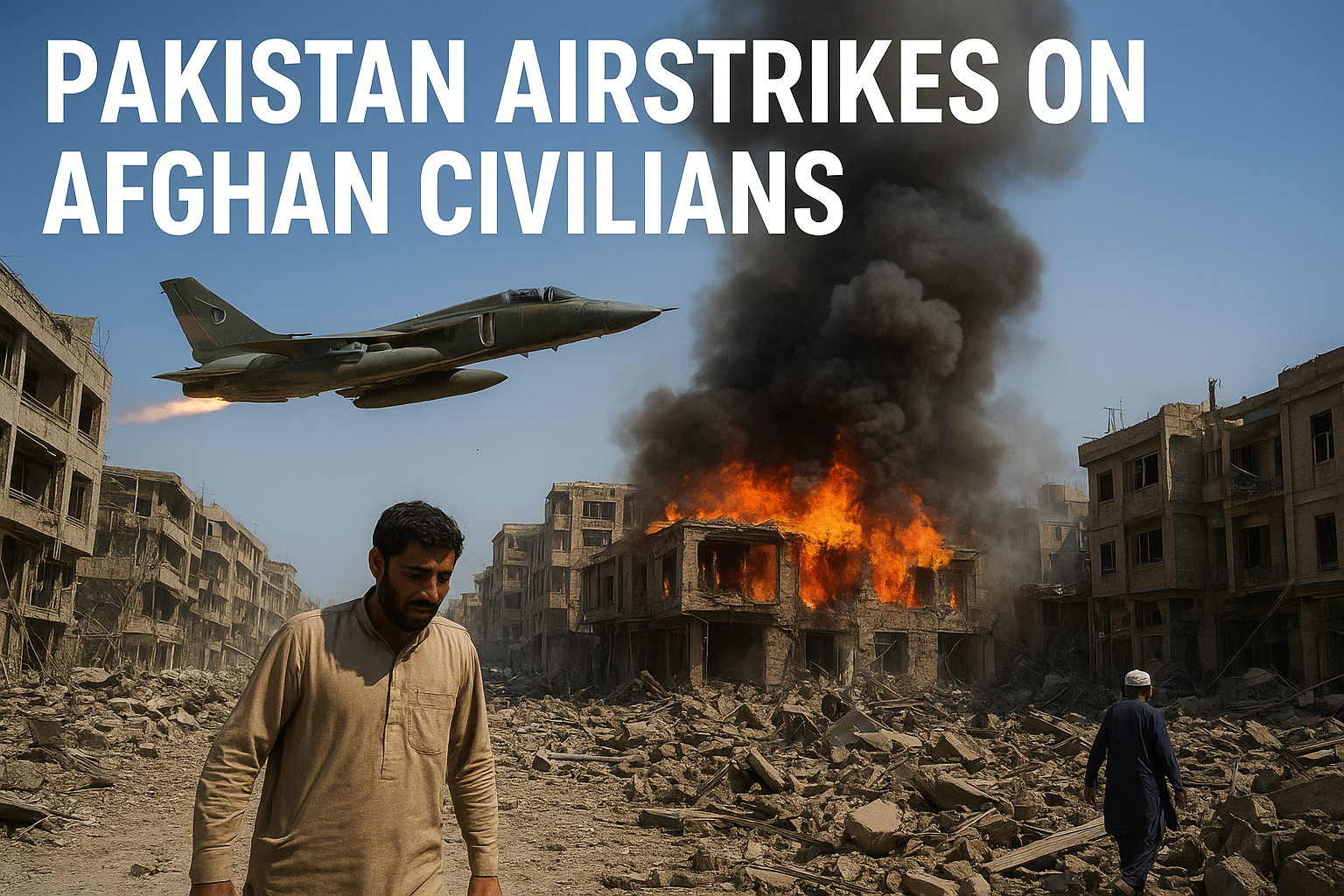
 Pakistan Airstrikes on Afghan Civilians: Tensions between Pakistan and Afghanistan have once again reached a boiling point after Pakistan launched a series of airstrikes inside Afghan territory, reportedly targeting civilian areas. The attacks have sparked outrage across Afghanistan, drawing strong condemnation from the Taliban government and international observers concerned about escalating violence in the region.
According to local reports, Pakistan’s airstrikes hit residential areas near the border, resulting in several civilian deaths and injuries. Among the victims were Afghan cricket players, whose deaths have fueled anger and grief across the nation. Witnesses claim that the attacks came without warning, leaving civilians with little time to escape.
Ceasefire Broken Within Days
The strikes came just days after a short-lived ceasefire was established between the two countries. The truce had been seen as a rare opportunity to ease months of cross-border clashes and restore stability in the volatile border region. However, Pakistan’s sudden offensive shattered the agreement, reigniting conflict and mistrust between Islamabad and Kabul.
The ceasefire had been mediated through back-channel communications and was aimed at halting the exchange of fire that had intensified in recent weeks. Both sides had accused each other of harboring militants responsible for deadly attacks along the Durand Line, the disputed border separating the two nations. Despite initial optimism, the fragile peace quickly crumbled after the latest airstrikes.
Taliban Condemns Pakistan’s “Violation of Sovereignty”
In response, the Taliban government accused Pakistan of violating Afghanistan’s sovereignty and international law. Taliban spokespersons called the airstrikes “an act of aggression against innocent Afghans” and warned that such actions would not go unanswered.
“The Islamic Emirate of Afghanistan strongly condemns Pakistan’s attacks on our civilians,” said a Taliban spokesperson in a statement released on Friday. “These actions are a clear violation of our territorial integrity and will have serious consequences.”
The Taliban also claimed to have carried out retaliatory operations against Pakistani forces stationed along the border. According to their statement, more than 50 Pakistani soldiers were killed in counterattacks—a claim that Pakistan’s military has neither confirmed nor denied.
Pakistan’s Official Response
Islamabad, meanwhile, defended its actions, stating that the airstrikes were aimed at “terrorist hideouts” inside Afghan territory. Pakistani officials allege that militant groups operating from Afghan soil have been carrying out cross-border attacks targeting Pakistani security personnel and civilians in Khyber Pakhtunkhwa and Balochistan provinces.
A senior Pakistani defense official stated, “Pakistan has the right to defend its people and territory from terrorist threats. We have shared intelligence with Afghan authorities multiple times, but the continued presence of anti-Pakistan elements inside Afghanistan leaves us no choice but to act.”
However, Afghan officials insist that the areas struck were civilian-populated and had no connection to militant groups. Videos circulating on social media show destroyed homes and injured residents, intensifying global concern over civilian casualties.
International Reaction and Concerns
The international community has urged both nations to exercise restraint and avoid further escalation. The United Nations called for an immediate investigation into the strikes and emphasized the importance of protecting civilian lives. Neighboring countries, including Iran and China, have also expressed alarm over the growing instability along the Pakistan-Afghanistan border, warning that renewed conflict could disrupt regional peace efforts.
Human rights organizations have called for transparency and accountability from both governments. “Civilian lives must never be targeted or used as leverage in political or military disputes,” said Amnesty International in a statement. “Those responsible for civilian deaths must be held accountable.”
Ceasefire Reinstated—But For How Long?
In a surprising turn of events, a new ceasefire was announced between Pakistan and Afghanistan shortly after the strikes. The agreement was intended to halt further exchanges of fire and create space for diplomatic dialogue. However, analysts remain skeptical about its durability.
Despite the truce, satellite images and reports from local sources indicate the mobilization of heavy weapons, artillery, and additional troops near the border. Both sides appear to be reinforcing their positions, raising fears that another round of fighting could erupt at any moment.
Security experts believe that without concrete political negotiations, the ceasefire may only offer temporary relief. “This truce is fragile and likely short-lived,” said a regional analyst based in Kabul. “Unless both governments engage in serious dialogue and address the root causes of the conflict, tensions will continue to flare up.”
A Longstanding Border Dispute
The underlying tension between Pakistan and Afghanistan is not new. The two countries have a long history of mistrust, often centered around the Durand Line—a colonial-era border that Afghanistan has never officially recognized. Pakistan, on the other hand, considers it an international boundary. This dispute has fueled decades of diplomatic strain and periodic clashes.
The recent violence also highlights the growing challenges both nations face from militant groups operating along their shared frontier. While Pakistan accuses Afghanistan of sheltering Tehreek-e-Taliban Pakistan (TTP) fighters, Kabul blames Islamabad for providing support to anti-Taliban factions. These mutual accusations have made cooperation on border security nearly impossible.
Outlook: Fragile Peace Amid Uncertainty
As of now, the situation remains tense but relatively calm following the latest ceasefire announcement. However, with reports of troop build-ups and unverified claims of cross-border skirmishes still emerging, the risk of renewed conflict looms large.
For civilians living near the border, the fear is far from over. Families displaced by the airstrikes continue to search for safety, while communities mourn the loss of their loved ones, including young athletes who represented Afghanistan’s bright future.
Unless both Islamabad and Kabul commit to meaningful dialogue and mutual respect for sovereignty, the border may remain a flashpoint for violence—threatening not only bilateral relations but also the fragile stability of the wider region.