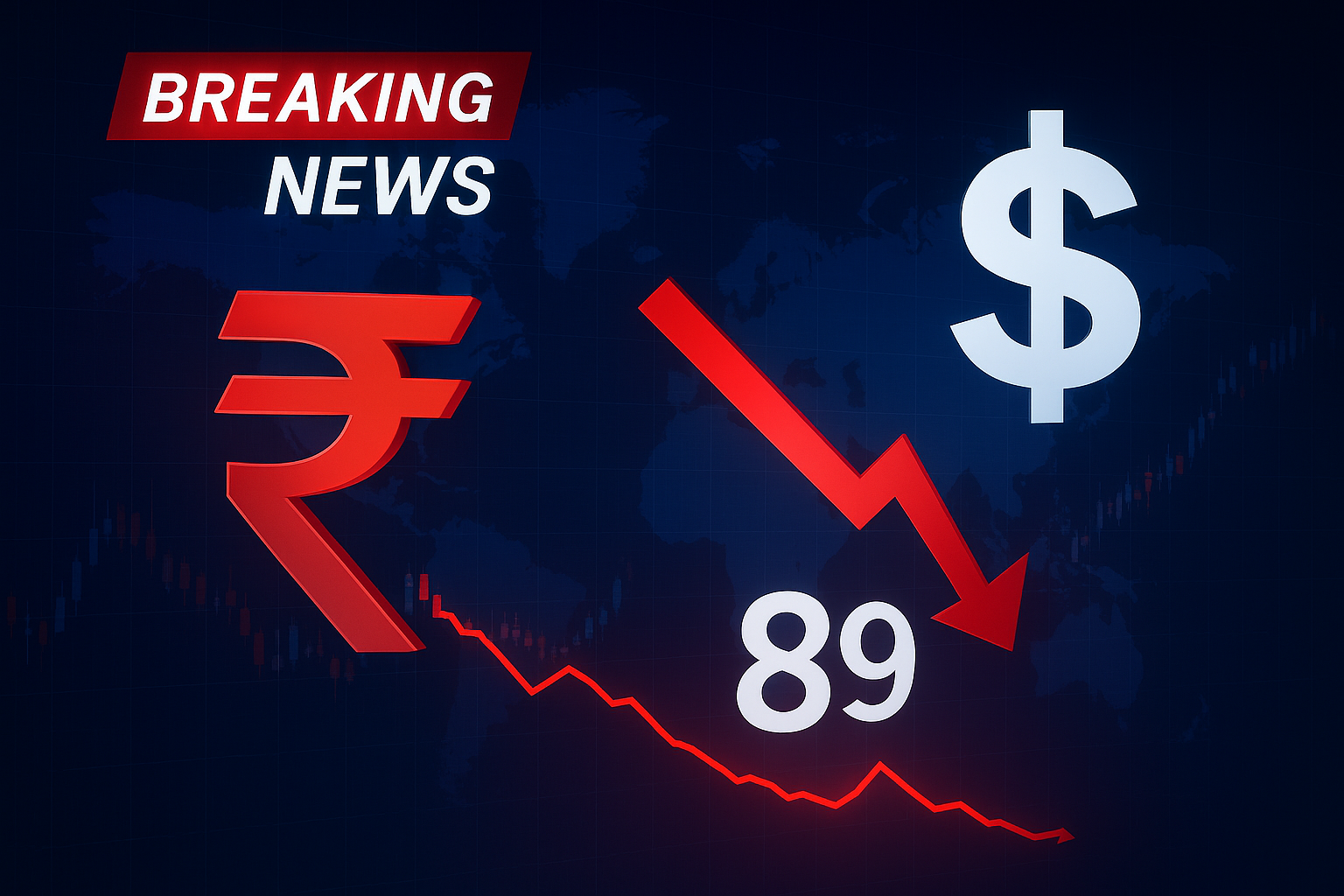
 The Indian Rupee has officially hit its lowest value ever, crossing the ₹89 per US dollar level for the first time in history. This sharp fall has raised serious concerns across markets, policymakers, and citizens. With the Rupee now approaching the 90-mark, many are asking: What exactly is happening? Why is the currency falling so fast? And what will happen next?
In this article, we break down the complete story in simple language so anyone can understand—students, investors, job seekers, and especially UPSC aspirants.
What Happened? Rupee Crosses ₹89 per Dollar
The Rupee’s fall has been steady over the past few months, but the latest drop marks a critical milestone.
For the first time ever, the currency slipped below ₹89/$, signalling deeper stress in the Indian economy and global financial system.
This fall did not happen overnight. Multiple external and internal factors pushed the currency down.
Why Is the Rupee Falling? (Simple Breakdown)
To understand the drop, we need to look at two major categories of reasons:
-
Global/External factors
-
Domestic/Internal factors
Both are affecting the Rupee at the same time, creating powerful downward pressure.
1. Global Factors Weakening the Rupee
The world economy is going through a difficult phase right now. And whenever global uncertainty rises, the US Dollar becomes stronger.
A stronger dollar automatically means a weaker Rupee, because currencies are always measured relative to each other.
Here are the major global reasons:
1. Global Uncertainty Strengthens the Dollar
Whenever the world faces economic or political instability, investors run toward the US Dollar because it is considered a “safe haven.”
Events like wars, trade tensions, rising oil prices, global recession fears, or financial crises all push investors toward the Dollar.
As a result, the Dollar becomes stronger worldwide.
And when the Dollar strengthens:
➡️ Rupee becomes weaker
➡️ Imports become costlier
➡️ Foreign exchange reserves come under pressure
This basic economic relationship is crucial for UPSC and competitive exams.
2. High US Interest Rates Pull Money Out of India
The US Federal Reserve has been keeping interest rates high.
When rates are high:
-
Global investors prefer to invest in the US
-
Funds leave countries like India
-
Demand for the US Dollar increases
This directly pushes the Rupee down further.
3. Rising Global Oil Prices Impact India
India imports more than 85% of its crude oil.
When oil prices soar:
-
India needs more dollars to buy crude
-
Dollar demand increases
-
Rupee weakens
This cycle keeps repeating whenever global oil prices spike.
2. Domestic Factors Weakening the Rupee
Apart from global reasons, several internal issues are also putting pressure on the currency.
One major factor highlighted in the video is the weakening US–India trade relationship.
US–India Trade Deal Under Stress
India’s exports to the US have recently decreased.
Why?
Because several Indian goods are now facing higher tariffs and stricter trade rules.
As a result:
-
Exports to the US are dropping
-
Dollar inflows into India are declining
-
The Rupee faces more selling pressure
This is a significant factor behind the currency’s sudden fall.
India’s Widening Trade Deficit
India’s imports are rising faster than its exports.
This creates a trade deficit, meaning India is:
-
Importing more
-
Exporting less
-
Sending out more dollars than it receives
This automatically pulls the Rupee down.
Foreign Investors Are Pulling Out Money
Global investors (FIIs) have been withdrawing money from Indian markets due to:
-
High US interest rates
-
Global risk factors
-
Domestic policy uncertainty
Whenever foreign investors sell Indian assets, they take dollars back home, increasing pressure on the Rupee.
Indian Companies Need More Dollars for Payments
Large Indian corporations with global commitments also need dollars for:
-
Buying raw materials
-
Paying foreign loans
-
Importing technology
-
Investing abroad
When corporate dollar demand rises, the Rupee weakens further.
Understanding the Dollar–Rupee Relationship (UPSC Note)
The video emphasizes a simple but essential concept:
**When the Dollar strengthens → Rupee weakens.
When the Dollar weakens → Rupee strengthens.**
This happens because currencies are always traded in pairs.
If the US Dollar becomes stronger due to global factors, the Rupee automatically looks weaker—even if India’s economy is stable.
This is why UPSC aspirants must understand global financial relationships.
Is Crossing ₹90/$ Possible?
Many analysts now believe that the Rupee nearing 90 per dollar is no longer impossible. If the current trends continue, India may see:
-
Higher import costs
-
More inflation pressure
-
Slower GDP growth
-
Higher fuel prices
-
Costlier overseas education
-
Expensive international travel
The Reserve Bank of India (RBI) may intervene, but it cannot permanently stop global market forces.
Impact on Common People
A falling Rupee affects everyone in daily life.
1. Fuel Prices May Go Up
Because India imports most of its crude oil.
Higher crude prices → Higher petrol, diesel, LPG prices.
2. Cost of Imported Goods Will Rise
Products such as:
-
Mobile phones
-
Laptops
-
Cameras
-
Cars
-
Machinery
-
Electronics
will become more expensive.
3. Education Abroad Becomes Costly
Students studying in the US, UK, Canada, Australia will have to spend more because fees are calculated in foreign currency.
4. Foreign Travel Becomes Expensive
Flight tickets, hotel stays, and shopping abroad will now cost more.
5. Inflation Pressure Increases
When imports become expensive, overall inflation rises in the country.
Is There Anything Positive?
Yes. A weaker Rupee can help some sectors.
1. Exports Become More Competitive
Exporters earn more Rupees when they convert foreign income.
2. IT and Software Companies Benefit
Most IT companies earn in dollars, so their profits rise.
But still, the overall economic impact of a falling Rupee remains negative.
How Can India Control the Rupee’s Fall?
India can take several long-term steps:
✔ Strengthen the US–India trade deal
✔ Boost exports
✔ Reduce dependence on imported oil
✔ Increase domestic manufacturing
✔ Attract more foreign investment
✔ Maintain stable monetary policy
But these are long-term solutions and will take time.
Why UPSC Aspirants Should Understand This Topic
The video highlights that topics like currency depreciation, global economics, and trade relationships are extremely important for:
-
UPSC Prelims
-
UPSC Mains (GS Paper 3)
-
RBI Grade B
-
Banking exams
-
State PSC exams
Questions may appear like:
-
“Explain the relationship between Dollar strength and Rupee weakness.”
-
“What are the causes of Rupee depreciation?”
-
“How do global events impact India’s currency?”
Having a clear understanding gives aspirants an advantage.
Conclusion
The Rupee falling below ₹89 per dollar is a landmark event in India’s economic history. Multiple factors—global uncertainty, a strong US Dollar, weakening US–India trade ties, rising oil prices, and domestic market pressures—have pushed the currency to record lows.
While the situation may stabilize if global conditions improve, India must address deep-rooted structural issues to prevent another sharp fall.
For now, all eyes remain on the RBI and global markets as the Rupee approaches the crucial 90-level.