
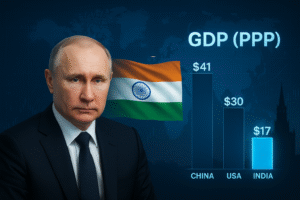
 India’s global rise has been a major topic in international diplomacy, economics, and geopolitics. But a recent statement from Russian President Vladimir Putin has added even more fuel to the conversation. In a rare interview with an Indian news outlet, Putin declared that India is now the world’s third most powerful economy, surpassing traditional global giants when measured by Purchasing Power Parity (PPP).
This interview is more than just an economic discussion. It represents a powerful shift in international perceptions and highlights the growing strategic partnership between India and Russia, a relationship that has reached an all-time high, partly due to the ripple effects of Donald Trump’s earlier policies on global alliances.
Let’s break down everything Putin said — and why it matters.
India–Russia Relations at an All-Time High
India and Russia have always shared a strong diplomatic and defense partnership, but the current phase marks a new peak.
Putin emphasized that the relationship today is stronger than ever. This strengthening of ties has been influenced by several global shifts — particularly the foreign policy realignments during Donald Trump’s presidency. Trump’s America-first approach pushed several countries to diversify their alliances. For Russia, this phase encouraged deeper engagement with Asian powers, especially India.
Additionally, India’s neutral stance on various global conflicts and its willingness to maintain independent relationships with all major powers have made it an even more valuable strategic partner for Moscow.
The message from Putin was clear:
India–Russia cooperation is not just continuing — it is accelerating.
A Rare Moment: Putin’s Interview With Indian Media
One of the standout aspects of this development is not just what Putin said, but where he said it.
Putin sat down for an interview with an Indian news channel, an unusual and notable move. Indian media often faces internal criticism for lack of access to global leaders, but this interview represents a major shift in visibility and credibility.
For the first time in years, a top global leader chose Indian journalists to deliver major geopolitical and economic messages to the world. This not only boosts India’s media presence globally but also reflects the growing respect for India’s role in international affairs.
Putin’s Big Statement: India Is the 3rd Most Powerful Economy
The highlight of the interview was Putin’s breakdown of the global economic hierarchy.
He emphasized that to understand real economic strength, one must look at Purchasing Power Parity (PPP) rather than nominal GDP. PPP reflects the actual buying power and economic capacity of a nation’s population — often giving a clearer picture of domestic strength.
According to Putin’s figures:
-
China: $41 trillion
-
United States: $30 trillion
-
India: $17 trillion
This places India firmly in third place, ahead of long-established economic powers like Japan, Germany, and the UK.
Putin’s statement reinforces what many economists have been saying for years — India’s rise is not just projected; it is happening right now.
Why Putin Focuses on PPP Instead of Nominal GDP
Most global rankings use nominal GDP, which is influenced by currency value, inflation, and external financial conditions. PPP, however, provides a deeper understanding of:
-
Domestic economic strength
-
Production capacity
-
Consumer purchasing power
-
Real cost of living
-
Market stability
Under PPP, India’s economy is much larger than nominal measurements suggest.
Putin made it clear that countries should be judged by real economic capability, and by that measure, India already stands among the top three.
This reshapes the global economic narrative and strengthens India’s position in key decision-making forums.
India’s Growing Global Influence
Putin’s remarks highlight what many nations have begun to acknowledge:
India is no longer a developing power — it is a global force.
India’s influence is rising in multiple ways:
-
Rapid economic expansion
-
Strong leadership on global platforms
-
Increasing military modernization
-
Successful space missions
-
Digital transformation and fintech revolution
-
Global manufacturing growth under “Make in India”
-
Expanding diplomatic engagement
The world is watching India differently now. And Putin’s acknowledgement adds significant weight to this perception shift.
The tone of pride and respect in his comments reflects how India has positioned itself as a decisive and stable global player.
Russia Says It Doesn’t Need G8 Membership
Another major point Putin made was that Russia does not need G8 membership.
The G8 originally included the world’s biggest economies, but Russia was suspended in 2014. Today, with the rise of organizations like BRICS, SCO, and other multi-polar alliances, Russia believes that the G8 has lost its relevance.
Putin pointed out that nations like India, China, and Russia are shaping a new global order where economic groupings are no longer dominated by the West.
This aligns strongly with India’s vision of a multi-polar world — one where no single bloc controls global decision-making.
India’s Economic Rise and National Pride
Putin’s acknowledgment is also a boost to Indian national pride.
It sends a message that India’s leadership, economic reforms, and global engagement have earned international respect. At a time when the world is rethinking alliances, India stands out as a reliable, stable, and influential nation.
This recognition also motivates further economic ambitions:
-
Becoming a global manufacturing hub
-
Achieving the $5 trillion GDP target
-
Expanding trade partnerships
-
Leading new technology and innovation pathways
For Indian citizens, hearing a major world leader call India the third most powerful economy reinforces confidence in the country’s trajectory.
How This Affects Global Politics
Putin’s comments also have deeper geopolitical implications.
-
India’s role in BRICS becomes even more central.
-
Russia strengthens its Asian partnerships amid Western sanctions.
-
India gains leverage in global negotiations, including trade and energy.
-
The Indo-Russian relationship expands beyond defense into energy, finance, AI, and space.
-
The global power balance shifts further toward Asian economies.
In short, India is no longer just participating in global discussions — it is helping shape them.
Conclusion
Vladimir Putin’s statement that India is the world’s third most powerful economy is much more than a diplomatic compliment. It reflects global economic realities, geopolitical shifts, and India’s rapidly growing influence.
With India–Russia relations at an all-time high, global alliance structures shifting, and economic momentum on India’s side, the country is stepping into a new era of global prominence.
This moment marks a turning point — not just for India’s economy, but for its role in shaping the future of the world.