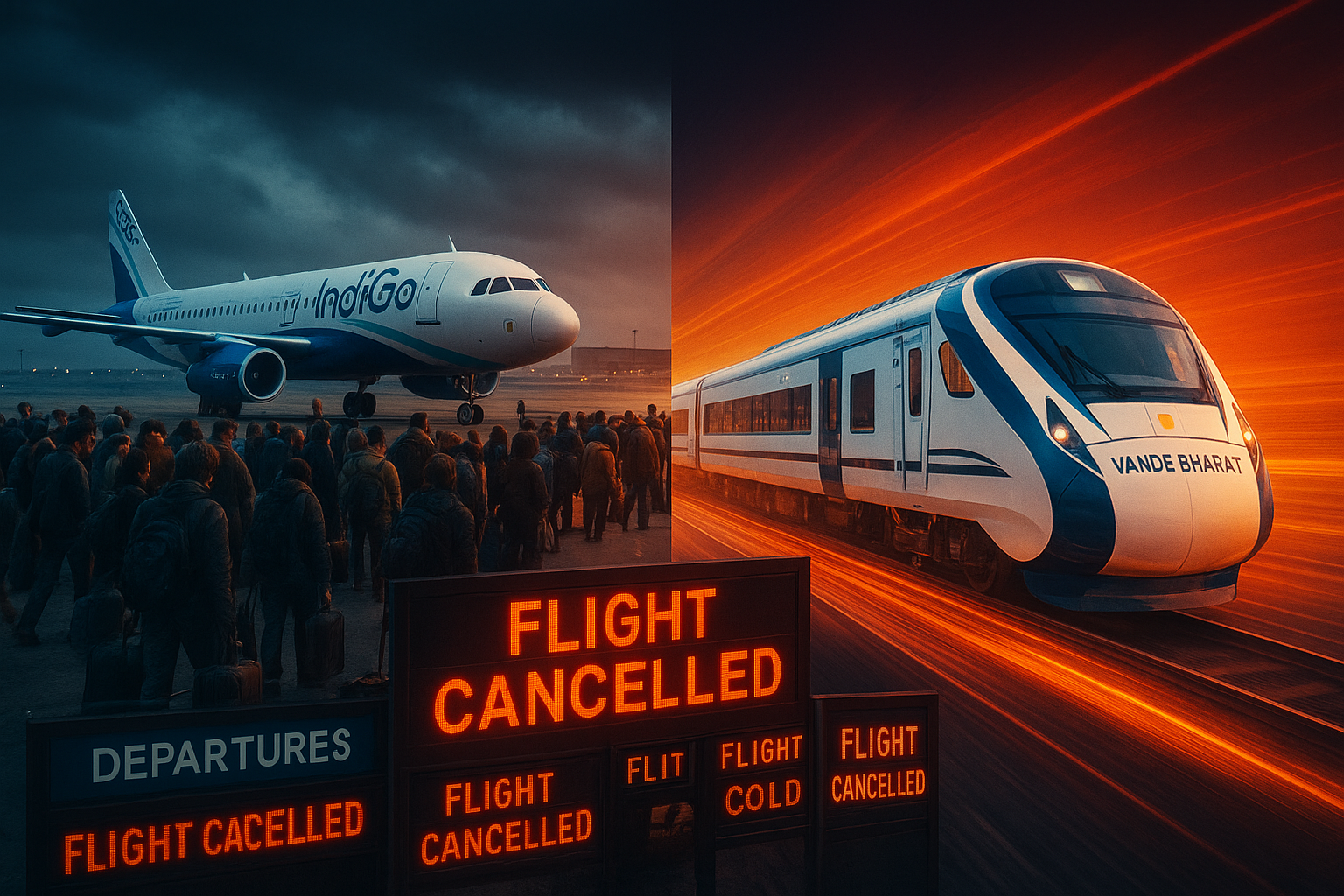
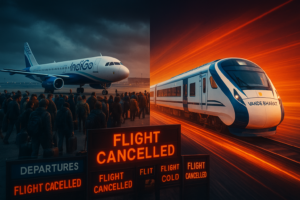
 India’s aviation sector is facing one of its biggest meltdowns in recent years, and at the center of this storm is IndiGo, the country’s largest airline with nearly 60% market share. What began as scattered delays has now snowballed into a full-blown crisis—thousands of passengers stranded, hundreds of flights canceled every day, and airports overflowing with frustration.
But amidst this chaos, something unexpected has happened.
The Indian Railways has quietly stepped in as the nation’s emergency transport lifeline.
From stranded flyers to last-minute travelers, trains are once again becoming the reliable fallback option.
So the big question is:
Is this just a temporary rescue—or the beginning of a major turnaround for India’s railway system?
Let’s break down what’s happening in the aviation sector, how the Railways is stepping up, and what this means for the future of travel in India.
The Aviation Crisis: What Exactly Went Wrong?
For weeks, India’s aviation network has been sitting on a ticking time bomb.
The situation finally exploded when IndiGo began canceling flights on an unprecedented scale.
Here’s what the data tells us:
-
1,200+ flights canceled in November alone
-
400–500 flights being canceled every single day recently
-
Thousands more facing multi-hour delays
-
Long queues at every major airport
-
Passengers stranded without clear answers
IndiGo’s dominance in the market means that when the airline struggles, the entire aviation system collapses like dominoes.
This isn’t a normal disruption—it’s a nationwide breakdown.
Massive Crew Shortage: The Real Reason Behind the Crisis
Interestingly, the issue is not a shortage of aircraft.
Planes are available. Routes are scheduled. Demand is high.
The problem lies in something far more critical:
There are not enough crew members—especially pilots.
Aviation insiders say:
-
Many pilots are exhausted from long flight hours
-
Several crew members have reportedly taken mass sick leave
-
Training and rostering delays have built up for months
-
A seasonal surge in travel has made the gap even worse
In simple terms, airlines have planes, but no one to fly them.
This has created a ripple effect across the entire aviation ecosystem, clogging up operations day after day.
The Passenger Nightmare: Long Delays, Lost Bags, And No Refund Clarity
If you’ve visited an airport in the last few weeks, you’ve probably noticed the chaos.
Passengers are facing:
1. Delays that stretch for hours
People who booked morning flights have been forced to wait till evening or even night.
2. Last-minute cancellations
Many travelers reach the airport only to be told their flight “won’t operate today”.
3. Refund confusion
At airline counters, frustrated travelers are told:
-
Refunds will take time
-
Rebooking options are limited
-
Compensation rules are unclear
4. Baggage handling issues
There are multiple complaints about:
-
Misplaced luggage
-
Bags not arriving on time
-
Passengers being sent on alternate flights while luggage stays behind
5. No proper communication
SMS alerts often come too late.
The helplines remain busy.
And airport staff are overwhelmed.
For a country with booming air travel demand, the experience has become extremely unpredictable.
Railways Steps In: The Unexpected Rescuer
When airlines fail, only one national network is capable of absorbing lakhs of passengers at once—the Indian Railways.
And right now, it is doing exactly that.
As the aviation system crumbles, trains have become the:
-
Safer option
-
More reliable alternative
-
More accessible mode of transport
Stranded flyers across India are rushing to railway counters and apps like IRCTC to book Tatakals, waiting list seats, and last-minute berths.
From Delhi airport to Mumbai, Hyderabad, Chennai, and Kolkata—
Passengers have realised that the only guaranteed way to reach their destination is to take a train.
What the Railways is doing effectively:
-
Adding extra coaches
-
Managing heavy rush efficiently
-
Offering predictable schedules
-
Providing multiple connectivity options across cities
-
Ensuring passengers aren’t left stranded
For many, trains are proving more dependable than flights—something that hasn’t been said in decades.
Why the Railways’ Role Is So Important Right Now
The railway network is showing what large-scale public infrastructure can achieve when managed proactively.
Here’s why its intervention matters:
1. Massive capacity
Railways can transport thousands of people at once—something airlines cannot match in a crisis.
2. Fixed schedules
Even if trains run late, they rarely face sudden cancellations affecting hundreds of passengers in a single stroke.
3. Affordability
Last-minute airfares have skyrocketed, while trains remain reasonably priced.
4. National reach
Flights may cancel—but trains almost always run.
5. Public trust
The Railways is seen as dependable during emergencies.
This crisis is becoming a reminder of how essential the Indian Railways is to the nation’s mobility ecosystem.
Will This Crisis Revive Railways’ Popularity?
Something fascinating is happening.
Passengers who were loyal to air travel for years—especially business travellers and young flyers—are now rediscovering the comfort of trains.
People are saying things like:
-
“Trains are much less stressful.”
-
“At least I know I’ll reach home.”
-
“Even if there’s a delay, cancellations are rare.”
-
“Railways feels more reliable right now.”
This shift in perception could become a turning point for the Railways.
With new Vande Bharat trains, improved punctuality, better interiors, and modern stations, the Railways is already upgrading.
This aviation crisis might accelerate public appreciation even faster.
Could Railways Become the Preferred Choice Again?
If the aviation chaos continues, India may witness a travel behaviour shift:
1. More people choosing trains for inter-state journeys
Especially those under 12–15 hours.
2. Tourists opting for premium trains like Vande Bharat or Tejas
These provide comfort closer to air travel.
3. Businesses rethinking short-haul flights
Routes like Delhi–Jaipur, Mumbai–Pune, or Bengaluru–Mysuru may become train-first choices again.
4. Railways gaining a new market segment
Passengers who earlier flew regularly might now see trains as a stable option.
If this trend continues, the Railways could witness a resurgence in popularity and passenger numbers.
Is This Crisis a Warning for Indian Aviation?
Absolutely.
The IndiGo meltdown exposes deeper structural issues in the aviation industry:
-
Over-dependence on a single airline
-
Fragile crew rostering standards
-
Pilot shortage crisis
-
Poor customer support systems
-
Limited safeguards for passengers
A system where one company controls 60% of the market is vulnerable.
This crisis should push policymakers to rethink competition, pilot training, and passenger rights.
Final Verdict: Train Turnaround or Temporary Fix?
Right now, Railways is the only dependable lifeline for millions of Indians.
It has rescued the travel ecosystem during a moment of aviation collapse.
But the big question remains:
Is this a temporary rescue—or the beginning of a major shift in how Indians travel?
If airlines fail to fix their crew shortages, communication lapses, and customer-service failures, passengers will continue to drift toward the Railways—not out of nostalgia, but out of necessity.
And if Railways continues to modernize, expand, and improve, it might just turn this crisis into a long-term opportunity.
For now, one thing is clear:
IndiGo may have dumped passengers…
but the Railways has rescued India.