

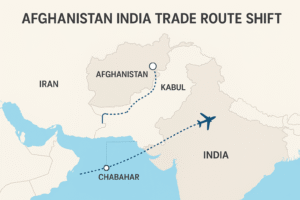

In a major shift, Afghanistan has officially ended its dependency on Pakistan for trade routes and redirected its commercial path toward Iran’s Chabahar Port, where India plays a major strategic role.
At the same time, India has launched a new air route from Delhi to Kabul, strengthening trade and connectivity like never before.
This development has huge implications for India, Pakistan, and the entire region.
Let’s break it down in the simplest, clearest way.
Why Afghanistan’s Decision Matters
For decades, Afghanistan was forced to rely on Pakistan for almost all its international trade. Being a landlocked nation, it had no other choice.
But this long-standing dependency often created political tensions. Pakistan’s frequent border closures, customs delays, and political pressure tactics slowed Afghan trade and affected the Afghan economy.
Now, Afghanistan has taken the bold step of shifting away from Pakistan completely.
Afghanistan Shifts Trade from Pakistan to Iran
Afghanistan’s Commerce Ministry made a major announcement:
Afghan trade will no longer pass through Pakistan. Instead, it will now move through Iran’s Chabahar Port.
This is a historic geopolitical shift.
For Pakistan, this is a big blow. For India, it’s a major diplomatic and strategic victory.
Here’s why this matters:
-
Afghanistan is no longer dependent on Pakistan’s borders
-
India gets stronger access to Afghanistan
-
Iran strengthens its role in regional trade
-
Pakistan’s influence in Kabul weakens dramatically
This is a three-way change in the balance of power.
Chabahar Port: The New Gateway for Afghan Trade
Chabahar Port in Iran is not just any port.
It is the only port India has developed outside its borders.
India has invested heavily in Chabahar because it gives New Delhi a direct route to Afghanistan without touching Pakistan.
Now Afghanistan’s decision makes Chabahar the new backbone of its trade.
✔ Why Chabahar is a better choice:
-
Much smoother and predictable trade environment
-
No political interference from Pakistan
-
Direct connection to India-backed infrastructure
-
Lower costs and fewer delays
This move changes how goods will move between India, Iran, and Afghanistan for years to come.
Iran Gave Huge Discounts to Attract Afghanistan
Iran played a smart diplomatic game.
To help Afghanistan shift away from Pakistan, Iran announced massive tariff cuts at Chabahar Port:
🔹 30% reduction in port tariffs
🔹 75% reduction in storage fees
These reductions make Chabahar significantly cheaper than Pakistani ports.
For Afghanistan, a country struggling economically, such financial benefits are impossible to ignore.
This move adds strong motivation to completely cut Pakistan out of the equation.
India’s Strategic Win in the Region
India has always needed a direct connection to Afghanistan — for trade, security, and diplomatic relations.
But Pakistan blocked all Indian land access to Afghanistan.
Chabahar was India’s answer.
And now, Afghanistan’s decision has made sure that the India–Iran–Afghanistan trade triangle becomes permanent.
What India gains:
-
Stronger foothold in Afghanistan
-
Direct trade access ignoring Pakistan
-
More influence in Central Asia
-
Boost for India’s regional connectivity initiatives
This is why many analysts call it Afghanistan’s gift to India.
Pakistan Loses Its Biggest Leverage
Pakistan has always used Afghan trade routes as political leverage.
Block the border.
Delay trucks.
Increase customs pressure.
Close trade gates during political disputes.
This gave Pakistan tremendous influence over Afghanistan.
But now, with Afghanistan shifting to Iran, Pakistan loses that leverage.
What Pakistan loses:
-
Transit trade fees
-
Strategic influence over Kabul
-
Political control over Afghan imports and exports
-
Economic advantage at border crossings
For Pakistan, this is a major diplomatic setback.
India Launches Delhi–Kabul Air Route
As if the trade route shift wasn’t big enough, India added another powerful move:
India has launched a new direct air route from Delhi to Kabul.
This gives Afghanistan a fast, Pakistani-free connection to India.
Flights mean:
-
Faster trade of perishables
-
Easier movement of businessmen
-
Humanitarian supplies can reach quickly
-
Political engagement becomes smoother
Together, the new air route and Chabahar Port create a two-layer connectivity network between India and Afghanistan.
What This Means for Afghanistan
For Afghanistan, this shift is not just political — it’s economic survival.
Afghanistan gains:
-
Lower trade costs
-
More reliable routes
-
Freedom from Pakistan’s border politics
-
Direct access to Indian markets
-
Stronger ties with Iran
Afghanistan also benefits from India’s investments in roads, schools, hospitals, and infrastructure built over the last two decades.
This new route helps stabilize Afghanistan’s economy at a critical time.
What This Means for India
India has always maintained strong ties with Afghanistan.
But Pakistan’s blockages made trade difficult.
Now India gets:
-
A reliable trade route through Iran
-
Increased presence in Afghanistan
-
Opportunity to participate more in Afghan reconstruction
-
Stronger hold in Central Asia
The Delhi–Kabul air route adds even more connectivity advantages.
This move aligns with India’s Connect Central Asia Policy and strengthens India’s position in the region.
What This Means for Pakistan
This is a major loss for Pakistan on both economic and diplomatic fronts.
Pakistan loses:
-
Transit revenue
-
Influence over Afghan politics
-
Control of Afghan supply chains
-
A major geopolitical bargaining tool
With Afghanistan no longer relying on Pakistan’s land routes, Pakistan’s ability to pressure Kabul reduces sharply.
Analysts believe this will weaken Pakistan’s role in regional decision-making.
Why This Shift Is Geopolitically Important
This change is not just about trade routes — it’s about power.
💥 It weakens Pakistan
💥 It strengthens India
💥 It gives Afghanistan independence
💥 It boosts Iran’s regional role
For the first time in decades, Afghanistan is breaking out of Pakistan’s shadow.
The India–Iran–Afghanistan partnership now forms a strong strategic triangle.
This triangle challenges China–Pakistan influence in the region as well.
Future Impact: What Happens Next?
The changes may lead to:
-
More Indian investment in Chabahar Port
-
Increased Afghan exports to India
-
New trade corridors linking Central Asia
-
Less political control for Pakistan at border points
-
Stronger India–Afghanistan diplomatic ties
India may also expand sea-air cargo routes from Chabahar to Indian cities.
This would completely eliminate Pakistan from the regional trade map.
Conclusion
Afghanistan shifting its trade route from Pakistan to Iran’s Chabahar Port is a historic geopolitical shift.
Iran’s tariff cuts, India’s investments, and Afghanistan’s frustration with Pakistan have come together to create a new regional order.
Add India’s new Delhi–Kabul air route, and the message is clear:
A new chapter of India–Afghanistan trade and connectivity has begun.
Pakistan’s influence in the region is shrinking.
Chabahar Port is the new gateway of regional trade.
This is truly one of the most significant developments in South Asian geopolitics in recent years — and it sets the stage for a new era.