

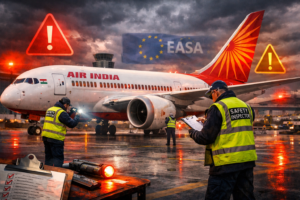

These findings have triggered increased scrutiny from international aviation authorities. The issue is especially sensitive because Air India is currently undergoing a massive transformation under the ownership of the Tata Group.
While the airline is investing billions of dollars in new aircraft, technology, and passenger experience, the safety concerns raised in Europe could affect its reputation and international operations.
This article explains what regulators found, why it matters, and what the consequences could be for Air India.
European Aviation Regulators Raise Safety Concerns
The safety issue came to light after inspections conducted by the European Union Aviation Safety Agency (EASA).
EASA is responsible for monitoring aviation safety across Europe. It regularly inspects airlines operating flights to and within the European Union.
During these inspections, regulators reportedly identified several safety-related lapses in Air India’s operations.
These concerns reportedly included:
-
Maintenance documentation issues
-
Operational safety procedures
-
Compliance with aviation safety standards
-
Aircraft inspection and reporting gaps
While regulators have not publicly detailed every issue, the findings were serious enough to trigger additional scrutiny of Air India’s flights into Europe.
Why European Aviation Safety Checks Are Strict
European aviation regulators are known for maintaining some of the strictest aviation safety standards in the world.
Airlines flying into the European Union must meet detailed requirements related to:
-
Aircraft maintenance
-
Pilot training
-
Flight safety procedures
-
Operational documentation
-
Aircraft inspections
The European Union Aviation Safety Agency conducts random inspections at airports to ensure compliance.
If airlines fail these checks repeatedly, regulators may impose restrictions such as:
-
Increased inspections
-
Operational warnings
-
Reduced flight permissions
-
Complete bans from European airspace
Because of these strict rules, airlines treat any European safety warning very seriously.
Air India Under the Tata Group Transformation
The situation is particularly significant because Air India is currently undergoing one of the biggest transformations in aviation history.
After decades under government control, the airline was acquired by the Tata Group in 2022.
The Tata Group launched a major revival plan for the airline that includes:
-
Ordering hundreds of new aircraft
-
Upgrading passenger experience
-
Improving operational efficiency
-
Integrating aviation subsidiaries
Air India has already placed record aircraft orders from companies like Airbus and Boeing.
The goal is to turn Air India into a world-class international airline capable of competing with major global carriers.
However, safety concerns raised by European regulators could slow down that progress if not addressed quickly.
What Safety Lapses Mean for Airlines
In aviation, safety issues are treated with extreme seriousness.
Even minor lapses in documentation or procedures can trigger regulatory action.
When aviation authorities identify problems, they usually follow a step-by-step process:
1. Warning and Monitoring
The airline is notified about the issues and asked to fix them within a specific time frame.
2. Increased Inspections
Regulators may conduct more frequent safety checks on aircraft and flights.
3. Operational Restrictions
If problems continue, the airline may face restrictions on certain routes.
4. Flight Reductions or Ban
In extreme cases, airlines may be banned from operating in certain regions.
This is why the findings related to Air India have attracted significant attention.
Could Air India Face a Ban in Europe?
At the moment, there is no ban on Air India flights to Europe.
However, aviation experts say the situation must be resolved quickly.
If safety issues exceed acceptable limits, regulators could take stronger action.
Possible consequences include:
-
Reduced number of flights to European cities
-
Additional inspections before aircraft departures
-
Temporary operational restrictions
-
In the worst case, suspension of certain routes
Such actions would significantly impact Air India’s international expansion plans.
Impact on Air India’s International Operations
Europe is one of the most important international markets for Air India.
The airline operates multiple flights to cities such as:
-
London
-
Paris
-
Frankfurt
-
Amsterdam
-
Rome
These routes connect India with major global hubs and generate significant revenue.
Any restriction in Europe would affect:
-
Passenger connectivity
-
Airline reputation
-
Revenue from international routes
-
Expansion strategy
Therefore, resolving the safety concerns quickly is critical for the airline.
Why Safety Reputation Matters in Aviation
Airlines rely heavily on global trust and reputation.
Passengers choose airlines based on factors like:
-
Safety record
-
Reliability
-
International reputation
-
Aircraft quality
If safety concerns become public, they can influence traveler decisions.
Global airline rankings and aviation safety audits also play a role in shaping public perception.
This is why airlines work aggressively to resolve regulatory warnings.
Steps Air India May Take to Address the Issues
To resolve the situation, Air India is likely to take several corrective steps.
Strengthening Safety Audits
The airline may increase internal safety checks to identify and correct operational gaps.
Improving Documentation
Many aviation inspections focus on paperwork and compliance records.
Air India may update maintenance and operational documentation.
Staff Training
Additional training programs for ground staff, engineers, and pilots could be introduced.
Coordination with Regulators
Airlines often work closely with regulators like the European Union Aviation Safety Agency to fix problems quickly.
By taking these steps, Air India can demonstrate its commitment to global safety standards.
Aviation Industry Watching the Situation Closely
The aviation industry is closely monitoring the situation because Air India is currently one of the fastest-growing international carriers.
The airline has ambitious plans to expand routes across:
-
Europe
-
North America
-
Southeast Asia
-
Australia
With hundreds of new aircraft expected to join the fleet in the coming years, Air India aims to become a major global aviation player.
However, maintaining world-class safety standards will be essential to achieving that goal.
What This Means for Passengers
For passengers, there is no immediate reason for concern.
Air India continues to operate flights normally, and regulators monitor safety continuously.
In fact, aviation experts say inspections like these are part of a standard global safety system designed to keep air travel secure.
However, the situation highlights the importance of:
-
Strict safety compliance
-
Continuous monitoring
-
Rapid response to regulatory findings
Passengers can expect airlines to take these concerns seriously.
Conclusion
The scrutiny faced by Air India after European regulators flagged safety lapses highlights the high standards required in international aviation.
With the airline now under the Tata Group, expectations are even higher as the company attempts to transform Air India into a leading global carrier.
While the safety issues raised by the European Union Aviation Safety Agency are serious, they also present an opportunity.
By addressing the concerns quickly and strengthening operational processes, Air India can reinforce its commitment to safety and protect its growing international presence.
For now, the aviation world will be watching closely to see how the airline responds to these challenges and whether it can maintain its ambitious expansion plans.