

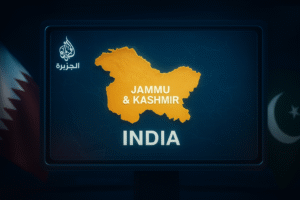

In a major geopolitical surprise, Al Jazeera—often criticized in India for biased reporting—has aired a map that shows the entire Jammu & Kashmir as an integral part of India.
This move has shocked many viewers across South Asia, especially in Pakistan, where the media narrative consistently disputes India’s territorial claims.
What makes this even more remarkable is that the Arabic version of Al Jazeera broadcasted this correct map. Since Arabic-language news reaches millions of viewers across the Gulf region, the impact is far greater than a regular English broadcast.
This single map has now sparked intense debate about Qatar’s shifting priorities, Pakistan’s declining influence in the Arab world, and how regional alliances are reshaping.
Why This Map Matters
Al Jazeera has a long history of presenting maps that either distort or question India’s territorial boundaries. So this accurate representation of Jammu & Kashmir stands out as a major course correction.
For India, this is significant because:
-
It validates India’s territorial position on a global platform.
-
It reduces Pakistan’s ability to push its narrative in the Arab world.
-
It signals changing geopolitical preferences among Gulf nations.
For decades, the Kashmir issue has been portrayed with ambiguity in many Western and Middle Eastern media outlets. This time, Al Jazeera removed that ambiguity by showing all of Jammu & Kashmir, including PoK, as part of India.
Huge Impact on the Arab Audience
The fact that this map appeared on Al Jazeera Arabic is crucial.
Why?
Because Arabic-speaking viewers often rely on Al Jazeera as a primary source of international news. Many of these viewers live in:
-
Qatar
-
Saudi Arabia
-
UAE
-
Oman
-
Bahrain
-
Kuwait
For them, Kashmir is usually seen through the lens of Islamic solidarity with Pakistan. But when a major Arab network presents the region as part of India, it creates a psychological shift.
It sends a subtle message:
The Arab world is no longer obligated to support Pakistan’s Kashmir narrative.
This is not just a map.
It is a political signal.
The Video Also Explained the Durand Line
The Al Jazeera video didn’t stop at just showing the map.
It also discussed the historical context of the Durand Line, the controversial border between Pakistan and Afghanistan.
Key points highlighted:
-
The Durand Line was created in 1893 during British rule.
-
Afghanistan has rejected this border for decades.
-
Pakistan has faced multiple attacks along this border.
-
The region remains unstable due to Taliban control and Pashtun nationalism.
By including the Durand Line issue, the video indirectly highlighted Pakistan’s internal and external challenges.
This contrasts sharply with India’s clear territorial integrity shown in the same clip.
This comparison did not go unnoticed by viewers.
A Deliberate Provocation to Pakistan?
Many analysts believe the map was shown intentionally.
This wasn’t just a mistake or oversight.
Here’s why the move seems deliberate:
-
Al Jazeera rarely makes cartographic errors, especially in politically sensitive content.
-
Qatar and Pakistan have recently experienced diplomatic tension.
-
Pakistan sided with the Taliban, which Qatar helped host for peace talks.
-
Qatar is strengthening ties with Saudi Arabia and Western nations—Pakistan is losing strategic importance.
Showing the full J&K map as Indian could be a subtle message:
Qatar is no longer interested in supporting Pakistan’s Kashmir narrative.
The timing is also interesting because Pakistan’s standing in the Arab world has weakened due to:
-
Economic crisis
-
Political instability
-
Growing ties between Arab nations and India
-
Declining military influence in Gulf defense agreements
This map only adds fuel to Pakistan’s frustration.
Why Pakistan Is Worried
When a global network like Al Jazeera publishes such a map, the diplomatic fallout can be serious.
Here’s what Pakistan now fears:
1. Losing narrative control
Pakistan has relied heavily on foreign media to propagate its Kashmir claims.
A major channel contradicting that hurts their position.
2. Decline in Arab support
Many Gulf nations, especially Saudi Arabia and UAE, have already formed closer ties with India.
Qatar seems to be moving in the same direction.
3. International isolation
With the Taliban controlling Afghanistan and tensions rising at the Durand Line, Pakistan is losing leverage.
4. Impact on domestic propaganda
Pakistani media will now be forced to defend why Al Jazeera “betrayed” their narrative.
This single map could lead to days of debate across Pakistani talk shows.
India’s Rising Influence in the Middle East
The correct J&K map reflects the broader reality:
India is becoming a major power in the Middle East.
Reasons:
-
India is the biggest partner of Gulf nations in trade and energy.
-
Millions of Indians work in UAE, Saudi Arabia, and Qatar.
-
India has strong security partnerships, especially with Oman and Saudi Arabia.
-
The India–Middle East–Europe Corridor (IMEC) will strengthen economic ties further.
As Gulf nations look toward stable, powerful partners, India stands out.
Pakistan, on the other hand, continues to struggle economically and diplomatically.
Qatar’s Shift: Snubbing Pakistan?
Let’s look at Qatar’s recent actions:
1. Qatar–Taliban Relations
Qatar hosted the Taliban’s political office for years.
Pakistan supported the Taliban too, but Qatar believes Pakistan tried to dominate the process.
2. Qatar–Saudi Defense Understandings
Saudi Arabia and Qatar have reconciled their past disputes.
With India building strong ties with Saudi Arabia, Qatar sees value in aligning with India too.
3. Declining Pakistani Influence
Pakistan’s military once trained Gulf armed forces.
Now Gulf nations are reducing dependence on Pakistan’s military support.
Taken together, these factors show a coordinated shift.
The map is symbolic of Qatar choosing strategic realism over old alliances.
The Creator Encouraged Likes & Subscriptions
Interestingly, the video’s creator highlighted how much effort went into the post-processing of the map.
He urged viewers to:
-
Like the video
-
Subscribe to the channel
-
Share it widely
This shows that the creator knew the map would attract attention and stir debate—especially in India and Pakistan.
The call-to-action indicates confidence that the map would go viral.
And it did.
Conclusion: A Small Map, A Big Message
Al Jazeera showing the entire Jammu & Kashmir as part of India is not an ordinary event.
It reflects deeper geopolitical changes:
-
Gulf nations are moving closer to India.
-
Pakistan’s influence is declining.
-
Regional priorities are shifting toward stability and economic strength.
-
Qatar is strengthening ties with powerful partners like Saudi Arabia and distancing itself from Pakistan’s old narratives.
This map is more than just a graphic.
It is a wake-up call to Pakistan and a diplomatic win for India.