 India’s space agency ISRO is facing one of its toughest moments in recent years.
Two consecutive failures involving its most trusted launch vehicle — PSLV (Polar Satellite Launch Vehicle) — have raised serious concerns.
The PSLV C61 mission had already failed earlier.
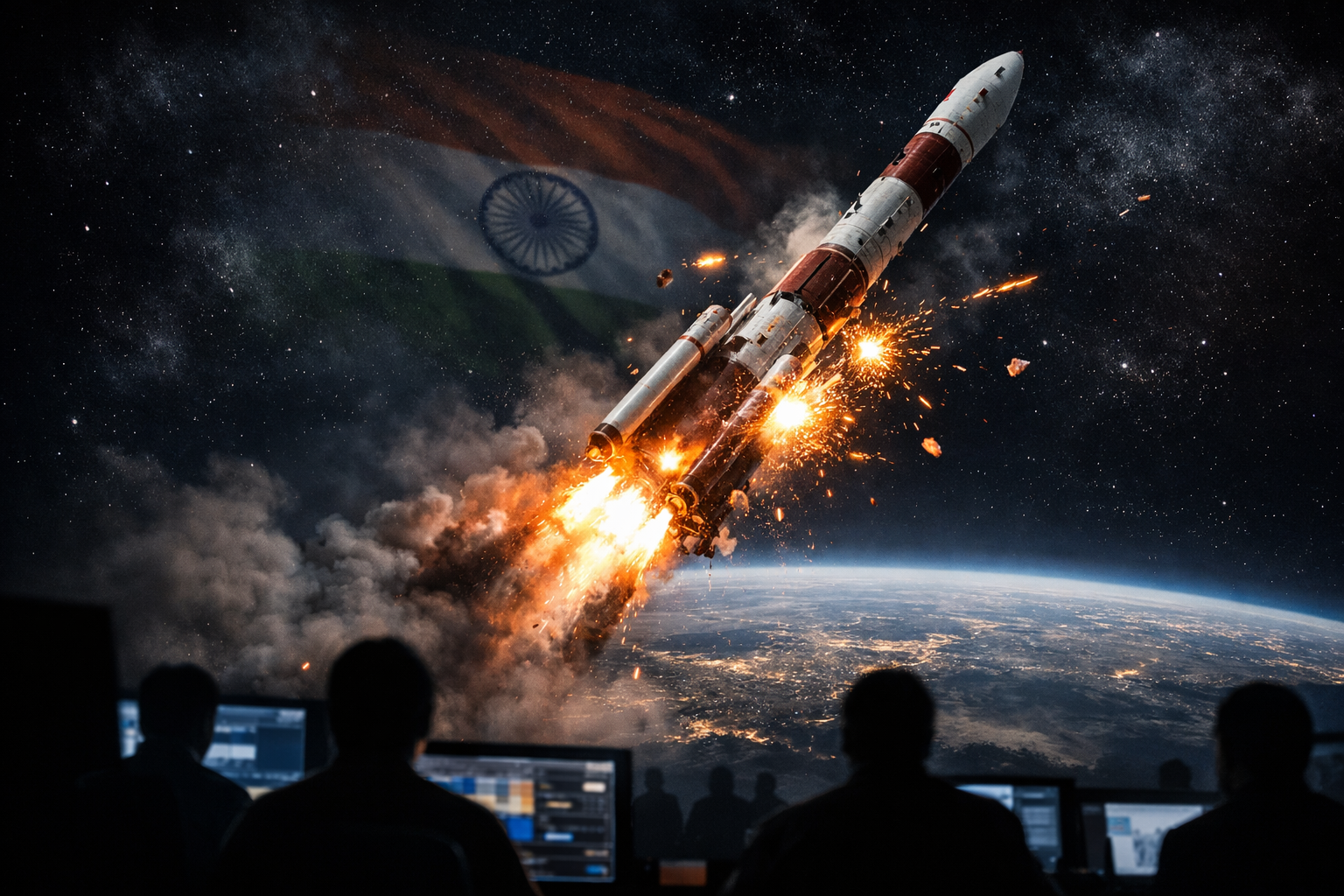
Now, the PSLV C62 launch has also suffered setbacks, resulting in the loss of 16 satellites.
For an agency known globally for reliability and precision, this is a major blow.
ISRO’s PSLV: A Symbol of Reliability Until Now
For decades, PSLV has been the backbone of India’s space program.
It earned the nickname “workhorse of ISRO” due to its consistent performance.
The rocket successfully launched satellites for:
-
India
-
Foreign governments
-
Private global companies
Because of this track record, PSLV was considered one of the most reliable rockets in the world.
What Happened With PSLV C61 Mission?
The trouble started with PSLV C61.
During its mission:
-
The rocket failed to complete its primary objectives
-
Satellite deployment did not occur as planned
-
Mission control confirmed technical anomalies
This failure surprised many experts because PSLV rarely fails.
ISRO initiated a detailed investigation after the C61 mission.
PSLV C62 Failure Deepens the Crisis
Before ISRO could fully recover from C61, PSLV C62 also encountered problems.
Key points from the C62 setback:
-
The rocket failed to achieve mission objectives
-
16 satellites were lost
-
Expected orbit was not properly achieved
Back-to-back failures are extremely rare for ISRO, especially with PSLV.
Why PSLV Failures Matter So Much
PSLV is not just another rocket.
It plays a critical role in India’s space ecosystem.
Importance of PSLV for ISRO:
-
Launches Earth observation satellites
-
Supports navigation and communication missions
-
Carries commercial payloads for international clients
-
Generates revenue through global launch contracts
Any failure directly affects India’s credibility in the global space market.
Understanding PSLV’s Multi-Stage Design
One reason behind PSLV’s historic success is its four-stage design.
PSLV stages explained:
-
First Stage – Solid fuel motor
-
Second Stage – Liquid fuel engine
-
Third Stage – Solid fuel stage
-
Fourth Stage – Liquid fuel stage for precise orbit placement
This combination of solid and liquid propulsion made PSLV extremely versatile.
However, complexity also means multiple points of failure.
Possible Reasons Behind Consecutive Failures
ISRO has not released a final report yet, but experts suggest a few possibilities.
Possible causes include:
-
Propulsion system malfunction
-
Stage separation failure
-
Software or guidance error
-
Structural stress during flight
Even a minor error can cause mission failure at orbital speeds.
Impact on ISRO’s Global Reputation
ISRO built its reputation over five decades.
It became famous for:
-
Cost-effective missions
-
High success rates
-
Launching satellites at a fraction of global costs
These recent setbacks could temporarily affect:
-
International launch contracts
-
Confidence of private satellite companies
-
India’s competitive position against SpaceX, Arianespace, and China
However, experts say one or two failures don’t erase decades of success.
Commercial Launch Services at Risk?
PSLV is a key player in India’s commercial launch services.
Through NSIL (NewSpace India Limited), ISRO markets PSLV launches globally.
Potential short-term effects:
-
Delay in new commercial bookings
-
Extra scrutiny from foreign clients
-
Insurance costs may increase
Still, ISRO’s long-term reliability record remains strong.
How ISRO Has Handled Failures in the Past
ISRO is no stranger to setbacks.
In the past, failures led to:
-
Stronger mission reviews
-
Improved testing procedures
-
Enhanced quality control
Examples include:
-
Early GSLV failures
-
Chandrayaan-2 partial mission setback
Each time, ISRO came back stronger and smarter.
What This Means for Future ISRO Missions
These PSLV failures will likely slow things down — but only temporarily.
Expected next steps:
-
Detailed failure analysis
-
Corrective engineering changes
-
Additional ground tests
-
Delayed launch schedules
Future missions may be postponed to ensure zero-risk launches.
Is India’s Space Program in Trouble?
The short answer: No, but it’s a serious warning sign.
India’s space program includes:
-
Gaganyaan human spaceflight
-
Chandrayaan missions
-
Aditya-L1 solar mission
-
Small Satellite Launch Vehicle (SSLV)
PSLV issues will push ISRO to re-evaluate systems, not abandon progress.
Experts React to Back-To-Back PSLV Setbacks
Space analysts agree on one point:
“Failures are part of space exploration, but learning from them defines great agencies.”
Many experts believe:
-
ISRO will regain momentum
-
Transparency will help rebuild confidence
-
System upgrades will improve future reliability
Lessons for ISRO and Global Space Industry
These incidents offer lessons not just for India but the world.
Key takeaways:
-
Even proven rockets can fail
-
Continuous upgrades are essential
-
Testing must evolve with mission complexity
Space remains a high-risk, high-precision field.
Final Thoughts: A Temporary Setback, Not the End
The back-to-back PSLV rocket setbacks are undeniably serious.
Losing 16 satellites is a significant blow.
But ISRO’s history proves one thing clearly:
Failures fuel improvement, not defeat.
With careful investigation and corrective action, ISRO is expected to bounce back stronger, protecting India’s position as a leading global space power.