

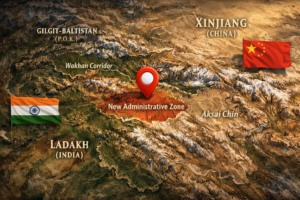

Beijing has created a brand-new administrative unit — a “county” — called Sunling County, carved out of its Xinjiang region. On a map, it looks routine. But look at where exactly this county sits, and the picture changes fast.
Sunling County borders the Wakhan Corridor of Afghanistan, sits close to Ladakh, and shares a boundary with Pakistan-occupied Kashmir (PoK). In geopolitics, location is everything — and this location says a lot.
What Exactly Is Sunling County?
In China’s administrative system, a “county” (xian) is a formal unit of local governance — it has its own government offices, budget allocation, infrastructure planning, and security apparatus.
Sunling County has been established within the Kashgar Prefecture of Xinjiang. This is not a random choice. Kashgar is already one of the most strategically sensitive areas in all of Asia.
Here is what makes this region uniquely important:
- It sits at the edge of the Wakhan Corridor — a narrow strip of Afghan territory that connects Central Asia to South Asia.
- It is directly adjacent to Pakistan-occupied Kashmir (PoK), a region India considers its own sovereign territory.
- It is a short distance from Ladakh, the Indian union territory that has already seen fierce standoffs with Chinese troops.
- The Karakoram Highway — the backbone of the China-Pakistan Economic Corridor (CPEC) — passes through this broader region.
Why Is China Creating New Counties in Border Areas?
This is not an isolated event. China has been systematically restructuring its administrative units in sensitive border zones for years.
In 2021, China renamed several villages inside Arunachal Pradesh — a state India firmly controls but China claims as “South Tibet.” In 2023, it created new county-level units in Tibet near the Indian border. Now, Sunling County in Xinjiang follows the same playbook.
The motivations behind this pattern are clear:
- Administrative control: A formal county means permanent government presence — roads, police, military logistics, and surveillance infrastructure.
- Territorial signalling: Creating counties asserts de facto jurisdiction, regardless of international boundaries.
- Infrastructure acceleration: County-level governance unlocks state funding for roads, bridges, and communication networks — all of which have dual military use.
In short, this is how China prepares a region for long-term strategic use — quietly, incrementally, and legally under its own domestic framework.
The Wakhan Corridor: A Gateway China Now Controls More Firmly
The Wakhan Corridor is a thin sliver of land in northeastern Afghanistan, barely 50 kilometres wide at points. It shares a brief but symbolically important border with China’s Xinjiang.
For centuries, this corridor served as a buffer between empires. Today, it is a bridge between worlds — connecting China to Afghanistan, and through it, to Iran, Pakistan, and the rest of Central Asia.
By setting up a county right at this junction, China gains a permanent, institutionalised foothold near the corridor. It can now monitor movement into and out of Afghanistan with state-level machinery, not just military patrols.
This also gives Beijing a closer eye on three Central Asian neighbours — Kazakhstan, Kyrgyzstan, and Tajikistan — all of which border Xinjiang and are areas where China has been steadily expanding economic and security influence.
India’s Concerns: What New Delhi Is Watching
For India, this development lands on top of an already-tense relationship with China along the Himalayan frontier.
The Galwan Valley clashes of 2020 reminded the world that the Line of Actual Control (LAC) is not just a line on a map — it is a live fault line. Since then, India has invested heavily in border infrastructure, road-building in Ladakh, and forward deployment of troops.
Now, with Sunling County established so close to Ladakh and PoK, India faces several new concerns:
- Dual encirclement: India already worries about the China-Pakistan axis. A new Chinese administrative unit near PoK tightens that pincer from the north.
- CPEC vulnerability: If China strengthens its grip over this region, the Karakoram Highway and CPEC projects in PoK become even harder for India to challenge diplomatically.
- Intelligence and surveillance: A county-level government in Sunling means China can now deploy civilian surveillance systems, population monitoring tech, and communication interception infrastructure far closer to Indian territory.
- Precedent for further expansion: If Sunling County goes unchallenged, it sets a template for more such moves — in Aksai Chin, in Arunachal Pradesh, and elsewhere.
The Bigger Picture: China’s Salami-Slicing Strategy
Defence analysts have long described China’s border strategy as “salami slicing” — taking territory or influence one thin slice at a time, each step too small to justify a military response but cumulatively transformative.
Renaming villages. Building roads in disputed zones. Constructing “model villages” just across the LAC. And now, creating an entirely new county right at the junction of Xinjiang, Afghanistan, Ladakh, and PoK.
Each move, taken alone, may appear administrative or routine. Taken together, they paint a consistent strategic picture: China is methodically locking in its border positions before any formal resolution is ever reached.
What Should India Do Now?
India’s response cannot be purely military. The challenge here is strategic and diplomatic as much as it is territorial.
Experts suggest a multi-pronged approach:
- Accelerate India’s own border infrastructure in Ladakh and Arunachal Pradesh.
- Raise the issue formally in international forums — the UN, the Quad, and bilateral channels with the US, Japan, and Australia.
- Deepen intelligence-sharing on Chinese border activities with trusted partners.
- Strengthen India’s own presence in Central Asia, including through the International North-South Transport Corridor (INSTC) and ties with Afghanistan’s neighbours.
Final Thoughts
The establishment of Sunling County is not just a domestic administrative exercise by Beijing. It is a strategic signal — carefully designed to look routine while fundamentally altering the ground reality at one of Asia’s most sensitive crossroads.
India has faced this kind of slow-motion pressure before. The lesson from Galwan, from Doklam, and from the South China Sea is always the same: when China moves quietly, the world must pay attention loudly.
Sunling County has been created. The question now is: what happens next?