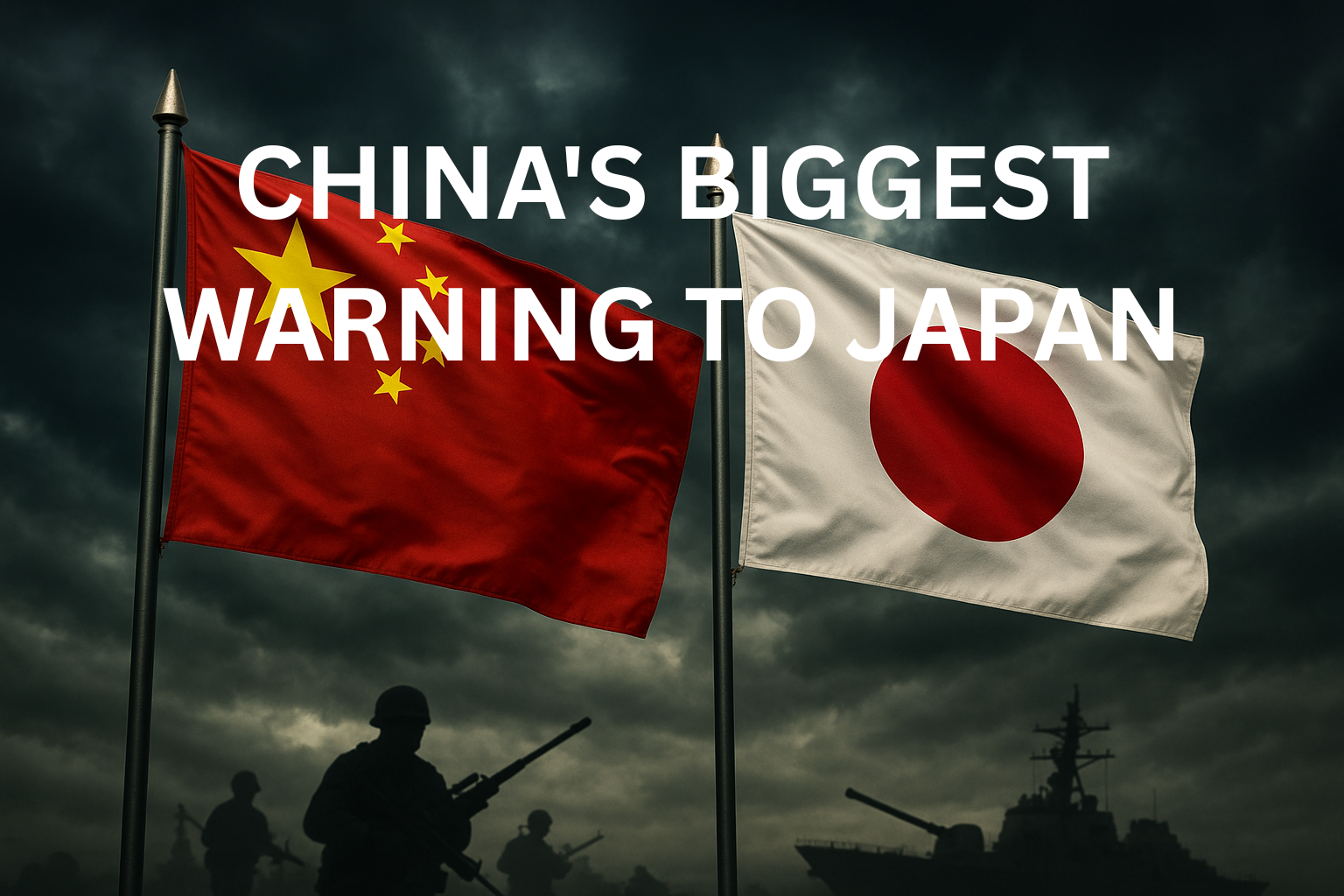
 China and Japan have always shared a complicated relationship. But today, the situation is more intense than it has been in years. With the U.S.-China rivalry growing and the global political landscape shifting fast, China has now issued one of its strongest warnings to Japan in recent times.
This article breaks down everything in simple, easy-to-read points—so you can understand what is happening, why it matters, and how it could affect Asia and the world.
1. Tensions Between China and Japan Are Rising Fast
The speaker highlights that the tensions between China and Japan are not new—but they are now entering a dangerous phase.
Both countries are powerful.
Both have strong economies.
Both play major roles in Asia.
But they also have a long history of mistrust and conflict.
With the United States strengthening partnerships across Asia and Europe, China believes Japan is aligning too closely with U.S. strategies aimed at containing Beijing. This has made China extremely cautious—and increasingly aggressive—in its messaging toward Tokyo.
2. The U.S.-China Rivalry Is Fueling the Fire
A major reason for this rising tension is the intense rivalry between China and the United States.
Washington openly supports Japan’s military modernization.
Japan openly supports the U.S. stance on Taiwan.
China openly sees this as a threat.
The speaker explains the “G2 Concept”, which imagines the U.S. and China as the two main global powers competing for dominance. Japan, because of its strategic location and military potential, becomes a critical player in this competition.
China believes the U.S. is using Japan to limit China’s influence in Asia.
Japan believes China’s expanding military power threatens regional peace.
This rivalry is pushing both nations into a more confrontational mindset.
3. China’s Direct Warning to Japan: “Stop Playing With Fire”
China has recently delivered one of its harshest warnings to Japan regarding the Taiwan issue.
Beijing said clearly:
Japan must stop “playing with fire.”
This message came after Japan voiced concerns over China’s actions near Taiwan and expressed support for maintaining stability in the region.
From China’s perspective:
-
Taiwan is a core national interest
-
Any foreign interference is seen as hostile
-
Japan’s involvement makes China feel cornered
Beijing warns that Japan is crossing a dangerous line by increasing military cooperation with the U.S. and commenting on Taiwan’s security.
For China, Taiwan is non-negotiable.
For Japan, Taiwan is essential for regional stability and sea routes.
This conflict of interests could cause serious future confrontations.
4. History Still Shapes Today’s Problems
One of the strongest emotional drivers of China’s attitude toward Japan is history.
The speaker emphasizes how deeply the memories of World War II still affect Chinese society.
During the war, the Japanese military committed brutal atrocities in China—including the Nanjing Massacre, forced labor, and widespread violence. These events created long-lasting trauma that still influences public opinion in China today.
Even though more than 75 years have passed:
-
Chinese citizens have not forgotten
-
The Chinese government frequently reminds the population of these events
-
National pride and historical memory play a major role in diplomacy
This historical pain creates distrust.
That distrust shapes modern politics.
And modern politics now shapes Asia’s future.
5. China’s Nationalism Strategy Keeps the Tensions Alive
The Chinese Communist Party (CCP) uses history as a political tool. According to the speaker, China regularly promotes nationalism through:
-
Education
-
Media
-
Films
-
Public speeches
-
Memorial events
By reminding citizens of Japan’s wartime actions, the CCP strengthens national unity and directs public anger outward. This strategy makes Japan an easy target for political messaging.
Whenever tensions rise, China amplifies historical grievances to rally public support.
This means even small incidents can turn into big controversies.
And when big incidents happen, the reaction from the Chinese public becomes explosive.
6. The Recent Incident That Shocked Both Nations
A tragic recent event further intensified tensions: the death of a Japanese child in China.
The details of the incident created strong emotions in both countries.
This tragedy became a symbol of the fragile relationship between the two nations.
For many Chinese citizens, the incident triggered painful memories of the past.
For many Japanese citizens, it raised concerns about safety and rising anti-Japanese sentiment in China.
The speaker points out that this incident reflects how sensitive and volatile the relationship has become. Even a single event can create a wave of anger, sadness, and political tension.
7. Japan’s Security Concerns Are Growing Too
Japan is not staying silent.
The government has been strengthening its defense capabilities at a level not seen since World War II. This includes:
-
Increasing defense spending
-
Building long-range missiles
-
Hosting more U.S. military assets
-
Forming alliances with India, Australia, and Europe
-
Modernizing its Self-Defense Forces
Japan believes China’s military rise is a real threat.
China believes Japan’s military revival is a threat.
This loop of suspicion keeps pushing both sides further apart.
8. Why Taiwan Is the Main Flashpoint
The Taiwan issue is the center of the conflict.
Here’s why:
-
Japan relies heavily on sea lanes near Taiwan for trade.
-
If Taiwan falls to China, Japan fears its security will be compromised.
-
The U.S. expects Japan to support Taiwan in any conflict.
-
China has warned both the U.S. and Japan to stay out of Taiwan.
So Japan sees Taiwan as survival.
China sees Taiwan as sovereignty.
The U.S. sees Taiwan as strategy.
This triangle is extremely dangerous.
9. Could There Be a Military Clash?
Experts believe the risk of a direct military confrontation—while still low—is rising.
Possible flashpoints include:
-
Naval clashes in the East China Sea
-
Airspace violations
-
Cyber-attacks
-
Miscommunication during military drills
-
Accidental clashes during U.S.-Japan joint operations
One misstep could trigger a crisis.
The speaker warns that the more Japan and China push each other, the higher the risk of something going terribly wrong.
10. What This Means for the Future of Asia
China’s warning to Japan is more than a simple political statement.
It is a sign of shifting power, rising tension, and growing insecurity.
The future depends on:
-
How the U.S.-China rivalry evolves
-
How Japan balances defense and diplomacy
-
Whether both nations can manage historical emotions
-
Whether Taiwan remains stable
If tensions continue to rise, Asia could enter a more unstable era.
But if the two nations can cooperate, the entire region will benefit.
Conclusion: A Relationship at a Dangerous Crossroads
China’s biggest warning to Japan—“stop playing with fire”—shows how serious the situation has become.
History, nationalism, military power, and global politics are all pulling China and Japan into a confrontational path. The recent tragic incident only highlights how fragile things are.
This is not just a regional issue.
It affects the global economy, international security, and the future of the Indo-Pacific.
The world must watch closely—because the next moves by China and Japan could reshape Asia for decades.