


The Blast Near Red Fort: What Happened?
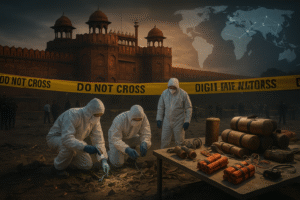
A sudden explosion near Delhi’s Red Fort shocked residents and authorities alike. The location is one of the most sensitive zones in the country—both historically and strategically. The sound of the blast echoed across nearby areas, leading to immediate deployment of police units, forensics teams, and anti-terror squads.
Initial visuals showed damaged surroundings, debris scattered across the blast site, and a rapid cordon by security forces. Social media began buzzing within minutes, with citizens posting videos, theories, and eyewitness accounts.
Authorities initially maintained that the “blast reason was unclear,” and there was no immediate evidence of terrorism. But the story quickly took a turn.
Early Investigations Showed No Terror Angle: Why the Change Now?
Right after the incident, officials publicly avoided linking the explosion to terrorism. This is a standard protocol when evidence is incomplete. However, the investigation soon uncovered disturbing details.
Forensic samples, chemical residues, and blast patterns suggested the presence of powerful materials. As the hours passed, police teams carried out raids across multiple locations based on intelligence inputs.
This led to one of the biggest discoveries connected to the case.
2.9 Tons of Explosives Found: A Major Red Flag
Authorities seized approximately 2.9 tons of explosives and related materials from various sites during follow-up investigations.
This quantity immediately raised national alarm:
-
It is far beyond what is used in local criminal activity.
-
It indicates intent for large-scale damage.
-
It suggests pre-planning and logistical support.
-
It points toward a well-organized terror network rather than isolated individuals.
The discovery of detonators, timers, and military-grade components further strengthened suspicion that the blast was part of a broader terror operation.
Because of this, agencies invoked anti-terror laws, including provisions under the UAPA (Unlawful Activities Prevention Act), shifting the investigation into a national security domain.
Who Is Dr. Umar? The Key Suspect in the Spotlight
As the probe expanded, one name repeatedly surfaced: Dr. Umar.
Why is Dr. Umar significant?
-
He is linked to a network of terrorists under observation by multiple Indian agencies.
-
Several of his close associates were arrested earlier in separate terror-related cases.
-
Since these arrests, Dr. Umar has been on the run, moving between safe houses and receiving support from underground operatives.
-
His digital footprints, financial transactions, and communication patterns have been under surveillance.
What is his alleged role?
According to investigators, Dr. Umar is believed to be:
-
A coordinator in the procurement of explosives.
-
Connected to handlers and terror financiers based outside India.
-
Potentially linked to radical organizations aligned with groups such as Jaish-e-Mohammed (JeM).
While authorities have not officially announced his direct involvement in the Red Fort blast, intelligence sources indicate that his name is emerging as a central figure in the developing case.
Pakistan Issues NOTAM: Why Is This Important?
Amid the ongoing investigation, reports surfaced that Pakistan has issued a NOTAM (Notice to Airmen). A NOTAM is usually issued for logistical, military, or aviation-related reasons. However, Pakistan’s timing has raised eyebrows.
Why does this matter?
-
Historically, Pakistan has issued NOTAMs during major military exercises, missile tests, or sensitive internal operations.
-
The NOTAM came shortly after the Delhi blast, sparking speculation among analysts about a possible strategic or informational link.
-
Some experts believe it could be an attempt to create narrative fog or to divert attention.
While there is no official confirmation that the NOTAM is related to the blast investigation, it has become part of the broader discussion, especially as media and analysts track cross-border developments.
Propaganda, Disinformation, and Media Noise
As with every major national incident, misinformation and sensational media coverage have flooded online platforms.
Some unverified claims include:
-
False accusations about groups unrelated to the case
-
Edited videos suggesting foreign involvement
-
Bot-driven narratives targeting India-Pakistan relations
Authorities have urged the public to avoid speculation, rely on official statements, and not share unverified content. Despite this, online propaganda continues to shape public perception, creating confusion around the investigation.
Experts warn that disinformation campaigns often run parallel to terror operations to influence political and social reactions.
Possible JeM (Jaish-e-Mohammed) Connection
One strand of the investigation hints at possible involvement of JeM-linked operatives.
Why JeM is under scrutiny:
-
JeM has a long history of targeting India using sleeper cells and remote handlers.
-
Intelligence agencies have previously intercepted communication about potential attacks around Delhi.
-
Some explosive components found in recent raids match patterns seen in previous JeM-backed plots.
However, agencies are cautious and have not publicly confirmed the organization’s involvement. Theories remain under evaluation as evidence is still being analyzed.
The Role of ‘Kinjal’: Emerging Digital Footprint
The name Kinjal has appeared in online discussions and inside the investigation leads connected with digital activities, communication channels, or potential informant networks.
Details remain unclear, but sources suggest:
-
Kinjal may be involved in distributing propaganda.
-
The person might be helping circulate encrypted messages.
-
They could be a small link in a wider communication chain.
This part of the investigation is still developing, and officials have not made any public statements about Kinjal’s identity or involvement.
A Fluid Situation: What We Know So Far
The case is far from settled, and new information continues to emerge. Here is the consolidated status:
-
A blast occurred near Red Fort, causing national alert.
-
Early investigations denied a terror link, but new evidence suggests otherwise.
-
Authorities have seized 2.9 tons of explosives, signaling large-scale planning.
-
Dr. Umar has emerged as a key suspect, with links to a wider network.
-
Anti-terror laws have been invoked to expand the scope of the investigation.
-
Pakistan’s NOTAM and online propaganda are adding complexity to the situation.
-
Potential JeM connections and the name Kinjal are under examination.
Conclusion: A Case That Demands Vigilance
The Delhi blast is no longer being viewed as a standalone incident. With massive explosive recoveries, suspected cross-border links, and emerging characters like Dr. Umar, the investigation has expanded into a major anti-terror operation.
As agencies work around the clock, the situation remains fluid. Official updates are expected in phases, and clarity will improve as more evidence is analyzed. For now, the focus remains on uncovering the full network, preventing further threats, and ensuring public safety.