

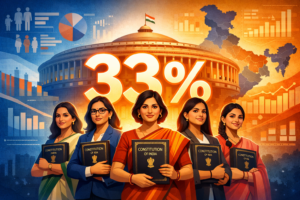

In this article, we break down exactly what Delimitation is, why it is tied to the Women’s Reservation Bill, and what constitutional provisions are involved.
“The Women’s Reservation Bill has been passed — but without Delimitation, not a single reserved seat can be notified.”
What Is Delimitation?
Delimitation literally means the act of fixing limits or boundaries. In the Indian political context, it refers to the redrawing of constituency boundaries and the reallocation of seats in Parliament and State Assemblies.
The core purpose is simple: equal representation based on population. As India’s population grows and shifts, constituencies that were drawn decades ago no longer reflect the current reality. A constituency with 5 lakh voters should not carry the same weight as one with 25 lakh voters.
This is the principle of political equity — one person, one vote, equal value.
What the Constitution Says: Articles 82 and 170
Two critical constitutional provisions govern Delimitation in India:
Article 82 — Readjustment of Lok Sabha Seats
Article 82 of the Constitution mandates that after every census, Parliament must readjust the allocation of seats in the Lok Sabha and redraw constituency boundaries. This means the number of seats each state gets in the Lower House must reflect its updated population.
Article 170 — Readjustment of State Assembly Seats
Article 170 applies the same logic to State Legislative Assemblies. After every census, the number and boundaries of constituencies in each state assembly must also be readjusted to reflect population changes.
Together, Articles 82 and 170 make Delimitation a constitutional obligation — not a political choice. And the Women’s Reservation Bill explicitly states that reservations will be activated only after the next Delimitation exercise is completed.
Why Is Delimitation Being Delayed?
India’s last Delimitation exercise was based on the 2001 Census. The 2021 Census was delayed due to the COVID-19 pandemic and has not yet been conducted. Without an updated Census, Delimitation cannot begin.
There is also a politically sensitive angle. States in southern India — like Tamil Nadu, Kerala, and Andhra Pradesh — have done better in controlling population growth compared to states in the north. A new Delimitation based on the latest population data could reduce their seat count in Parliament, shifting political power northward.
This makes Delimitation one of the most politically charged exercises in Indian democracy. It is not just about boundaries — it is about power.
The Women’s Reservation Bill: What It Actually Promises
The Nari Shakti Vandan Adhiniyam, passed in a special session of Parliament in September 2023, reserves one-third of all seats in the Lok Sabha and State Legislative Assemblies for women. This includes seats reserved for Scheduled Castes and Scheduled Tribes.
Key provisions of the bill include:
- 33% seats reserved for women in Lok Sabha and State Assemblies.
- Reservation will be rotated across constituencies after each Delimitation cycle.
- The law will come into force only after Delimitation is completed following the next Census.
- The reservation will last for 15 years, after which Parliament will review it.
“The bill is law on paper. But the clock for implementation hasn’t started yet — because the Census hasn’t happened.”
Women Already Have Reservation in Local Bodies — Here’s the Proof It Works
While Parliament debates the timeline, women’s reservation is already a reality at the grassroots level. Panchayati Raj institutions and Urban Local Bodies such as Municipal Corporations already have at least 33% reservation for women, and many states have raised it to 50%.
This is guaranteed under the 73rd and 74th Constitutional Amendments, passed in 1992. These amendments inserted a mandatory 33% reservation for women in village Panchayats, Block Panchayats, District Panchayats, Municipal Committees, and Municipal Corporations.
States like Rajasthan, Uttarakhand, and Bihar have already extended this to 50%. Today, India has over 14 lakh elected women representatives at the local governance level — the largest number in the world.
The local body experience proves the concept works. Women in Panchayats have driven change in sanitation, education, water access, and maternal health outcomes in their villages. Bringing this energy to Parliament is the natural next step.
Special Parliamentary Sessions and the Road to Implementation
The Women’s Reservation Bill was tabled and passed during a specially convened session of Parliament in September 2023, coinciding with the inauguration of the new Parliament building. It was passed with near-unanimous support across party lines — a rare moment of political consensus.
However, ongoing discussions and special sessions have continued to examine the implementation roadmap. The critical questions being debated include:
- When will the long-pending Census finally be conducted?
- How will the Delimitation Commission approach the north-south seat disparity?
- Will there be sub-reservations for OBC women within the 33% quota?
The ruling government has stated its commitment to conducting the Census at the earliest, which would then trigger the Delimitation process and ultimately bring the Women’s Reservation law into force. But experts estimate this may not happen before 2029 at the earliest.
What This Means for Indian Democracy
Currently, women hold only around 15% of seats in the Lok Sabha — one of the lower ratios among large democracies. For context, Rwanda leads the world at over 60%, while Bangladesh, a neighbouring country, has seen a woman serve as Prime Minister multiple times.
When the Women’s Reservation Bill finally comes into force, it will transform Indian parliamentary politics. More women in Parliament means policies on healthcare, education, safety, and economic empowerment are more likely to be shaped by those who understand these needs firsthand.
Conclusion: A Promise Made, A Process Awaited
The Women’s Reservation Bill is a landmark achievement for Indian democracy. But its implementation is locked behind a constitutional process — Delimitation — that is itself waiting on a Census that is yet to be completed.
Articles 82 and 170 are not roadblocks — they are safeguards for fair representation. The Delimitation process, when done right, ensures that every Indian’s vote carries equal weight. And when that process is complete, India will finally see one-third of its Parliament filled with women — a transformation long overdue.
The question is not if it will happen. The question is when.