

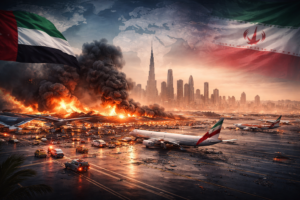

Dubai, known as a global hub for business, tourism, and aviation, is now facing an unexpected crisis.
Let’s break down what’s happening, why it matters, and most importantly — why the UAE is choosing restraint instead of retaliation.
What Happened in Dubai?
Dubai has reportedly suffered heavy damage, especially at its major aviation hub — Dubai International Airport.
This airport is not just important for the UAE.
It is one of the busiest international transit points in the world.
Key impacts:
-
Airport infrastructure damaged
-
Flights temporarily halted
-
Global travel routes disrupted
-
Thousands of passengers affected
This is not just a local issue — it’s a global aviation crisis.
Flights Halted: A Massive Disruption
Dubai serves as a bridge between Asia, Europe, and Africa.
With flights suspended:
-
Airlines are rerouting through alternative hubs
-
Ticket prices are increasing
-
Travel delays are spreading worldwide
Airlines like Emirates and Etihad Airways are directly impacted.
This disruption is costing millions of dollars daily.
Economic Shock to the UAE
The UAE economy depends heavily on:
-
Tourism
-
Aviation
-
Trade
Dubai alone contributes a large portion of the country’s GDP.
Financial losses include:
-
Decline in tourism bookings
-
Business travel cancellations
-
Cargo shipment delays
-
Reduced investor confidence
In simple terms:
Every hour of disruption means huge losses.
Why Is Iran Being Linked?
Tensions between the UAE and Iran have existed for years.
The region is already unstable due to:
-
Ongoing conflicts
-
Proxy wars
-
Strategic rivalries
Any attack or disruption quickly raises suspicion.
However, it’s important to note:
Direct confirmation is often complex in geopolitical situations.
The Big Question: Why Isn’t UAE Retaliating?
This is the most important part.
Despite the damage, the United Arab Emirates has not launched any direct military response.
Here’s why:
1. Economic Over Military Strategy
The UAE is not just a country — it’s a global business hub.
Dubai thrives on:
-
Stability
-
Foreign investment
-
Tourism
A military response could:
-
Scare investors
-
Crash markets
-
Damage long-term growth
Peace is more profitable than war.
2. Avoiding Regional War
The Middle East is already fragile.
A direct strike on Iran could:
-
Trigger a larger war
-
Involve multiple countries
-
Disrupt global oil supply
The UAE understands that escalation could spiral out of control.
3. Diplomatic Pressure Over Military Action
Instead of war, the UAE is likely choosing:
-
International diplomacy
-
Back-channel negotiations
-
Strategic alliances
Global powers often prefer controlled responses over open conflict.
4. Dependence on Global Trade Routes
The UAE sits near one of the world’s most critical oil routes — the Strait of Hormuz.
Any military escalation could:
-
Block oil shipments
-
Spike global fuel prices
-
Hurt the UAE’s own exports
So restraint is a strategic move.
5. Strong Defense, But Smart Restraint
The UAE has a powerful and modern military.
But modern warfare isn’t just about strength —
it’s about timing and strategy.
Sometimes not attacking is the strongest move.
Global Impact of the Crisis
This situation is not limited to Dubai.
Worldwide effects:
-
Airline industry losses
-
Tourism slowdown
-
Oil market uncertainty
-
Stock market volatility
Countries connected to Dubai routes are also feeling the pressure.
What Happens Next?
The coming days are crucial.
Possible scenarios:
-
Airport operations gradually resume
-
Diplomatic talks increase
-
Global powers intervene to stabilize the region
The UAE will likely focus on:
-
Rebuilding infrastructure
-
Restoring confidence
-
Maintaining global partnerships
Final Thoughts
Dubai’s crisis highlights how quickly global stability can be shaken.
Even a single disruption in a major hub like Dubai International Airport can impact the entire world.
But the bigger story is this:
👉 The United Arab Emirates is choosing strategy over emotion.
👉 It is prioritizing economy over conflict.
👉 And stability over retaliation.
In today’s interconnected world,
war is costly — but peace is powerful.