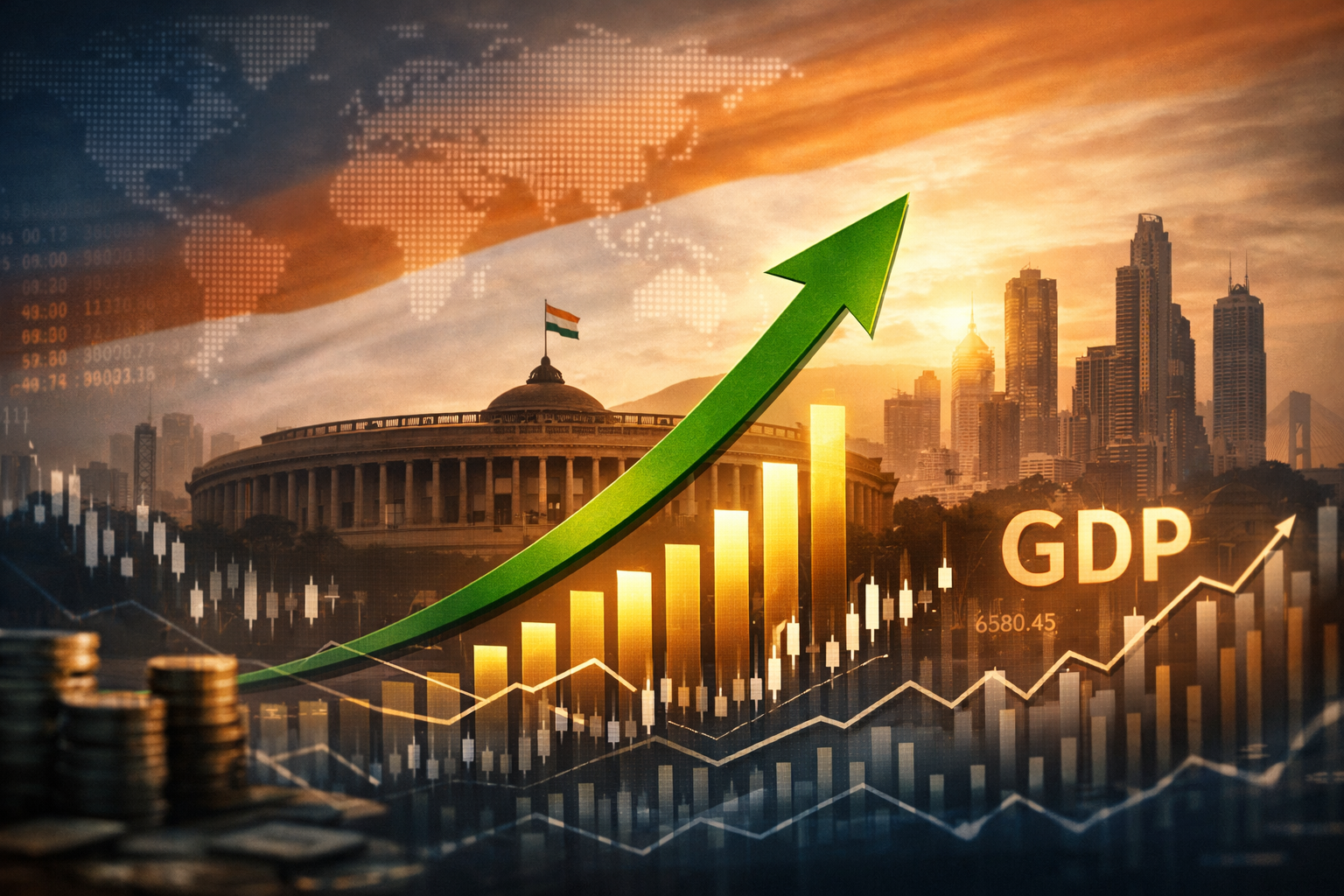
 India’s economic outlook for the financial year 2025–26 (FY26) looks strong and optimistic. According to the First Advance Estimates released by the government, India’s economy is expected to grow by 7.4% in FY26. This projection places India among the fastest-growing major economies in the world.
The estimate comes at an important time, just weeks before the Union Budget 2026, which will be presented on February 1, 2026, a Sunday. The timing has sparked discussions not only about economic policy but also about whether stock markets will operate on budget day.
This article explains what the First Advance Estimate is, how the 7.4% growth figure was calculated, and why it matters for investors, businesses, and ordinary citizens.
What Is the First Advance Estimate?
The First Advance Estimate (FAE) is one of the most important economic data releases by the Indian government.
It is published every year on January 7 by the Ministry of Statistics and Programme Implementation (MoSPI).
The estimate provides an early assessment of how the economy is likely to perform in the upcoming financial year.
Although it is not the final number, it gives policymakers, investors, and analysts a strong base to plan decisions.
Why the First Advance Estimate Matters
The First Advance Estimate plays a critical role in economic planning.
It helps the government shape policies ahead of the Union Budget.
It also guides corporate investment decisions and financial market expectations.
Banks, stock markets, and global institutions closely track this data to understand India’s growth momentum.
India’s GDP Growth Forecast for FY26
According to the First Advance Estimate released on January 7, India’s economy is projected to grow at 7.4% in FY26.
This growth rate reflects steady domestic demand, improving infrastructure, and resilient consumption.
Despite global economic uncertainties, India continues to show strong fundamentals.
The estimate reinforces confidence in India’s medium-term growth story.
Key Factors Behind the 7.4% Growth Projection
The First Advance Estimate is not based on assumptions alone.
It uses a wide range of real economic data collected from multiple sectors.
Here are the key indicators considered for the FY26 growth estimate.
Financial Performance of Listed Companies
One of the major inputs is the financial performance of listed firms.
Quarterly earnings data from companies listed on stock exchanges are analyzed.
Strong revenue growth, stable profits, and improved balance sheets indicate healthy economic activity.
Corporate performance reflects trends in manufacturing, services, and consumption.
Vehicle Sales as a Growth Indicator
Vehicle sales play a vital role in GDP estimation.
Data from passenger vehicles, commercial vehicles, and two-wheelers is carefully studied.
Higher vehicle sales indicate strong consumer confidence and increased mobility.
Growth in electric vehicles and logistics transport also supports economic expansion.
Railways Passenger and Freight Earnings
Indian Railways is a major backbone of the economy.
The First Advance Estimate includes data on passenger earnings and freight revenue.
Higher freight earnings signal strong industrial and trade activity.
Increased passenger traffic reflects recovery in travel and tourism.
Air Cargo Handled Across Airports
Air cargo data is another crucial metric.
Cargo handled at airports shows trends in exports, imports, and supply chains.
Growth in air freight points to strong global trade participation.
It also highlights the expansion of India’s logistics and aviation sectors.
Other Important Economic Indicators
Several other indicators are also used in the estimation process.
These include:
• Industrial production data
• Electricity consumption
• Government expenditure trends
• Tax collections
• Infrastructure activity
Together, these metrics provide a comprehensive picture of economic health.
Union Budget 2026 and Market Expectations
The Union Budget 2026 will be presented on February 1, 2026, which falls on a Sunday.
This unusual timing has raised questions about stock market operations on budget day.
Traditionally, markets remain open during budget presentations, even on holidays.
However, official confirmation is awaited regarding market hours.
How GDP Estimates Influence the Union Budget
GDP growth estimates directly influence budget planning.
Higher growth allows the government more fiscal space for spending.
It supports higher capital expenditure on infrastructure, health, and education.
It also boosts confidence in tax revenue projections.
The 7.4% growth estimate strengthens the case for growth-oriented policies.
What Is the Second Advance Estimate?
The Second Advance Estimate (SAE) is the next update to GDP projections.
It will be released on February 26, 2026.
This estimate incorporates more complete data from the financial year.
It often revises growth figures based on updated information.
Difference Between First and Second Advance Estimates
The First Advance Estimate is based on partial data and trends.
The Second Advance Estimate uses more finalized numbers.
While major changes are rare, minor revisions are common.
Markets and policymakers watch the second estimate closely for confirmation.
How Reliable Is the 7.4% Growth Projection?
While the estimate is credible, it is still provisional.
Global risks such as inflation, geopolitical tensions, and energy prices remain.
Domestic factors like monsoon performance and consumption trends also matter.
However, India’s strong domestic demand provides stability.
Impact on Investors and Businesses
For investors, a 7.4% growth outlook is a positive signal.
It supports long-term equity investments and sectoral expansion.
Businesses gain confidence to increase hiring and capital spending.
Foreign investors see India as a stable growth destination.
What This Means for Ordinary Citizens
Economic growth impacts everyday life.
Higher growth can lead to more jobs and better incomes.
Government spending on welfare and infrastructure may increase.
Improved economic activity supports small businesses and startups.
India’s Position in the Global Economy
With a projected 7.4% growth, India remains ahead of many major economies.
It strengthens India’s role as a global growth engine.
International agencies closely monitor these estimates.
The outlook enhances India’s standing in global economic forums.
Conclusion
The First Advance Estimate for FY26, projecting 7.4% GDP growth, paints a positive picture of India’s economic future.
It reflects strong fundamentals backed by real economic indicators.
As the Union Budget 2026 approaches, this estimate will shape policy discussions and market sentiment.
The upcoming Second Advance Estimate on February 26, 2026, will provide further clarity.
For now, India’s growth story remains strong, resilient, and full of opportunity.