

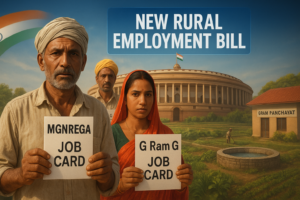
The Indian government has introduced a major rural employment reform in Parliament. A new bill proposes replacing the MGNREGA (Mahatma Gandhi National Rural Employment Guarantee Act) with a fresh scheme called “G Ram G”.
This move has sparked nationwide discussion, especially among rural workers, policymakers, and economists. MGNREGA has been one of India’s largest social welfare programs since 2005. Replacing it marks a significant shift in rural employment policy.
This article explains what G Ram G is, why MGNREGA is being replaced, how the new scheme will work, and what it means for rural India—in simple language.
What Is G Ram G Scheme?
G Ram G is a newly proposed rural employment guarantee scheme presented in Parliament. The government claims it will improve efficiency, transparency, and local participation compared to MGNREGA.
Like MGNREGA, G Ram G promises 100 days of guaranteed wage employment every year for rural households. The work will focus on unskilled manual labor related to local development projects.
The key difference lies in decentralized execution, faster wage payments, and flexible participation for rural families.
A Quick Look At MGNREGA’s Journey
MGNREGA was launched in 2005 with the goal of providing livelihood security to rural households.
It guaranteed:
-
100 days of wage employment
-
Legal right to work
-
Focus on rural infrastructure
-
Financial inclusion through bank payments
Over the years, MGNREGA helped millions during droughts, economic slowdowns, and the COVID-19 pandemic.
However, challenges remained.
Why Is MGNREGA Being Replaced?
According to discussions highlighted in the video and parliamentary debate, the government believes MGNREGA has structural limitations.
Some major issues include:
-
Delayed wage payments
-
Centralized decision-making
-
Administrative bottlenecks
-
Lack of flexibility for farmers
-
Reduced impact in certain regions
The new G Ram G scheme is being positioned as a reform, not a removal of rural job guarantees.
100 Days Of Guaranteed Employment Continues
One important relief for rural workers is that G Ram G retains the 100-day job guarantee.
Every eligible rural household will still be entitled to:
-
100 days of wage employment per year
-
Unskilled manual work
-
Government-funded wages
This ensures that the core promise of employment security remains intact.
Focus On Local Development Projects
Under G Ram G, work will prioritize local and community-driven projects.
These include:
-
Water conservation
-
Rainwater harvesting
-
Land development
-
Soil improvement
-
Rural asset creation
The aim is to ensure that employment work also creates long-term benefits for villages.
Faster Wage Payments Within 15 Days
One of the biggest criticisms of MGNREGA was delayed wage payments.
G Ram G directly addresses this issue.
Under the new scheme:
-
Wages must be paid within 15 days
-
Payments will be digitally tracked
-
Accountability mechanisms will be strengthened
This change is expected to boost worker confidence and participation.
Unemployment Allowance For Delays
If work is not provided or wages are delayed beyond the specified time, workers will receive an unemployment allowance.
This provision ensures:
-
Legal protection for workers
-
Financial compensation for delays
-
Pressure on authorities to act quickly
This feature strengthens the scheme’s rights-based approach.
Decentralized Implementation Through Gram Panchayats
A major shift in G Ram G is decentralized execution.
Unlike MGNREGA’s heavy dependence on central administration, G Ram G gives more power to:
-
Gram Panchayats
-
Local governing bodies
-
Village-level institutions
Local authorities will be responsible for:
-
Identifying projects
-
Registering workers
-
Monitoring implementation
This ensures better alignment with village needs.
Flexibility For Rural Households
Another important feature of G Ram G is flexible participation.
Rural households will be allowed to:
-
Choose when they want to work
-
Avoid conflict with farming seasons
-
Balance agriculture and wage labor
This is especially beneficial for small and marginal farmers who depend on seasonal agricultural cycles.
How G Ram G Helps Farmers And Laborers
G Ram G aims to support both landless laborers and small farmers.
Benefits include:
-
Income support during lean seasons
-
Creation of productive rural assets
-
Improved water availability
-
Reduced migration to cities
By integrating employment with development, the scheme seeks to strengthen rural economies.
Transparency And Accountability Measures
The new bill emphasizes transparency.
Expected measures include:
-
Digital attendance records
-
Online wage tracking
-
Social audits at village level
-
Public disclosure of project details
These steps aim to reduce corruption and leakages.
Political And Public Reactions
The proposal has received mixed reactions.
Supporters say:
-
G Ram G modernizes rural employment
-
It fixes long-standing MGNREGA issues
-
Decentralization empowers villages
Critics argue:
-
MGNREGA should be improved, not replaced
-
Transition risks disrupting livelihoods
-
Implementation details remain unclear
Debate is ongoing in Parliament.
Will G Ram G Fully Replace MGNREGA?
If the bill is passed, G Ram G will gradually replace MGNREGA.
The government may:
-
Phase out MGNREGA
-
Merge existing job cards
-
Transfer workers into the new system
Clear guidelines will be crucial during the transition period.
What Rural India Can Expect Next
In the coming months, we can expect:
-
Parliamentary debate and amendments
-
Detailed implementation rules
-
Pilot projects in select states
-
Awareness campaigns for workers
The success of G Ram G will depend on execution, not just intent.
Conclusion: A Big Shift In Rural Employment Policy
The proposal to replace MGNREGA with G Ram G marks a major policy shift.
By retaining the 100-day guarantee, ensuring faster payments, decentralizing power, and offering flexibility, the government aims to create a more effective rural employment system.
However, smooth implementation, transparency, and worker awareness will decide whether G Ram G truly improves rural livelihoods.
As Parliament debates the bill, all eyes are on how this transformation will shape the future of rural India.