
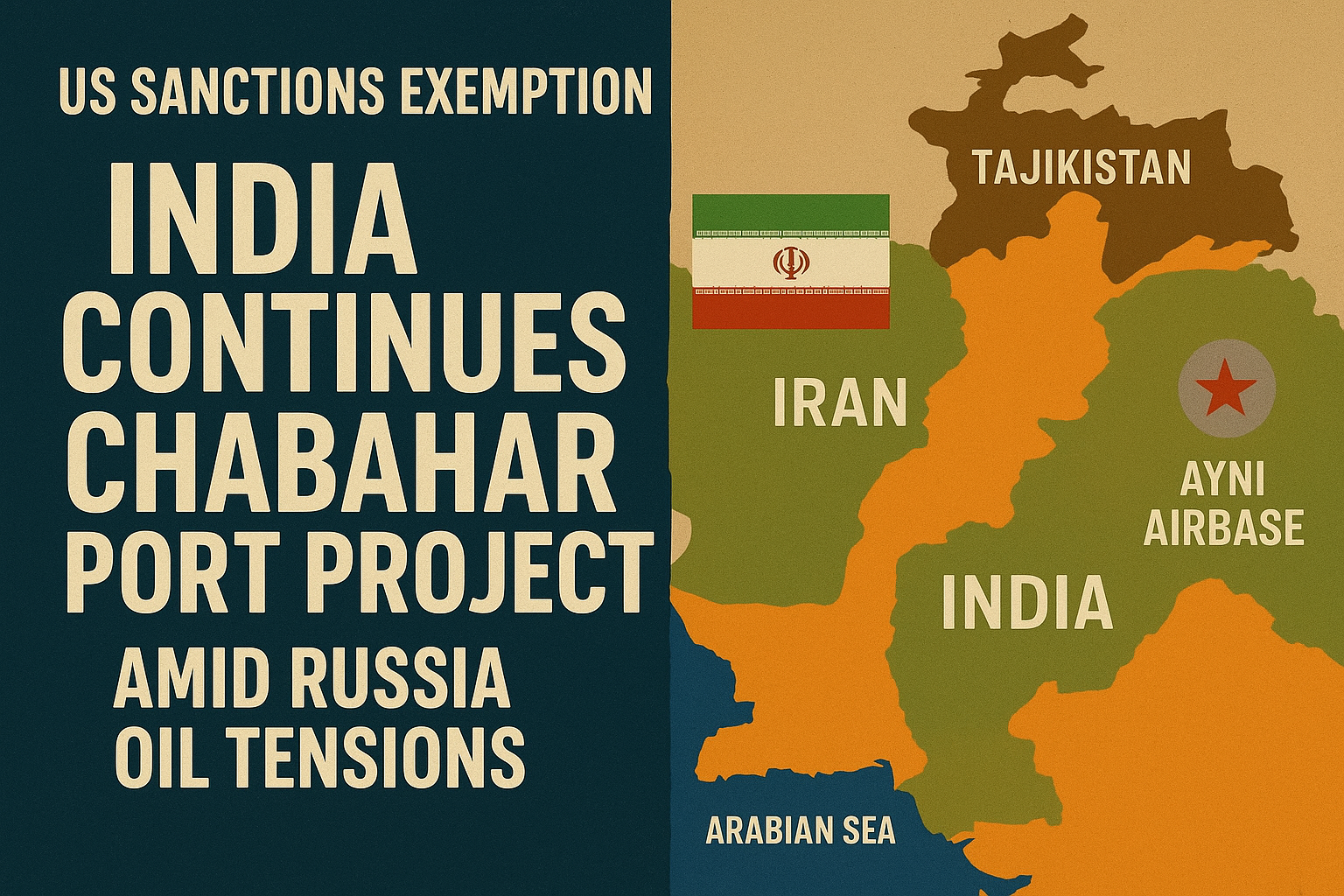
 India continues to navigate the complex global geopolitical landscape with careful diplomacy and strategic foresight. Even as Washington imposes strict sanctions on countries tied to Russia and Iran, New Delhi has managed to secure a key exemption from the United States — allowing it to proceed with the Chabahar Port project in Iran.
At the same time, India has concluded operations at the Ayni Airbase in Tajikistan, a move that reflects its shifting strategic priorities in Central Asia. This balance between engagement and restraint highlights India’s evolving approach to national security and global partnerships.
Chabahar Port: India’s Gateway to Central Asia
The Chabahar Port, located in southeastern Iran, has long been a cornerstone of India’s regional connectivity strategy. The project offers India direct access to Afghanistan and Central Asia, bypassing Pakistan, which has traditionally blocked Indian overland trade routes.
Despite heavy U.S. sanctions on Iran, Washington has consistently granted India waivers to continue work on the Chabahar Port. The reasoning is simple — the project serves not just India’s interests but also supports Afghanistan’s economic stability and regional trade integration.
The latest exemption is especially significant as global tensions rise over India’s continued imports of discounted Russian oil. The waiver shows that Washington still values its strategic partnership with New Delhi, even when policy differences exist.
A Strategic Balancing Act
India’s ability to continue the Chabahar project while managing relations with both Russia and the U.S. showcases its multi-alignment strategy.
On one hand, India relies on Russian oil and defense equipment, crucial for its economic and security needs. On the other, it seeks to deepen ties with the United States and other Western allies, particularly in technology, trade, and defense cooperation.
This dual engagement is not new for India, but under current global tensions — including the Russia-Ukraine conflict and U.S.-China rivalry — it has become more delicate than ever.
India Ends Operations at the Ayni Airbase
In a parallel development, India has decided to end its operations at the Ayni Airbase in Tajikistan after managing it for nearly two decades (20–25 years).
The airbase was one of India’s most significant overseas military facilities, allowing it to project power and maintain a strategic presence in Central Asia. It also provided India with a vantage point to monitor Pakistan and Afghanistan, especially during times of regional instability.
Historical Context: George Fernandes’ Vision
The Ayni Airbase, also known as Farkhor Airbase, traces its roots back to the late 1990s and early 2000s. It was developed with the strong backing of India’s then-Defence Minister George Fernandes, who believed India needed a military foothold in Central Asia to balance regional power dynamics.
For years, the base symbolized India’s determination to engage beyond South Asia, serving as a strategic outpost during the height of the U.S. presence in Afghanistan and the rise of regional terrorism.
However, as geopolitical conditions evolved, maintaining the base became less essential — both strategically and financially.
Why India Ended the Ayni Mission
Several factors contributed to India’s decision to step back from the Ayni Airbase:
-
Changing Regional Equations – Since the Taliban’s return to power in 2021, India has worked to normalize relations with Afghanistan. The airbase, once used to monitor developments there, has lost much of its earlier relevance.
-
Improved Diplomatic Ties – India has strengthened its diplomatic and trade presence in Central Asia through non-military channels, including energy, connectivity, and cultural cooperation.
-
Economic Priorities – With growing global inflation, defense modernization costs, and new infrastructure commitments like Chabahar, India is focusing on investments that yield direct strategic or economic returns.
-
Strategic Shift to the Indo-Pacific – India’s military and diplomatic priorities have shifted towards the Indo-Pacific region, where countering China’s influence has become a major focus.
The Bigger Picture: Geopolitical Realignment
Ending the Ayni operation doesn’t signify India’s retreat from Central Asia. Instead, it reflects a recalibration of strategy — moving from a military presence to economic and diplomatic engagement.
The focus now lies on regional connectivity, energy trade, and infrastructure projects that strengthen India’s influence without heavy military expenditure.
Chabahar Port fits perfectly into this vision, linking India to Central Asian markets and helping it maintain a stable footprint in the region through trade and logistics rather than bases and troops.
US Exemption: A Diplomatic Win for India
The U.S. sanctions exemption for Chabahar is more than just a technical waiver — it’s a diplomatic victory.
It shows Washington’s recognition of India’s unique geopolitical position and the mutual benefits of cooperation. For the U.S., India remains a critical partner in ensuring stability in the Indo-Pacific and countering China’s Belt and Road Initiative (BRI).
For India, this exemption ensures the continuity of a project that boosts both economic and strategic interests, connecting it directly to Iran, Afghanistan, and Central Asia.
Russia Oil Tensions: A Tightrope Walk
While the U.S. has offered flexibility on Chabahar, its patience with India’s Russian oil imports has been more limited.
Since the start of the Russia-Ukraine conflict, India has significantly increased its purchase of discounted Russian crude, arguing that it serves its domestic energy security and economic stability.
Washington has voiced concerns but stopped short of imposing penalties, understanding that forcing India to choose sides could backfire strategically.
Still, the balancing act is becoming more complex as Western sanctions tighten and U.S. elections loom — potentially shifting future policy directions.
India’s Strategy Going Forward
India’s long-term strategy revolves around three key goals:
-
Preserve Strategic Autonomy – India continues to pursue an independent foreign policy, maintaining relations with all major powers without aligning exclusively with any bloc.
-
Enhance Regional Connectivity – Through projects like Chabahar Port and the International North-South Transport Corridor (INSTC), India aims to strengthen trade routes linking South Asia, Central Asia, and Europe.
-
Prioritize Economic Strength – India understands that global influence increasingly depends on economic resilience. Hence, its foreign engagements increasingly focus on energy security, supply chains, and infrastructure.
Conclusion
India’s ability to secure a U.S. sanctions exemption for the Chabahar Port while ending operations at the Ayni Airbase marks a turning point in its regional strategy.
This dual move symbolizes a transition from military presence to economic connectivity, aligning perfectly with India’s broader vision of global engagement.
As tensions persist over Russian oil imports and changing alliances, India continues to play the role of a balancer — not a follower — in global geopolitics.
By maintaining strategic flexibility, New Delhi has shown once again that it can defend its interests, build partnerships, and pursue peace — all while charting its own independent course