

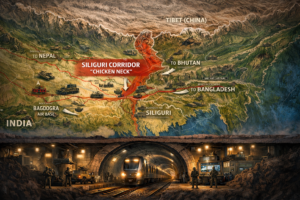

Because of its unique geography and proximity to international borders, the Siliguri Corridor has long been considered a strategic vulnerability. Now, the Indian government is planning a bold move — the construction of an underground railway network to strengthen this critical lifeline.
This development marks a significant shift in India’s security and infrastructure strategy.
What Is the Siliguri Corridor?
The Siliguri Corridor is a narrow stretch of land located in West Bengal. It connects the northeastern states of India to the rest of the country.
At its narrowest point, the corridor is only 20 to 40 kilometers wide. This limited width makes it extremely sensitive from both a military and logistical perspective.
The corridor is surrounded by:
-
Nepal to the west
-
Bangladesh to the south
-
Bhutan to the north
-
China (Tibet Autonomous Region) further north
Due to this geography, any disruption in the Siliguri Corridor could impact the entire Northeast region of India.
Why Is It Called the “Chicken Neck”?
The name “Chicken Neck” comes from its shape on the map. It resembles the narrow neck of a chicken, connecting the larger mainland body to the smaller northeastern part.
Because it is so narrow, it is seen as a potential choke point. In case of military tension or conflict, this region could become highly vulnerable.
This is why India has always treated the Siliguri Corridor as a high-priority security zone.
Rising Strategic Concerns in the Region
In recent years, tensions along the India-China border have increased. The 2020 Galwan Valley clash highlighted the need for stronger infrastructure and defense preparedness.
China’s growing infrastructure development near the Indian border has also raised strategic concerns.
Although the Siliguri Corridor is not directly on the Line of Actual Control (LAC), its proximity to sensitive borders makes it strategically important.
If this corridor were compromised, connectivity between mainland India and states like:
-
Assam
-
Arunachal Pradesh
-
Manipur
-
Mizoram
-
Meghalaya
-
Nagaland
-
Tripura
could be severely affected.
This makes securing the corridor not just a military priority but a national necessity.
India’s Plan to Fortify the Siliguri Corridor
To address these concerns, the Indian government is planning to enhance security in the region.
One of the most important initiatives is the construction of an underground railway network in the Siliguri Corridor.
This move is designed to ensure uninterrupted connectivity with the Northeast, even during emergencies or conflicts.
Unlike traditional rail lines that run above ground and are more exposed, underground rail networks offer better protection from:
-
Air strikes
-
Sabotage
-
Natural disasters
-
Surveillance
This makes the underground railway project a proactive and forward-looking strategy.
Why Underground Rail Is a Strategic Game-Changer
Building an underground railway in the Siliguri Corridor is not just an infrastructure upgrade. It is a strategic masterstroke.
Here’s why:
1. Enhanced Security
Underground infrastructure is harder to detect and target. This significantly reduces vulnerability during wartime or high-tension situations.
2. Reliable Connectivity
The Northeast depends heavily on road and rail connectivity through this corridor. Any disruption can impact:
-
Supply chains
-
Military logistics
-
Civilian movement
-
Economic activity
An underground rail system ensures continuity even if surface routes are damaged.
3. Faster Military Mobilization
In case of emergency, rapid troop movement is critical. A secure underground railway can facilitate quicker and safer deployment of forces.
4. Long-Term Strategic Planning
This project shows that India is not reacting to threats but preparing in advance for potential future challenges.
The Importance of the Northeast for India
India’s Northeast region is rich in natural resources, biodiversity, and cultural diversity. It also plays a key role in India’s Act East Policy, which aims to strengthen ties with Southeast Asian nations.
Improving connectivity with the Northeast is vital for:
-
Economic development
-
Trade expansion
-
Border security
-
National integration
The Siliguri Corridor acts as the only land bridge for this entire region.
That is why fortifying it is essential for both security and growth.
Infrastructure as a Tool of National Security
In modern geopolitics, infrastructure is closely linked to national security.
Countries around the world are investing in strategic roads, tunnels, railways, and airfields in border areas.
India has accelerated infrastructure development in recent years, especially along the northern and eastern borders.
The underground railway in the Siliguri Corridor fits into this broader strategy.
It reflects India’s commitment to strengthening its border infrastructure and safeguarding its strategic interests.
Challenges in Building Underground Rail in the Corridor
While the project is strategically important, it is not without challenges.
Geographic Complexity
The terrain in and around the Siliguri Corridor includes rivers, forests, and varying soil conditions. Underground construction in such areas requires advanced engineering.
High Costs
Underground rail projects are significantly more expensive than surface railways.
However, when national security is at stake, long-term benefits outweigh the costs.
Environmental Concerns
The region is ecologically sensitive. Careful planning will be needed to balance security needs with environmental protection.
Despite these challenges, the project remains a crucial step forward.
A Proactive Measure for Future Threats
The underground railway project is not a response to an immediate crisis. Instead, it is a preventive strategy.
By strengthening the Siliguri Corridor now, India is reducing risks in the future.
This approach ensures that even if geopolitical tensions rise, the country’s connectivity with the Northeast remains intact.
It sends a strong message that India is serious about defending its territorial integrity and strategic corridors.
What This Means for India’s Security Strategy
The move to fortify the “Chicken Neck” signals a shift toward deeper strategic planning.
India is:
-
Identifying vulnerable zones
-
Investing in advanced infrastructure
-
Prioritizing long-term national interests
The Siliguri Corridor may be narrow in width, but its importance is immense.
By reinforcing it with underground rail connectivity, India is strengthening one of its most critical strategic arteries.
Conclusion
The Siliguri Corridor, or the “Chicken Neck,” has always been a sensitive and vital link between mainland India and the Northeast.
With a width of just 20 to 40 kilometers at its narrowest point, the corridor demands constant attention and protection.
India’s plan to construct an underground railway network in the Siliguri Corridor is a bold and proactive measure. It aims to ensure uninterrupted connectivity, enhance security, and safeguard strategic interests.
In an era of evolving geopolitical challenges, infrastructure development is no longer just about growth. It is about national resilience.
By fortifying the Siliguri Corridor with underground rail, India is preparing for the future while protecting its present.
This strategic move could redefine how the country secures its most critical connections — ensuring that the Northeast remains firmly and safely linked to the rest of India.