

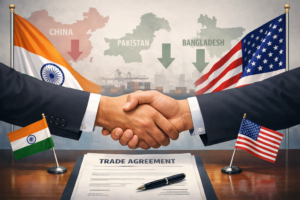

The deal is expected to reshape tariff structures, protect India’s key sectors, and strengthen the country’s position in international trade. At a time when global trade dynamics are rapidly changing, this agreement comes as a timely boost for India’s economy.
Let’s break down what this trade deal means, why it matters, and how it gives India a clear advantage in the region.
India–US Trade Deal: A Quick Overview
India and the United States recently announced a new trade agreement aimed at improving bilateral trade relations. One of the biggest highlights of the deal is its impact on tariffs, particularly the 18% tariff that had been imposed on Indian goods.
This tariff had been a major concern for Indian exporters, as it made Indian products less competitive in the US market. The new agreement is expected to reduce or restructure these tariffs, giving Indian businesses better access to one of the world’s largest consumer markets.
The deal reflects growing economic cooperation between India and the US, driven by shared strategic and economic interests.
Relief From the 18% Tariff: A Big Win for India
The 18% tariff imposed on Indian exports had created pressure on multiple sectors, including manufacturing, textiles, and engineering goods. These higher duties increased costs and reduced profit margins for Indian exporters.
With the new trade deal, India is expected to get significant relief from these tariffs. Lower trade barriers mean Indian goods can now compete more effectively in the US market.
This change is especially important at a time when global demand is uncertain and export-led growth is crucial for India’s economy.
Protection of Key Indian Sectors
One of the most important aspects of the new trade deal is India’s ability to protect sensitive domestic sectors.
India has ensured that key areas such as agriculture and dairy remain safeguarded from an influx of American goods. These sectors employ millions of people and are politically and economically critical.
By keeping certain tariffs in place, India has struck a balance between opening up trade and protecting domestic farmers and producers. This approach helps avoid the risk of cheaper imports hurting local livelihoods.
This move shows that India is negotiating trade deals on its own terms, rather than making blanket concessions.
Agriculture and Dairy: Why Protection Matters
Agriculture and dairy are not just economic sectors in India; they are the backbone of rural livelihoods.
Opening these sectors fully to American products could have flooded the Indian market with cheaper, subsidized goods from the US. This would have put immense pressure on small farmers and cooperatives.
The new trade deal ensures that these sectors remain shielded, while still allowing India to gain benefits in other areas such as manufacturing, technology, and services.
This selective approach strengthens India’s negotiating credibility on the global stage.
The Trump Era Influence on India’s Trade Policy
The influence of former US President Donald Trump is clearly visible in the background of this trade deal.
During the Trump administration, several export restrictions were imposed on Indian goods. India also lost certain trade benefits under US programs, which affected exports and business confidence.
These changes forced India to rethink its trade and economic strategy. One key response was adjusting the Goods and Services Tax (GST) to encourage domestic consumption and reduce dependence on exports.
The new trade deal can be seen as a corrective step, helping India recover from the disruptions caused during that period.
Boosting Domestic Consumption Through GST Adjustments
As export restrictions tightened in the past, India focused on strengthening its internal market.
The government made changes to GST rates in various sectors to stimulate spending and support domestic industries. This helped cushion the impact of reduced exports and global uncertainty.
The new US trade deal complements this strategy by reopening export opportunities while maintaining a strong domestic base.
Together, these steps make India’s economy more resilient to external shocks.
India’s Urgency to Finalize More Trade Deals
The global trade environment is evolving quickly, with countries forming new alliances and trade blocs.
India recognizes the urgency of finalizing trade agreements, not just with the US but also with the European Union, the UK, and other major economies.
Talks with the EU, in particular, are gaining momentum as India looks to secure better access to European markets.
The US trade deal sets a positive precedent and strengthens India’s hand in negotiations with other partners.
Changing Global Trade Dynamics Favor India
Global supply chains are shifting as companies look to reduce dependence on China.
India is emerging as a preferred alternative due to its large workforce, growing manufacturing base, and improving ease of doing business.
The new US trade deal reinforces India’s image as a reliable and strategic trade partner.
This shift gives India a competitive edge over neighboring countries that are facing political, economic, or trade-related challenges.
India vs China: A Strategic Advantage
China has long dominated global manufacturing and exports, but recent trade tensions and geopolitical issues have weakened its position.
India’s strengthened trade ties with the US help counterbalance China’s influence in global trade.
While China faces tariffs, sanctions, and supply chain diversification, India is gaining access, trust, and long-term partnerships.
This change significantly improves India’s standing in the international trade hierarchy.
Pakistan and Bangladesh Lag Behind
Compared to India, Pakistan and Bangladesh face limitations in terms of market access, trade diversification, and geopolitical influence.
Pakistan struggles with economic instability and limited export capacity, making it difficult to secure major trade deals.
Bangladesh remains heavily dependent on textiles and a narrow export base, which exposes it to risks if global demand shifts.
India’s diversified economy and proactive trade strategy place it well ahead of these neighbors.
A Stronger Position in International Trade
Overall, the new India–US trade deal positions India as a clear winner in South Asia.
By securing tariff relief, protecting key sectors, and strengthening global partnerships, India has created a balanced and forward-looking trade framework.
The agreement sends a strong message that India is ready to play a bigger role in global trade while safeguarding its domestic interests.
Conclusion: A Strategic Trade Victory for India
The new trade deal between India and the United States marks a significant milestone in India’s economic journey.
It reduces tariff pressures, protects sensitive sectors, and enhances India’s global competitiveness.
More importantly, it gives India an upper hand over China, Pakistan, and Bangladesh in the evolving international trade landscape.
As India continues to finalize more trade agreements and strengthen its economic foundations, its position as a global trade leader is only set to grow.