


What Is the Siliguri Corridor?
-
A narrow 22–24 km wide land strip in northern West Bengal
-
Connects mainland India to its northeastern states
-
Surrounded by Nepal, Bhutan, Bangladesh, and China
-
Considered India’s most vulnerable geographical point
-
Any threat to this corridor can isolate the entire Northeast from the rest of India
Because of these vulnerabilities, India has always treated the Siliguri Corridor as a top-priority strategic zone.
Why India Has Issued a Warning to Bangladesh
India’s warning comes after recent developments that raised concerns in New Delhi. While India and Bangladesh usually share friendly ties, the following issues triggered heightened alert:
1. Increasing Chinese Influence in Bangladesh
China has expanded its footprint in Bangladesh through:
-
Infrastructure investments
-
Military cooperation
-
Port development
-
Supply of submarines and advanced weaponry
India views this growing presence as a potential strategic risk, especially near the Siliguri Corridor.
2. Military Movements and Intelligence Inputs
Indian intelligence reportedly observed unusual troop activity and foreign military involvement in areas close to the Indian border.
This caused immediate concern because any foreign influence near the corridor is considered a direct threat.
3. Border Tensions and Smuggling Routes
India has faced recurring problems along the India-Bangladesh border, including:
-
Illegal migration
-
Cattle smuggling
-
Human trafficking
-
Arms and counterfeit currency networks
These factors forced India to tighten its security posture.
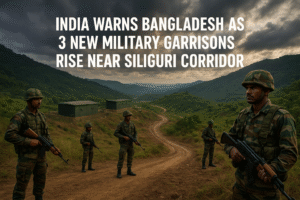
India’s Decision to Build 3 Military Garrisons
To strengthen its defensive capability, India has now established three major military garrisons in the region. These garrisons aim to:
-
Increase troop presence
-
Strengthen surveillance of the Siliguri Corridor
-
Ensure rapid mobilization in case of conflict
-
Secure the surrounding districts from infiltration
-
Deter any hostile actions backed by foreign powers
This is one of India’s most significant military steps in recent years, emphasizing the importance of protecting the corridor at all costs.
Strategic Importance of These New Garrisons
1. Faster Troop Deployment
The new garrisons allow India to deploy battalions within minutes instead of hours. This dramatically increases India’s readiness.
2. Multi-Layer Security Structure
India now has:
-
Border Security Force (BSF)
-
Assam Rifles
-
Central Armed Police Forces
-
Army infantry units
-
Armored vehicles and artillery detachments
All positioned to secure the Siliguri Corridor.
3. Countering China’s Presence
China has already built strong military infrastructure in Tibet and also maintains influence in Bangladesh.
India’s new positions help neutralize any potential two-front pressure.
4. Enhanced Air Surveillance
The garrisons support air-force monitoring over:
-
North Bengal
-
Bhutan border
-
Bangladesh border
-
Approaches from Tibet
This gives India a complete aerial view of potential threats.
Bangladesh’s Reaction
Bangladesh has stated that it does not pose any threat to India and denies any involvement in activities that could destabilize the region. Dhaka insists that its military cooperation with China is purely economic and defensive.
However, India remains cautious because:
-
Bangladesh’s strategic projects with China continue to rise
-
Several Chinese naval officers and engineers are already working in Bangladeshi ports
-
Certain border areas have seen increased movement
Thus, India believes it must prepare for all possibilities.
Historical Context: Why India Is Extra Sensitive
The Siliguri Corridor has been a point of tension since the 1962 India-China war. India remembers how quickly the Northeast could be cut off.
Key historical triggers include:
-
1962: China’s advance in Arunachal increased corridor vulnerability
-
1971: Bangladesh Liberation War strengthened India’s grip on the region
-
Recent decades: China’s Belt and Road Initiative (BRI) increased foreign presence near the corridor
All these factors show why India treats the corridor as a non-negotiable national asset.
Could This Lead to a Larger Conflict?
Experts believe that an India-Bangladesh conflict is unlikely because both nations benefit from economic cooperation. However, tensions could rise if:
-
China increases military presence in Bangladesh
-
Bangladesh offers strategic access to foreign militaries
-
Border skirmishes increase
-
Intelligence reports confirm external involvement near the corridor
India’s recent move is a pre-emptive defence measure, not a declaration of war.
India’s Larger Strategy in the Northeast
India has already strengthened its northeastern defence through:
-
Upgraded airbases in Tezpur, Hashimara, and Chabua
-
New mountain strike corps
-
Enhanced infrastructure near the China border
-
Highway and railway modernization in Sikkim and Arunachal
The new garrisons near the Siliguri Corridor now complete India’s defensive ring.
Impact on India-Bangladesh Relations
Positive Possibilities
-
More transparent talks on border management
-
Increased cooperation against smuggling and trafficking
-
Joint security programs
-
Stronger diplomatic channels
Negative Possibilities
-
Mistrust due to Chinese involvement
-
Misinterpretation of India’s military positioning
-
Increased political pressure in both countries
-
Possible diplomatic friction
However, both nations understand that instability in the region would harm them economically.
How This Affects the Northeast
Residents of India’s northeastern states depend on the Siliguri Corridor for:
-
Essential supplies
-
Road connectivity
-
Trade and transport
-
Defence logistics
Strengthening this corridor ensures:
-
Better security
-
Faster development
-
Reliable national integration
What Happens Next?
India is likely to take additional steps:
-
Installing more surveillance drones
-
Deploying advanced radars
-
Strengthening intelligence sharing with Bhutan and Nepal
-
Expanding road and tunnel networks near the corridor
Bangladesh may also try to balance its ties with both India and China to avoid confrontation.
Conclusion
India’s decision to set up three military garrisons near the Siliguri Corridor marks a major shift in South Asian geopolitics. While India insists this move is defensive, it clearly signals that New Delhi will not tolerate any strategic threat—direct or indirect—near its most critical lifeline.
The coming months will determine whether this situation escalates or becomes an opportunity for stronger cooperation between India and Bangladesh. For now, one thing is clear: the Siliguri Corridor remains India’s most important geography, and its protection is a national priority.