


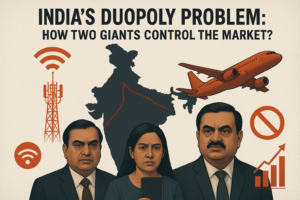
India is one of the fastest-growing economies in the world.
Yet behind this growth lies a serious concern — market control by just two major companies in key sectors.
From airlines to telecom, India is slowly becoming a duopoly-driven economy.
This situation raises big questions about competition, consumer choice, and long-term stability.
A recent crisis involving mass flight cancellations has once again exposed the risks of relying on only a few powerful players.
Let’s break down India’s duopoly problem, why it matters, and how it affects millions of citizens every day.
What Is a Duopoly?
A duopoly is a market structure where two companies dominate most of the market share.
In such markets:
-
Competition is limited
-
Prices are often controlled
-
Consumers have fewer alternatives
-
Innovation slows down
In India, several critical sectors are now close to duopolies.
The Flight Cancellation Crisis: A Wake-Up Call
Recently, India witnessed widespread flight cancellations.
Thousands of passengers were stranded.
Social media was flooded with complaints.
Customer support systems collapsed under pressure.
This incident revealed one major issue.
👉 India’s aviation sector is heavily dependent on just a couple of large players.
When one company struggles, the entire system suffers.
Why Dependence on Two Giants Is Dangerous
When a country relies on only two dominant companies:
-
A single failure can disrupt millions of lives
-
Service quality becomes secondary
-
Companies face less pressure to improve
-
Consumers lose bargaining power
In critical sectors like aviation, telecom, and digital services, this dependence becomes even more risky.
Telecom Sector: Another Duopoly in the Making
India’s telecom industry is a perfect example.
Once crowded with players, the market has now narrowed down to two major giants controlling most users.
While consolidation improved financial stability, it created new problems.
Rising ARPU: Profit Over Service?
One clear trend in the telecom sector is the steady rise in ARPU (Average Revenue Per User).
Both leading companies are:
-
Increasing tariffs
-
Removing low-cost plans
-
Pushing premium pricing
On paper, this looks good for business.
But for users, it raises concerns.
Are Services Improving With Higher Prices?
Despite higher ARPU:
-
Call drops still occur
-
Internet speed remains inconsistent
-
Rural connectivity is weak
-
Customer support complaints are rising
This suggests a shift in focus.
👉 Profit margins are growing faster than service quality.
The Digital Divide: Urban vs Rural India
One of the biggest issues highlighted is the digital divide.
Urban areas enjoy:
-
Faster internet
-
Better network coverage
-
More service options
Rural India faces:
-
Weak signals
-
Slow data speeds
-
Limited provider choices
The question is simple.
❓ Are telecom giants doing enough to bridge this gap?
Why Rural Connectivity Matters
Digital access today is not a luxury.
It affects:
-
Education
-
Healthcare
-
Online jobs
-
Government services
-
Digital payments
When rural areas fall behind, economic inequality widens.
A duopoly has little incentive to invest heavily in low-profit regions.
Lack of Competition Hurts Innovation
Healthy competition drives innovation.
In duopoly-controlled markets:
-
New ideas slow down
-
Customer experience stagnates
-
Prices rise quietly
-
Alternatives disappear
Smaller players struggle to survive due to:
-
High operational costs
-
Aggressive pricing by giants
-
Regulatory hurdles
Over time, consumers lose choice.
What Happens If One Giant Fails?
This is the biggest risk.
If one major company faces:
-
Financial trouble
-
Technical failure
-
Policy restrictions
The impact could be massive.
Millions could lose access to essential services overnight.
Entire industries could face instability.
This is not just a business risk.
It is a national concern.
Lessons From the Aviation Industry
The aviation crisis shows what happens when:
-
Backup options are limited
-
Market diversity is low
-
Consumers depend on a few brands
Ticket prices rise suddenly.
Alternatives are unavailable.
Passengers are left helpless.
The same pattern can repeat in telecom and digital sectors.
Are Regulators Doing Enough?
Regulatory bodies play a crucial role.
They must ensure:
-
Fair competition
-
Consumer protection
-
Infrastructure expansion
-
Price transparency
However, regulating powerful giants is not easy.
Strong policies and strict enforcement are essential to prevent misuse of dominance.
What Can Consumers Do?
While policy changes take time, consumers can stay proactive.
Here’s how:
-
Stay informed about market trends
-
Keep backup service options where possible
-
Voice concerns on public platforms
-
Support fair competition
Being aware is the first step to protection.
Why India Needs More Competition
For long-term growth, India needs:
-
More players in key sectors
-
Support for startups
-
Easier market entry
-
Strong anti-monopoly laws
Competition leads to:
-
Better services
-
Fair pricing
-
Faster innovation
-
Consumer empowerment
A healthy economy cannot depend on just two giants.
Fierce Market Competition Is Coming
The video warns viewers clearly.
The future market will be:
-
Highly competitive
-
Technology-driven
-
Fast-moving
Those who fail to prepare — whether companies or consumers — risk falling behind.
Staying adaptable is no longer optional.
Final Thoughts
India’s duopoly problem is real and growing.
From flight cancellations to rising telecom costs, the signs are everywhere.
While big companies bring scale and efficiency, over-dependence creates vulnerability.
To protect consumers and ensure sustainable growth, India must:
-
Encourage competition
-
Reduce digital inequality
-
Balance profits with responsibility
The question is not whether duopolies exist.
The real question is — how long can India afford them?