

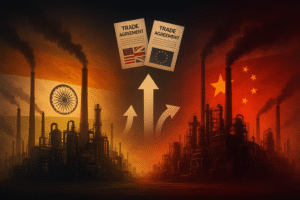
But the path to achieving this goal is not simple. Behind the headlines of trade agreements, incentives, and new schemes lies a deeper challenge — India is trying to build a manufacturing empire without solving the core structural problems.

This article breaks down the strategy, the contradictions, and the “deadly plan” that could either make India a giant or push the country into long-term risks.
1. India’s Rush to Sign Global Trade Agreements
India has recently signed multiple trade agreements that favor advanced economies, including the US, UK, and European Union.
On paper, these deals look like a masterstroke — they help India:
-
Increase export opportunities
-
Integrate into global value chains
-
Become a reliable partner to Western economies
-
Attract foreign manufacturers seeking a China-plus-one destination
These agreements are designed to show the world that India is open for business.
The government wants advanced nations to see India as a trusted, democratic, low-cost alternative to China.
But there’s a catch.
Most of these trade deals are heavily skewed toward the interests of developed nations. India is opening its markets faster than it can build domestic capacity. This could lead to increased imports, especially in high-tech sectors where India still lacks strong manufacturing capabilities.
In short:
India wants to grow exports, but its domestic base is still too weak to support that dream.
2. Domestic Investors Are Not Confident
One of the biggest roadblocks to India’s manufacturing rise is hesitation among domestic investors.
Unlike China — where long-term policy stability encouraged decades of massive investment — India faces constant changes in:
-
Tax rules
-
Business regulations
-
Compliance requirements
-
Government priorities
-
Industrial policies
This unpredictability makes Indian investors nervous about setting up large factories.
Instead of reinvesting profits into expansion, they prefer to:
-
Hold cash reserves
-
Invest in real estate
-
Put money into safer financial instruments
-
Expand slowly instead of aggressively
This leads to a lack of capital formation, which is the backbone of industrial growth.
China built factories at an unmatched speed because investors trusted the long-term vision.
In India, the vision changes frequently, so business owners choose to play safe.
If Indian companies are not confident enough to invest heavily, how can India compete with China’s scale?
3. The Profit Problem: Indian Industries Are Not Reinvesting Properly
The video referenced explains another major challenge — Indian companies often retain profits instead of reinvesting them in growth.
This problem has deep roots.
Here’s why Indian industries hold back:
-
They fear sudden policy shifts
-
They worry about unpredictable taxation
-
They doubt long-term market stability
-
They avoid taking high financial risk
-
They don’t trust the support system during crises
The result is a dangerous loop:
No reinvestment → No expansion → No scale → High production cost → Loss of global competitiveness
Meanwhile, Chinese companies operate on massive scale and enjoy economies of production.
India cannot beat China unless Indian companies reinvest aggressively into manufacturing.
At the moment, that’s not happening.
4. Quality Control Orders (QCOs): Good Idea or a Time Bomb?
The government has introduced Quality Control Orders (QCOs) to protect Indian industries, especially MSMEs (Micro, Small, and Medium Enterprises).
The idea is simple:
-
Enforce strict quality standards
-
Reduce cheap imports
-
Help local manufacturers survive
-
Build a “Made in India” brand
In the short term, this looks like a smart move.
But industry experts warn that this strategy may damage India’s global image.
The reason?
Many QCOs were implemented too quickly, without enough preparation time for manufacturers.
This has led to:
-
Confusion among exporters
-
Delays in shipments
-
Rejection of Indian goods in international markets
-
A perception that India is tightening controls too aggressively
Countries that import from India now worry:
“Will India change its quality rules again next year?”
“Will our shipments get stuck because of new compliance requirements?”
This creates trust issues.
If India wants global buyers to shift from China, it must create a stable, predictable business environment — not one filled with sudden rule changes.
5. MSME Support: Good for Votes, Bad for Long-Term Vision?
MSMEs form the backbone of India’s economy.
Naturally, every government wants to support them.
But here’s the harsh truth:
India cannot beat China using MSMEs alone.
To become a global manufacturing hub, India needs:
-
Mega factories
-
Massive supply chains
-
High technology manufacturing
-
Robust research and development
-
Large-scale production units
Current policies, however, appear to prioritize short-term support to small businesses over long-term industrial transformation.
This has created a situation where:
-
MSMEs depend on protectionist policies
-
Large manufacturers do not get enough push
-
India struggles to scale production
-
Export competitiveness remains low
If India truly wants to challenge China, it must shift focus from protecting smallness to building global-scale largeness.
6. The Low-Cost Masterplan: What India Is Trying to Do
Despite all these challenges, India has a clear plan.
The government wants to position the country as the world’s cheapest, most reliable manufacturing base.
Here’s the core strategy India is pushing:
1. Lower cost of labor compared to China
India wants global companies to save money by shifting production.
2. Access to huge consumer market
Companies cannot ignore India’s massive population and rising purchasing power.
3. Strategic partnerships with the US and Europe
India aims to become the preferred manufacturing partner for Western nations.
4. Incentives like PLI schemes
Production-Linked Incentives encourage industries like electronics, semiconductors, and mobile manufacturing.
5. Strengthening logistics
Ports, highways, and railways are improving to match China’s efficiency.
6. Digital governance
India uses digital tools to simplify compliance and reduce corruption.
This is India’s deadly plan — to offer the world a cheaper, democratic, diversified alternative to China.
But the big question remains:
Can India truly execute this plan without fixing its internal problems?
7. The Harsh Reality: Vision vs. Implementation
India wants:
-
high-tech manufacturing
-
global export leadership
-
massive industrial investment
But current policy priorities often focus on:
-
protecting MSMEs
-
immediate political benefits
-
quick wins instead of long-term strategy
This mismatch between vision and implementation is India’s biggest challenge.
Unless India:
-
builds investor confidence
-
stabilizes policies
-
encourages reinvestment
-
supports large-scale manufacturing
-
balances protection with openness
…the country may fall short of its goal to beat China.
8. Can India Beat China? The Final Answer
Yes — India absolutely can.
But only if the government and industries work together with a long-term mindset.
China’s dominance is not unshakeable.
Global companies are already diversifying.
India has the chance to become:
-
the world’s factory
-
the world’s back office
-
the world’s innovation hub
But this will require consistency, bold reforms, and stable policies.
India’s low-cost masterplan is powerful — but only if executed correctly.
Conclusion
India is standing at a historic turning point.
The world wants an alternative to China, and India is perfectly positioned to fill that space.
But to win this global race, India must:
-
boost capital formation
-
encourage reinvestment
-
maintain policy stability
-
improve quality standards without harming its image
-
support scale, not just smallness
If India corrects its fundamentals, the “deadly plan” to beat China will succeed.
If not, the dream of becoming a manufacturing superpower may remain on paper.