

“War has costs — naturally we must take transit fees from ships passing through the Strait of Hormuz.” — Iranian Lawmaker Alaeddin Boroujerdi
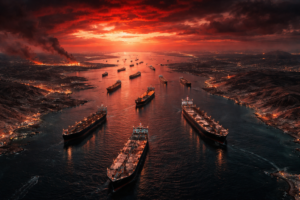

In this article, we break down exactly what is happening, why Iran made this decision, how Trump has responded, and — most importantly — what this means for India.
What Is the Strait of Hormuz — And Why Does It Matter?
The Strait of Hormuz is a narrow waterway connecting the Persian Gulf to the Gulf of Oman. At its narrowest point, it is just 33 km wide. Yet this sliver of ocean carries an enormous share of the world’s energy supply.
Here are some key numbers that show just how vital this waterway is:
- Around 20 million barrels of crude oil pass through the strait every single day.
- This represents roughly 20% of global petroleum consumption.
- Approximately 20% of the world’s liquefied natural gas (LNG) trade — mostly from Qatar — also flows through here.
- About 40% of India’s crude oil imports pass through this route.
In short, a disruption here does not just affect the Middle East. It affects fuel prices, food prices, and living costs across the entire world.
What Exactly Is Iran Doing?
Since the United States and Israel launched coordinated airstrikes on Iran on 28 February 2026 — killing Supreme Leader Ali Khamenei — Iran’s Islamic Revolutionary Guard Corps (IRGC) has imposed severe restrictions on maritime traffic through the strait.
Now, Iran has gone a step further. According to reports from Lloyd’s List and Iran International, Iran has set up an unofficial ‘approved vessel’ system — a new private corridor running north of Larak Island — and is charging ships for access.
The $2 Million Toll — Confirmed
Iranian lawmaker Alaeddin Boroujerdi, a member of parliament’s national security committee, confirmed the toll on state broadcaster IRIB. His exact reasoning:
“Collecting $2 million as transit fees from some vessels crossing the strait reflects Iran’s strength.”
At least one ship operator has already paid this fee, according to the Financial Times. At least eight vessels — including tankers and bulk carriers from India, Pakistan, and Greece — have used Iran’s new unofficial corridor.
The move is selective. Iran says the strait is closed only to ships from countries it considers enemies — primarily the US, Israel, and close Western allies. Neutral and friendly nations may apply for ‘approved’ status.
Why Has Iran Imposed This Toll?
Iran’s decision is driven by three interlinked factors:
1. Wartime Revenue Generation
The ongoing conflict with the US and Israel has imposed massive economic costs on Iran. The country’s leadership has openly admitted the toll is a way to recover some of those costs. As Boroujerdi stated, “war has costs” and charging transit fees is Iran’s way of making others share that burden.
2. Asserting Sovereign Control
Iran wants to signal that it — not the United States Navy — controls this waterway. By creating its own “sovereign regime” in the strait, Iran is broadcasting to the world that it holds the real leverage over global energy flows. This is less about money and more about power.
3. Economic and Diplomatic Pressure Tool
By selectively granting or denying access — and by setting a $2 million price tag — Iran can reward friendly nations (like China, Russia, India, Pakistan) and punish adversaries. This turns the strait into a live geopolitical weapon during negotiations.
Trump’s Ultimatum and Iran’s Response
US President Donald Trump issued a sharp 48-hour ultimatum on Truth Social, warning Iran to fully reopen the Strait of Hormuz. The threat was stark:
“If Iran doesn’t FULLY OPEN, WITHOUT THREAT, the Strait of Hormuz… the United States of America will hit and obliterate their various POWER PLANTS, STARTING WITH THE BIGGEST ONE FIRST!”
Iran did not back down. Instead, Tehran raised the stakes significantly:
- Iran’s Armed Forces said the strait would be ‘completely closed’ if the US strikes Iranian power plants.
- Speaker of Parliament Mohammad Baqer Qalibaf warned that financial institutions funding the US military could be considered legitimate targets.
- Iranian President Masoud Pezeshkian responded on X: “Threats and terror only strengthen our unity. The Strait of Hormuz is open to all except those who violate our soil.”
As of this writing, maritime intelligence firm Windward AI reports that Strait of Hormuz traffic is ‘near collapse,’ with only 16 AIS-visible ship crossings recorded over the past seven days. Under normal conditions, more than 150 ships transit the strait daily.
Impact on India: A Country Under Energy Pressure
India is one of the countries most exposed to the Strait of Hormuz crisis — and this $2 million toll makes a tense situation worse.
India’s Dependency on the Strait
India imports over 80% of its crude oil from abroad, and roughly 40% of all crude imports pass through the Strait of Hormuz. Beyond crude oil, India is almost entirely dependent on the Gulf for LPG and imports 60% of its natural gas from the region — primarily from Qatar.
How India Is Being Affected
- Brent crude oil has surged from around $70–72 per barrel before the conflict to over $100 per barrel, hitting a peak of $126 per barrel.
- India’s ‘crude basket’ — the weighted average of what India pays for oil — has reportedly hit $156 per barrel in some recent estimates.
- The Indian Rupee is under pressure, with analysts warning USD/INR could rise above 95 if the crisis continues.
- India has issued a Natural Gas Control Order under the Essential Commodities Act to stabilise supplies.
- Industrial gas users may face reduced allocations, though household LPG, CNG, and priority sectors like fertilisers are protected.
The Diplomatic Balancing Act
India is in active diplomatic talks with Tehran. Iran’s ambassador to India has indicated that Indian vessels may receive goodwill passage. Two Indian-flagged LPG carriers have already been granted transit through the strait, and Indian Navy destroyers have been deployed to the Gulf of Oman to escort merchant vessels. PM Modi has personally directed a coordinated government response to prevent black-marketing and hoarding.
India’s diversification strategy — sourcing crude from around 40 countries and ramping up Russian imports — is providing some buffer. But analysts warn that if this crisis drags on for months, the impact could resemble the economic pressure of the COVID-19 lockdowns, concentrated in energy, food, and manufacturing.
The Bigger Geopolitical Picture
This crisis is the largest disruption to global energy supply since the 1970s oil embargo. The events unfolding at the Strait of Hormuz have several layers:
- The US and its allies are coordinating a strategic petroleum reserve release to stabilise global markets.
- China, India, Pakistan, Malaysia, and Iraq are all in negotiations with Tehran to secure vessel passage.
- Several NATO members have declined to join a US-led Hormuz protection mission — a sign of fracturing Western unity.
- Alternative bypass routes, including Saudi Arabia’s East–West Pipeline and the UAE’s Fujairah pipeline, can only handle a fraction of normal traffic.
Iran is deliberately copying a tactic first used by Houthi rebels in the Red Sea — using a critical maritime choke point as leverage. The difference is that the Strait of Hormuz handles far more global trade and has far fewer alternatives.
Conclusion: The World’s Most Expensive Toll Road
Iran’s $2 million transit toll is not simply a fee. It is a declaration that Iran — not the US Navy, not international maritime law — controls access to nearly one-fifth of the world’s oil supply. Whether this toll becomes permanent policy or a short-term bargaining chip depends entirely on how the broader US-Iran-Israel conflict evolves in the coming weeks.
For India, the stakes are exceptionally high. Every tanker turned away or taxed at the strait translates directly into higher fuel costs, rising inflation, a weaker rupee, and pressure on millions of households. Diplomatic engagement with Iran, combined with rapid energy diversification, is the only path through this crisis.
One thing is certain: the Strait of Hormuz has moved from a shipping news story to the centre of the most consequential geopolitical standoff of 2026.