


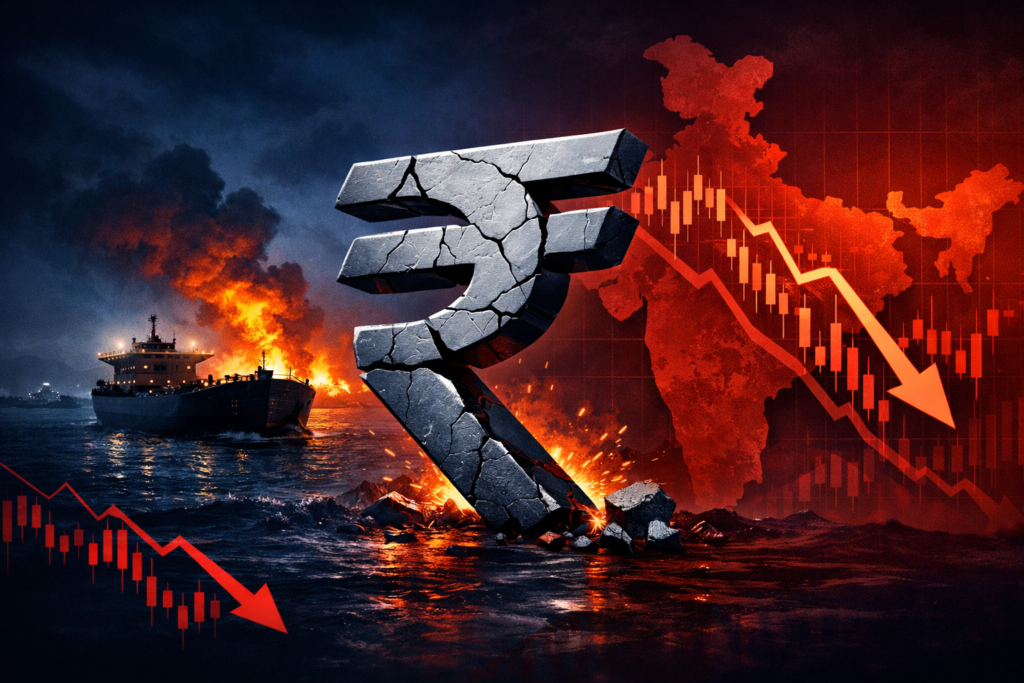
The Indian Rupee just hit a shocking new all-time low of ₹93.94 against the US Dollar on March 23, 2026. The Reserve Bank of India (RBI) is scrambling to control the damage. Crude oil prices have crossed $100 a barrel. The Middle East is on fire. And India’s energy supply is under serious threat.
So — is the RBI in emergency mode? And what does all of this mean for your daily life and India’s economy? Let’s break it all down in simple terms.
The Indian Rupee at an All-Time Low — What Just Happened?
India’s currency has been falling for months, but March 2026 crossed a critical threshold. The Rupee hit ₹93.94 per US Dollar — its worst level in history.
To put it in perspective:
- The Rupee first crossed ₹91/USD in December 2025.
- It moved from ₹90 to ₹92 in just 60 working days — a pace far faster than previous depreciations.
- In March 2026 alone, the Rupee lost 2.9% of its value.
- Without RBI’s intervention, dealers say the Rupee could have already crossed ₹95.
This is not a slow, gradual slide. This is a rapid currency shock — and the central cause is the war in the Middle East.
The Middle East Crisis — Why It Hits India So Hard
On February 28, 2026, the United States and Israel launched military strikes on Iran, beginning what is now called Operation Epic Fury. This conflict has had massive economic consequences for the rest of the world — especially India.
Why Does the Middle East Crisis Affect India?
India imports over 85% of its crude oil. A huge chunk of that — approximately 2.5 to 2.7 million barrels per day — passes through the Strait of Hormuz, the narrow waterway Iran has effectively closed in retaliation for strikes on its territory.
With the Strait of Hormuz blocked or severely disrupted, India suddenly lost access to oil from Iraq, Saudi Arabia, Kuwait, and the UAE — its biggest suppliers.
The result? Crude oil prices have surged from around $70 per barrel before the war to over $100 a barrel, with a peak of $119.50 during the most intense period. LPG supplies are short. Factories have slowed down. Indian households are struggling. Output in some sectors has been slashed by nearly half.
Is the RBI in Emergency Mode?
The short answer: Yes — practically speaking.
The RBI has not declared a formal ’emergency.’ However, its actions over recent weeks show it is operating in full crisis-response mode.
What RBI Is Doing Right Now
- Selling US Dollars aggressively: Market participants estimate the RBI sold $26–27 billion in March alone to slow the Rupee’s fall.
- Forward book exposure has surged past $100 billion — a record high. This means the RBI has made future commitments to buy dollars to support the currency.
- Forex reserves have dropped: India’s foreign exchange reserves fell from an all-time high of $728.5 billion (February 27, 2026) to $709.8 billion by mid-March — a decline of nearly $19 billion in just two weeks.
- Rate cuts: The RBI has cut its repo rate four times in 2025, bringing it down by a cumulative 125 basis points to support the slowing economy.
This level of intervention — billions of dollars per week, forward book at record levels, and an IMF reclassification of India’s exchange rate regime from ‘stabilised’ to ‘crawl-like’ — all confirm that the RBI is in damage-control mode.
The 30-Day Sanctions Waiver — A Lifeline for India?
One major development that could ease pressure on India is the US granting a 30-day sanctions waiver on Iranian oil.
On March 21, 2026, US Treasury Secretary Scott Bessent announced that the Trump administration had issued a temporary general licence allowing the purchase and sale of Iranian crude oil currently stranded at sea. The waiver applies to cargoes loaded before March 20 and delivered by April 19.
What Does This Mean for India?
- Approximately 140 million barrels of Iranian oil could enter global markets, bringing some relief to supply shortages.
- Indian refiners — cautious but interested — are evaluating whether to purchase these cargoes, pending clarity on payment terms and insurance.
- Earlier in March, the US had also granted India a 30-day waiver to buy stranded Russian crude, which Indian refiners moved quickly to secure.
- However, analysts note that this is a temporary patch, not a permanent fix. The waiver ends April 19, and deeper structural energy insecurity remains.
The US move reflects how deeply the Iran war has rattled global energy markets — and how even Washington has been forced to soften sanctions temporarily to prevent an economic meltdown.
Is There Hope? Ceasefire Talks Are Underway
Amid all the chaos, there is a glimmer of hope. Diplomatic channels have quietly opened behind the scenes.
- Foreign ministers from Egypt, Turkey, Saudi Arabia, and Pakistan met in Riyadh to explore a ceasefire off-ramp.
- Egyptian intelligence officials opened a backchannel with Iran’s Revolutionary Guard.
- US Special Envoy Steve Witkoff is involved in talks with multiple parties.
- President Trump, after issuing a 48-hour ultimatum demanding Iran reopen the Strait of Hormuz, announced a 5-day pause in planned attacks — a possible signal of de-escalation.
Markets are watching these developments closely. Any credible ceasefire announcement would likely trigger an immediate relief rally in the Rupee and a sharp drop in crude oil prices.
What Does All of This Mean for India’s Economy?
The Immediate Pain
- Higher fuel and LPG costs for households and businesses.
- Rising inflation risk as imported goods become more expensive.
- India’s 10-year government bond yield has climbed to 6.839%, up from 6.6% before the war.
- Foreign Portfolio Investors (FPIs) have already pulled out over ₹1.07 trillion from Indian equities in calendar year 2026.
- India’s Balance of Payments is expected to stay in deficit for two straight financial years — a first for the Indian economy.
The Silver Lining
- IT and software exporters earn in US Dollars — a weaker Rupee directly boosts their profits.
- Indian exporters gain a price advantage in global markets.
- A potential ceasefire, easing oil prices, and returning foreign investors could trigger a sharp recovery in the Rupee.
- India’s GDP growth forecast for FY2025-26 remains at a healthy 7.3–7.6%, and domestic consumption is expected to recover as monetary policy easing takes effect.
Key Takeaways
- The Indian Rupee hit a record low of ₹93.94/USD on March 23, 2026.
- The RBI is spending billions per week to defend the currency — acting in de facto emergency mode.
- The Middle East war has choked India’s oil supply via the Strait of Hormuz.
- A 30-day US sanctions waiver on Iranian oil offers temporary relief but is not a long-term solution.
- Ceasefire talks are underway — a resolution could rapidly stabilise both oil prices and the Rupee.
- The economy faces short-term pain, but India’s structural growth story remains intact.
Final Word
The RBI is not panicking — but it is certainly firefighting. The combination of a record-low Rupee, surging crude oil prices, foreign investor outflows, and a geopolitical crisis in the Middle East has created what analysts are calling a ‘perfect storm’ for the Indian currency.
The next few weeks are critical. If ceasefire talks succeed and oil prices fall, India could see a sharp recovery. If the conflict escalates further, analysts warn the Rupee could slide toward ₹96–97.
Stay informed, stay calm, and keep watching the Strait of Hormuz — because right now, what happens there determines what happens to your fuel bill, your investments, and India’s economy.