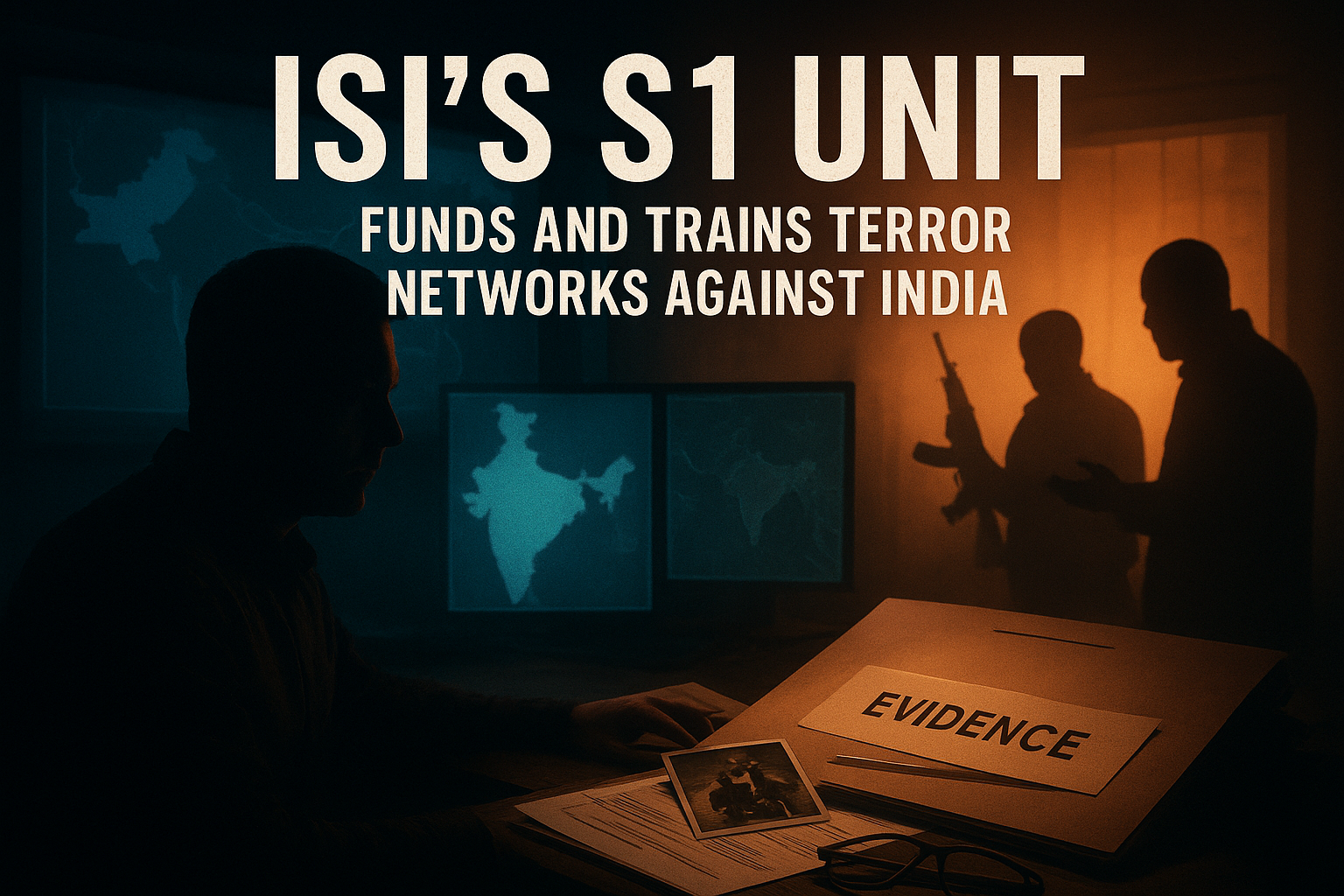
 Pakistan’s Inter-Services Intelligence (ISI) has long been accused of supporting terrorism in South Asia. A new video now sheds light on the covert operations of the ISI’s S1 Unit, revealing its role in funding, training, and guiding terror networks targeting India. The evidence presented highlights direct connections between ISI officials and major terror groups responsible for devastating attacks on Indian soil. This narrative raises serious concerns about regional security and the need for greater awareness of how state-sponsored terrorism operates behind the scenes.
What Is ISI’s S1 Unit?
The S1 Unit is reportedly one of the ISI’s most secretive wings. Its primary focus is covert warfare, including the planning, financing, and execution of terror missions across the Indian subcontinent.
According to the video, the S1 Unit functions as the backbone of Pakistan’s proxy war strategy, enabling terror groups to operate with precision and resources they could not access independently.
Direct Role in Major Attacks
The video highlights how the S1 Unit has been linked to some of the biggest terror attacks India has ever faced.
1. 2001 Parliament Attack
The attack on the Indian Parliament, carried out by Pakistan-backed terrorists, nearly pushed the two nuclear-armed nations into war. The investigative details discussed in the video indicate that handlers connected to the S1 Unit coordinated communication, training, and logistics.
2. 2008 Mumbai Attacks (26/11)
The Mumbai attacks were one of the most devastating acts of terrorism in India’s history.
Evidence suggests the S1 Unit played a crucial role in:
-
Training Lashkar-e-Taiba operatives
-
Funding the mission
-
Providing real-time guidance through handlers based in Pakistan
The video reaffirms how ISI officers coordinated with attackers as the events unfolded.
A Clear Command Structure Behind Terrorism
One of the key findings emphasized in the video is the organized hierarchy connecting ISI officials with terror commanders.
The S1 Unit reportedly maintains direct links with:
-
Jaish-e-Mohammed (JeM)
-
Lashkar-e-Taiba (LeT)
-
Hizbul Mujahideen (HM)
The structure identified includes:
-
ISI senior officers
-
S1 Unit directors
-
Terror group leaders
-
Foot soldiers on the ground
This chain of command provides seamless coordination across training camps, financial networks, cross-border infiltration routes, and digital communication lines.
Such coordination indicates a systematic state-backed mechanism rather than isolated extremist elements.
The Viral CCTV Image: A Direct ISI Connection
One of the most striking pieces of evidence discussed in the video is a viral CCTV image of a terrorist meeting ISI-linked officials.
This image reportedly shows a wanted militant captured on camera receiving instructions from individuals later identified as ISI personnel.
The footage underscores two crucial points:
-
Terror operatives frequently meet ISI officers face-to-face, proving direct collaboration.
-
The meetings take place in controlled environments, suggesting that operatives move freely under the ISI’s protection.
This visual proof strengthens India’s long-standing claim that Pakistan’s intelligence agency is actively involved in nurturing terror infrastructure.
How the S1 Unit Supports Terror Organizations
The video breaks down the operational strategies used by the S1 Unit to maintain a network of terrorist groups across South Asia.
1. Training and Grooming Militant Recruits
Recruits from Pakistan-occupied Kashmir and Punjab are reportedly trained in:
-
Handling assault weapons
-
Improvised explosive devices (IEDs)
-
Navigation and infiltration techniques
-
Communication systems
The training often happens in well-guarded camps run under the oversight of ISI-appointed personnel.
2. Funding Operations
The S1 Unit employs a mix of:
-
Hawala routes
-
Charity fronts
-
Fake NGOs
-
Narcotics trafficking
to funnel money into terror groups.
These funds are used for weapons, travel, safe houses, and recruitment.
3. Planning and Guiding Attacks
The unit is said to provide detailed attack playbooks to terror cells. This includes:
-
Identifying targets
-
Mapping escape routes
-
Monitoring Indian security forces
-
Providing satellite phones and encrypted communication tools
4. Overseeing Cross-Border Infiltration
The video explains how the S1 Unit organizes the movement of militants across the Line of Control (LoC).
Terrorists are often guided through:
-
Remote mountain routes
-
Riverine crossings
-
Night-time infiltration supported by Pakistani Rangers
Influence Beyond India
The S1 Unit’s operations reportedly extend beyond India’s borders.
The video highlights its involvement in:
Afghanistan
The unit has historically supported terror groups that destabilize governments and influence local politics. This includes backing the Taliban during earlier stages of conflict.
Bangladesh
The S1 Unit allegedly attempts to:
-
Influence extremist networks
-
Support anti-India elements
-
Create political unrest in the region
These activities demonstrate a broader strategy to project power and maintain instability across South Asia.
Why the S1 Unit Matters
Understanding the S1 Unit is essential for grasping the scale and strategy of terrorism supported by state agencies. Key reasons include:
1. State Sponsorship Makes Terror Networks Stronger
Groups like LeT and JeM become far more dangerous when backed by government-level intelligence and resources.
2. Regional Security Threat Intensifies
The S1 Unit’s activities extend across borders, affecting not just India but neighboring countries.
3. Harder to Combat Terrorism Without Transparency
The covert operations of the S1 Unit reduce accountability and complicate diplomatic efforts.
4. Continuous Radicalization
As long as such units remain active, the pipeline of trained militants continues uninterrupted.
The Need for Greater Awareness
The video’s narrative aims to educate viewers about the complex structure of terrorism in South Asia.
Many people see terrorism as the work of independent extremist groups, but the evidence shows a deeper, coordinated mechanism driven by state intelligence.
Raising awareness helps:
-
Encourage international pressure
-
Support counter-terrorism agencies
-
Strengthen policy responses
-
Expose how proxy warfare harms innocent civilians
Understanding the S1 Unit’s operations allows nations and global institutions to better address the root cause rather than just its visible outcomes.
Conclusion
The ISI’s S1 Unit operates as the hidden force behind several major terror networks targeting India. From planning attacks like the Parliament assault and the 26/11 Mumbai attack to supporting organizations like LeT, JeM, and HM, the unit plays a central role in Pakistan’s covert strategy.
The evidence discussed in the video—including the viral CCTV image—serves as a reminder of the direct links between terrorists and ISI officials.
Its influence reaches beyond India, shaping conflict zones in Afghanistan and Bangladesh as well.
Understanding the S1 Unit is crucial for recognizing how terrorism in South Asia is carefully planned, supported, and executed.
Greater awareness can help the global community address these challenges and promote long-term regional stability.