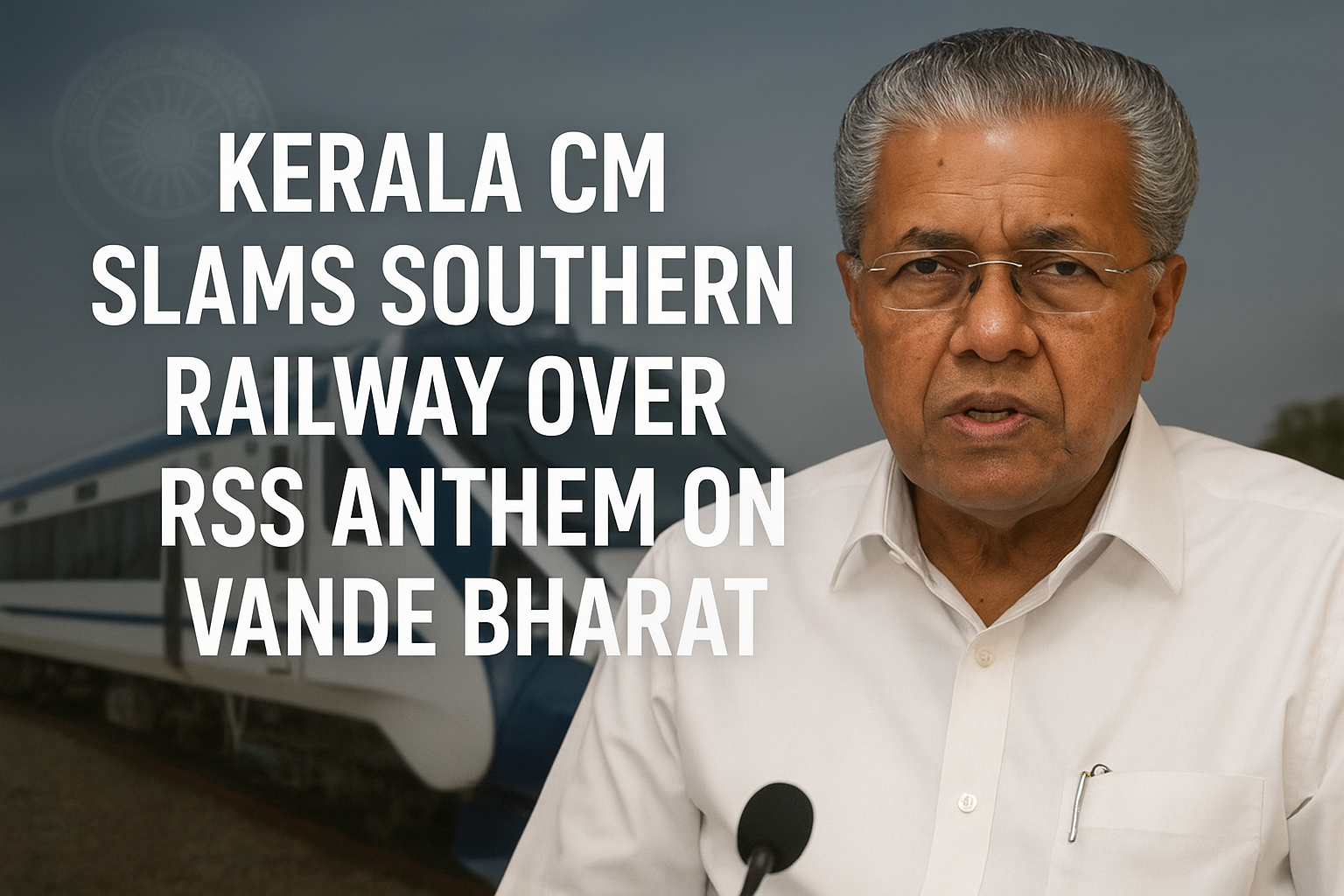
 A major political controversy erupted after Kerala Chief Minister Pinarayi Vijayan criticized Southern Railway for allegedly playing an RSS anthem for a group of school students aboard the Vande Bharat Express. The incident, which quickly spread across social media, has sparked debates around political neutrality, public institutions, and the use of government platforms for ideological messaging.
This article explains the incident, political reactions, official statements, and why the issue has gained nationwide attention.
What Triggered the Controversy?
The controversy began when a group of school students traveling on the Vande Bharat Express reportedly watched a video that included an RSS anthem. The screening allegedly happened with permission from railway staff on duty.
Parents and activists raised concerns after the video surfaced online, leading to immediate political reactions from Kerala’s government.
Kerala CM’s Strong Reaction
Kerala Chief Minister Pinarayi Vijayan strongly criticized Southern Railway, claiming that:
-
The railway authorities allowed the screening of content with political and ideological undertones.
-
Public spaces funded by taxpayers cannot be used to promote any organization’s ideology.
-
The incident reflects a growing trend of injecting political messaging into neutral institutions.
He termed the act “completely unacceptable” and demanded strict action.
Why the RSS Anthem Became the Issue
The core reason behind the controversy is the RSS (Rashtriya Swayamsevak Sangh) association. RSS is widely regarded as the ideological parent of the ruling BJP. The anthem being played in a government-run space has raised questions about:
-
Political neutrality of government services
-
Exposure of school students to ideological content
-
Possible misuse of public platforms for political messaging
This has turned a simple screening incident into a significant political flashpoint.
Southern Railway’s Initial Response
Following the CM’s criticism, Southern Railway issued clarifications.
Key points included:
-
The video was screened by a teacher accompanying the students.
-
Railway staff did not provide or promote the content themselves.
-
The situation escalated due to misunderstanding and misinformation.
However, critics argue that railway authorities should not have permitted any politically connected content to be played on a public train.
Opposition Parties React
Political parties in Kerala and across India quickly responded.
Congress Reaction
Congress leaders claimed that:
-
This reflects a deeper attempt to influence young minds.
-
Public transport services must remain ideology-free.
-
The incident raises concerns about national institutions being “politicized.”
Left Parties’ Response
The CPI(M) leadership supported the Chief Minister’s stance and reiterated:
-
The government must ensure public institutions stay neutral.
-
Any ideological infiltration needs to be addressed immediately.
BJP’s Counter-Statement
The Bharatiya Janata Party dismissed the criticism, saying:
-
The CM is exaggerating the issue for political gain.
-
The students voluntarily watched the video.
-
No rule prohibits cultural or motivational videos on trains.
BJP leaders argued that opposition parties unnecessarily link everything related to RSS to political propaganda.
Why This Incident Matters Nationally
The controversy is not limited to Kerala. It has opened discussions on:
1. Public Institution Neutrality
Public transport systems like railways are used by citizens of all backgrounds. People expect them to remain non-political.
2. Content Played for Minors
School students represent a sensitive group. Showing ideological content in a government space raises ethical concerns.
3. Increasing Ideological Tensions
The debate reflects the rising polarization in India. Even cultural content is being viewed through political lenses.
4. Accountability of Public Officials
Authorities must monitor what is being played on trains, especially when it involves minors.
What Do Parents and Teachers Say?
Parents of the students expressed mixed reactions.
Some felt:
-
It was inappropriate to expose children to politically linked content on a school trip.
-
The teachers should have been more careful.
Others claimed:
-
The video was educational and featured patriotic elements.
-
The controversy is being unnecessarily politicized.
Teachers reportedly maintained that the anthem was part of a cultural presentation.
Understanding the RSS Anthem and Its Significance
The RSS anthem, usually referred to as “Ekatmata Stotra,” is considered sacred by RSS volunteers. It promotes unity, nationalism, and discipline.
However:
-
It is closely tied to RSS ideology.
-
It is not commonly used in official government events.
-
Showing it in a public train adds political sensitivity.
This ideological link is what turned the incident into a nationwide debate.
Broader Issue: Politics and Public Spaces
This controversy highlights a larger problem seen across India:
-
Political messages appearing in schools.
-
Ideological influence in cultural events.
-
Government platforms used to promote party-linked content.
Public institutions must remain neutral to maintain trust among citizens. Even a small incident can spark huge debate if it hints at political indoctrination.
Legal and Ethical Dimensions
Is it illegal?
There is no explicit law banning the playing of an RSS anthem in a train. However, guidelines for school trips and public institutions recommend:
-
Avoiding political or religious content.
-
Ensuring safety and neutrality in learning environments.
Ethical concerns
The ethical issue revolves around:
-
Consent of parents
-
Role of teachers
-
Responsibility of railway authorities
Even if the act was unintended, the implications remain serious.
Southern Railway Faces Public Scrutiny
The railway management is now under pressure to:
-
Review guidelines for onboard content.
-
Issue clear instructions to staff.
-
Ensure such incidents don’t repeat.
Calls have emerged for stricter monitoring on trains, especially premium ones like Vande Bharat.
Kerala Government May Seek Official Action
Following the CM’s strong reaction, the Kerala government may:
-
Request a formal inquiry.
-
Write a letter to the railway ministry.
-
Demand a review of safety and content regulations.
If the situation escalates, it could turn into another Centre-State dispute.
Public Opinion Remains Divided
On social media, reactions vary:
Group 1: Supports the CM
-
Says public spaces must remain neutral
-
Believes ideological content should not be shown to children
Group 2: Supports the railway and teachers
-
Calls the controversy exaggerated
-
Says the anthem promotes discipline and unity
The debate reflects India’s increasingly polarized political environment.
Conclusion
The incident aboard the Vande Bharat Express has triggered a major political storm, with Kerala CM Pinarayi Vijayan accusing Southern Railway of allowing ideological propaganda. While the railway denies direct involvement, the controversy highlights the broader concern of maintaining neutrality in public institutions.
As the discussion continues, the focus now shifts to accountability, institutional guidelines, and how India manages the intersection of politics and public spaces.
This story may spark new regulations and more scrutiny on what content is allowed in government-run transport and educational trips.