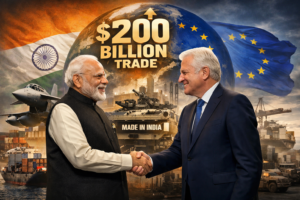
India has officially signed what many are calling the “Mother of All Deals” with the European Union. This landmark India-EU Free Trade Agreement (FTA) marks one of the biggest moments in India’s trade history and signals a new era of economic and strategic partnership between the two sides.
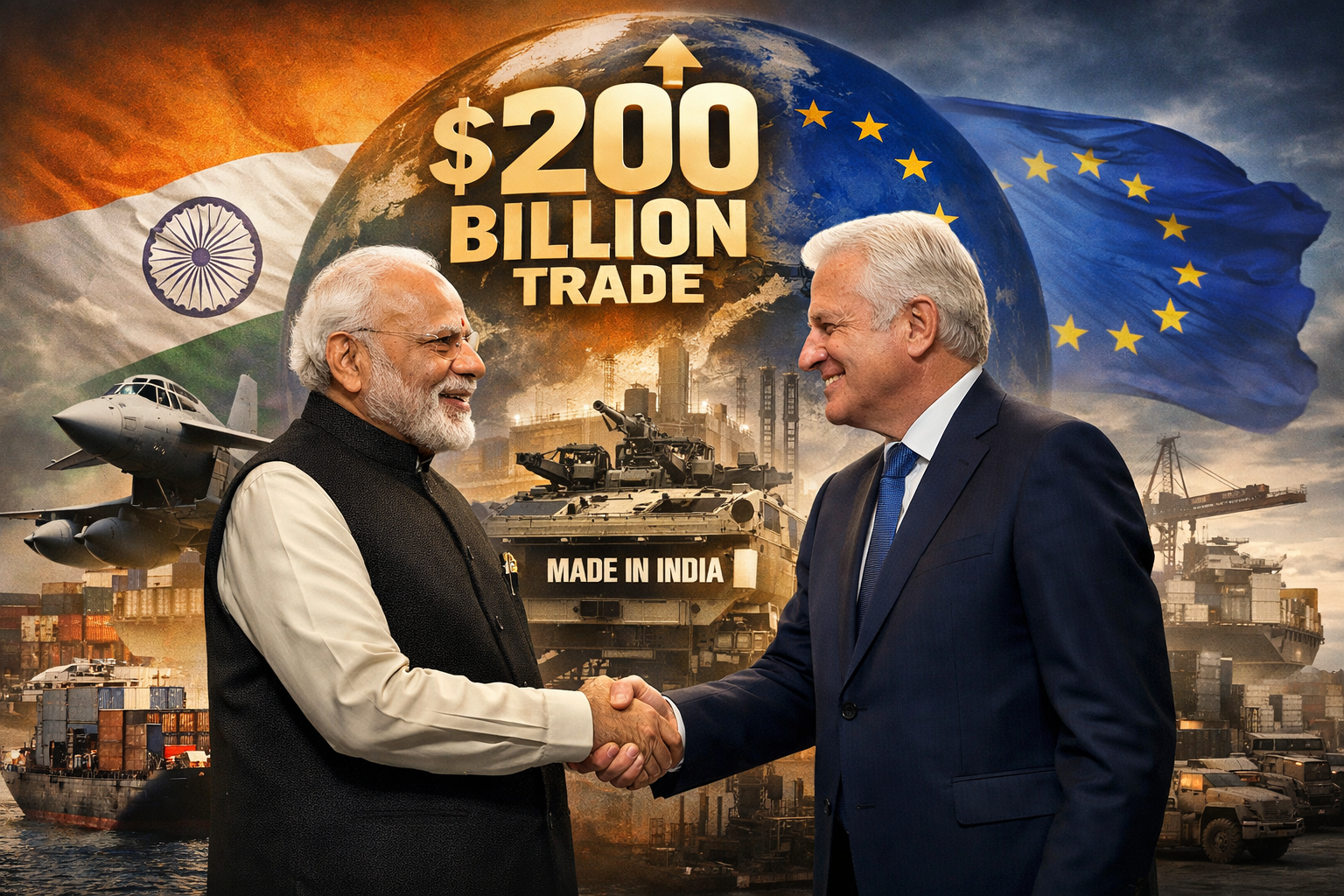
The announcement, highlighted by Prime Minister Narendra Modi, has already created waves across global markets, defence industries, and policy circles. With this deal, India-EU trade is projected to touch $200 billion in the coming years, reshaping global supply chains and strengthening India’s position as a manufacturing powerhouse.
What Is the “Mother of All Deals”?
The “Mother of All Deals” refers to the officially signed Free Trade Agreement between India and the European Union.
This agreement aims to:
-
Remove trade barriers
-
Boost bilateral commerce
-
Encourage large-scale investments
-
Promote manufacturing in India
-
Strengthen strategic and defence cooperation
Unlike previous trade pacts, this deal is being described as historic in scale and ambition.
Prime Minister Modi’s Big Announcement
Prime Minister Narendra Modi publicly announced the signing of this mega trade deal, calling it a turning point for India’s global economic engagement.
According to the announcement:
-
The agreement reflects India’s growing global influence
-
It aligns with the Make in India vision
-
It strengthens India’s long-term partnership with Europe
Modi’s statement underlined that this deal is not just about trade numbers but about economic sovereignty and strategic trust.
India-EU Trade Set to Reach $200 Billion
One of the biggest highlights of this agreement is the trade projection.
Experts and officials estimate that:
-
India-EU trade could reach $200 billion annually
-
Bilateral exports and imports will grow rapidly
-
Key sectors will see faster market access
This massive jump will make the European Union one of India’s most important trade partners.
European Arms to Be Made in India
A standout feature of this deal is defence manufacturing.
Under the agreement:
-
European defence companies will manufacture arms in India
-
Technology transfer will increase
-
Indian defence production capacity will expand
This move supports India’s goal of becoming self-reliant in defence while reducing dependence on imports.
Boost for Make in India Initiative
The trade agreement strongly supports the Make in India campaign.
Key benefits include:
-
Manufacturing facilities set up on Indian soil
-
Job creation across skilled and semi-skilled sectors
-
Local supply chain development
European companies will now see India as a preferred manufacturing hub, not just a consumer market.
Why This Deal Is Unique
The India-EU Free Trade Agreement stands out for several reasons.
1. Scale of the Agreement
This is one of the largest trade deals India has ever signed.
2. Strategic Depth
It goes beyond trade and includes defence, technology, and investment cooperation.
3. Long-Term Vision
The agreement focuses on future growth, not short-term gains.
This makes it a milestone in India’s trade policy.
Impact on Indian Economy
The economic impact of this deal is expected to be massive.
Higher Exports
Indian products will gain better access to European markets.
More Investments
European firms are likely to increase investments in India.
Stronger Manufacturing Base
Local production will reduce import costs and boost exports.
Overall, the deal strengthens India’s economic resilience.
What Europe Gains from the Deal
The European Union also benefits significantly.
-
Access to one of the world’s fastest-growing markets
-
Cost-effective manufacturing opportunities
-
Strategic partnership with a stable democracy
India offers Europe a reliable alternative amid global supply chain disruptions.
Defence and Strategic Cooperation
Defence manufacturing is only one part of a broader strategic alignment.
The agreement strengthens cooperation in:
-
Defence technology
-
Security partnerships
-
Geopolitical coordination
This partnership adds a strategic dimension to economic ties.
A New Chapter in India’s Trade Policy
The video announcing the deal emphasizes that this agreement marks a major shift in India’s trade approach.
India is now:
-
Signing deeper, high-impact trade agreements
-
Focusing on long-term partnerships
-
Positioning itself as a global manufacturing leader
This deal sets a template for future trade agreements.
What Comes Next?
While the signing is complete, many details will unfold over time.
According to the announcement:
-
More specifics will be discussed in future updates
-
Sector-wise impacts will become clearer
-
Implementation timelines will be revealed
Businesses and investors are closely watching the next steps.
Global Reaction to the Deal
The global response has been largely positive.
-
Markets see India as a rising trade power
-
Defence industries view India as a key production base
-
Analysts call it a game-changing agreement
The deal strengthens India’s image as a serious global economic player.
Challenges Ahead
Despite the excitement, challenges remain.
-
Implementation efficiency
-
Regulatory alignment
-
Balancing domestic and foreign interests
However, experts believe the long-term gains outweigh the short-term hurdles.
Why This Deal Matters for Ordinary Indians
This agreement is not just for governments and corporations.
For citizens, it means:
-
More jobs
-
Better infrastructure
-
Stronger economy
-
Higher global respect for Indian manufacturing
The benefits will gradually flow to multiple sectors of society.
Conclusion: A Historic Moment for India-EU Relations
The signing of the India-EU “Mother of All Deals” is a defining moment in modern Indian economic history.
With European arms to be made in India and trade expected to hit $200 billion, this agreement sets the stage for a powerful and long-lasting partnership.
As more details emerge, one thing is clear — India has arrived as a global trade and manufacturing force.