

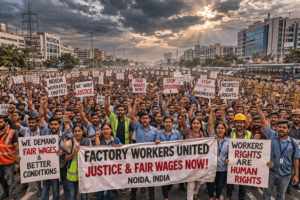

This was not a small-scale demonstration. It was a wake-up call — for factory owners, for policymakers, and for anyone paying attention to the widening gap between worker welfare and corporate profits in India.
What Happened? A Snapshot of the Noida Protest
The protest involved workers from factories and industrial units across Noida — one of India’s busiest manufacturing hubs. Their core demand was straightforward: a fair wage hike. But the scale of the turnout stunned observers.
- An estimated 40,000–45,000 workers participated in the protests.
- Demonstrations turned violent in several areas, with footage showing significant damage to vehicles and property.
- Factories were forced to temporarily shut down operations, disrupting supply chains.
- Fear and panic spread through nearby neighbourhoods, with residents describing scenes of chaos and destruction.
Videos circulating online painted a disturbing picture — burning vehicles, broken storefronts, and workers venting years of pent-up frustration. For many, this was not just about one wage revision. This was the result of years of suppressed grievances finally boiling over.
“This was not just about one wage revision. This was years of pent-up frustration finally boiling over.”
Why Is Noida a Hotspot? The Delhi NCR Inequality Puzzle
One question that instantly arises is: why Noida? Delhi NCR is a vast industrial region. Cities like Gurugram, Faridabad, and Ghaziabad also house large numbers of factory workers. Yet Noida continues to be the epicentre of labour unrest in the region. The answer lies in a mix of industrial density, poor labour governance, and a deeply fragmented workforce.
Gurugram, for instance, is dominated by the technology and services sector — industries where workers typically earn better salaries and enjoy some degree of job stability. Noida, on the other hand, remains a stronghold for garment manufacturing, electronics assembly, and other labour-intensive industries where margins are tight and wages are kept as low as possible.
This industrial composition makes Noida workers uniquely vulnerable. They are working in sectors that are directly competing in a brutal global market — and it is the workers who consistently end up paying the price.
The Unionization Problem: Why Noida Workers Have Less Power
At the heart of this crisis is a fundamental structural problem: Noida workers are severely under-unionized.
Across mature economies, trade unions serve as the primary tool through which workers negotiate wages, working conditions, and benefits. In Noida’s industrial belt, however, union membership remains disturbingly low. This means workers have almost no formal bargaining power when they sit across the table from employers.
What Weak Unionization Means in Practice
- Wages stagnate even as profits grow, because there is no organized collective body to push for revisions.
- Workers face exploitation in terms of overtime, unsafe conditions, and arbitrary dismissals, with no union to challenge management.
- Grievances build silently over months and years until they explode in unorganized, often violent mass protests — exactly as seen in this case.
- Without a union, workers lack legal protection against retaliatory firings for raising complaints.
The cruel irony is this: when workers are not organized, protests become the only language management is forced to listen to. And by then, the damage — to factories, to livelihoods, and to the economy — is already done.
The Global Competition Factor: China, Vietnam, and the Race to the Bottom
To understand why factory owners in Noida are so reluctant to raise wages, you need to zoom out and look at the global picture.
India’s manufacturing sector — particularly garments and electronics — competes fiercely with countries like China, Vietnam, Bangladesh, and Cambodia. In this race, the primary competitive advantage that Indian factories offer is low labour costs. The moment wages increase significantly, factory owners argue their products become more expensive and lose orders to competitors.
This logic, while understandable from a business perspective, creates a dangerous cycle. Workers are told year after year that wage hikes are impossible because the market won’t allow it. Over time, this narrative breeds resentment. Workers see the cost of living rise — rent, food, transport — while their salaries remain frozen. The breaking point, as Noida has now shown, is inevitable.
What this debate ultimately exposes is a flawed development model — one that treats workers as a cost centre rather than as the engine of economic growth. Countries like Vietnam have begun addressing this by building stronger social safety nets alongside their competitive manufacturing base. India needs to ask hard questions about whether it wants to win the race to the bottom, or build something more sustainable.
The Human Cost: What Workers Are Actually Demanding
It is easy to reduce this story to numbers — 40,000 protesters, a percentage wage increase demand, rupees per day. But behind those numbers are real people.
Most workers in Noida’s factories are migrants from Uttar Pradesh, Bihar, Jharkhand, and other states. They live in cramped rental accommodations, send a significant portion of their wages home to families, and often work 10 to 12-hour shifts in demanding physical conditions. A modest wage hike is not greed. It is the difference between barely surviving and living with a semblance of dignity.
That tens of thousands of such workers were driven to take to the streets — knowing full well the risks of police action, arrest, or job loss — tells you everything about how desperate the situation has become.
What Needs to Change: A Path Forward
The Noida protests are a symptom of deeper structural failures. Addressing them will require action at multiple levels:
- Stronger unionization: Workers need the right to organize freely, without fear of victimization. The government and civil society must actively support the growth of unions in industrial zones.
- Regular wage revision mechanisms: Wage boards and tripartite negotiations should be made more frequent and transparent, so that disputes do not reach boiling point.
- Linking wages to productivity and inflation: Workers should benefit automatically when companies profit and when the cost of living rises.
- Better labour law enforcement: Existing labour laws must be enforced more rigorously at the factory level, especially in Noida’s vast informal industrial sector.
Conclusion: Noida’s Workers Won’t Be Silenced Anymore
The Noida workers’ protest over the wage hike is one of the most significant labour events in India’s recent history. It lays bare the contradictions at the heart of India’s industrial economy — a nation that wants to be a global manufacturing powerhouse while simultaneously keeping its workers among the lowest paid in the world.
The violence and destruction witnessed during the protests are deeply unfortunate. But they are not surprising. When workers are left with no formal channels to express legitimate grievances, the streets become their parliament.
India’s economic ambitions will remain hollow unless the workers who power its factories are treated as partners in growth, not as line items on a cost sheet. Noida has spoken loudly. The question now is: is anyone listening?