

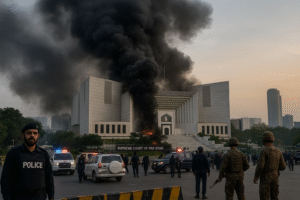

The attack has not only exposed Pakistan’s fragile security situation but also triggered a storm of political and military blame. From the streets of Islamabad to the corridors of power in Rawalpindi, questions are being raised about the leadership, military decisions, and the growing hostility along Pakistan’s borders.
The Islamabad Supreme Court Blast: A Wake-Up Call
The recent blast outside Pakistan’s Supreme Court sent shockwaves across the country. Dozens were injured, and several lives were lost in what appears to be one of the most daring attacks in Islamabad in years. Security forces quickly cordoned off the area, but the message was loud and clear — even the heart of Pakistan’s capital isn’t safe anymore.
This wasn’t an isolated act of terror. It comes amid a pattern of escalating violence that has gripped Pakistan over the last few months. From Khyber Pakhtunkhwa to Balochistan, extremist attacks are on the rise. The Islamabad blast, however, struck directly at the nation’s institutions — symbolizing a deeper, systemic breakdown.
Afghan Media’s Bold Claim: “Asim Munir Is Sacrificing Pakistanis”
What has truly sparked debate is the Afghan media’s reaction to the attack. Several Afghan outlets have accused Pakistan’s Army Chief, General Asim Munir, of using Pakistani citizens as “sacrificial pawns” to divert attention from border failures and avoid a larger confrontation with India.
According to these reports, Pakistan’s military leadership fears that a strong retaliation against cross-border insurgents could trigger a full-blown regional conflict — one that Pakistan may not be ready to handle. Hence, critics claim, the establishment is focusing inward while chaos brews on multiple fronts.
Afghan commentators have even gone as far as suggesting that the Islamabad blast was the consequence of Pakistan’s own covert policies backfiring. They accuse the Pakistani establishment of nurturing militant networks that are now turning against the state.
India Connection: The Cross-Border Chain of Violence
Interestingly, Afghan media drew parallels between the Islamabad bombing and a recent blast in India, suggesting that both incidents are connected to a broader regional power play.
Reports claim that after India’s bombing incident, tensions between New Delhi and Islamabad escalated quietly, with both nations accusing each other of sponsoring terror activities. Pakistan’s inability to control violence within its own borders, especially in its capital, has only added fuel to the fire.
Diplomatic relations between India and Pakistan were already icy, and now, these explosions — happening within days of each other — have reignited fears of another wave of cross-border hostility.
Taliban vs. Pakistan: From Allies to Adversaries
Perhaps the most alarming part of this entire situation is the growing rift between the Taliban regime and the Pakistani military. Once close allies, the two sides are now locked in a tense standoff along the Durand Line.
The Taliban government in Kabul has accused Pakistan of cross-border airstrikes targeting militant hideouts. Meanwhile, Pakistan insists that Afghan-based groups are launching attacks inside Pakistani territory — especially in Khyber Pakhtunkhwa and Balochistan.
This ongoing blame game has turned into an open confrontation. Taliban fighters have reportedly clashed with Pakistani border forces several times in recent weeks. Afghan officials now warn that any further incursion will be met with “direct military response.”
For Pakistan, this means it now faces not just internal terror threats but also growing hostility from across the western border — a nightmare scenario for its overstretched military.
Pakistanis Blame Everyone — India, Afghanistan, and Themselves
Public sentiment in Pakistan has turned bitter and divided. On social media, frustration is overflowing. Many citizens blame India for fueling unrest, while others accuse Afghanistan of harboring anti-Pakistan militants.
However, a rising number of voices are also turning inward — blaming their own leaders for mismanagement, poor intelligence coordination, and decades of flawed foreign policy. Critics argue that Pakistan’s reliance on militant proxies during the Afghan war era has now come full circle.
Protests have erupted in Karachi, Lahore, and Islamabad, demanding accountability from both the civilian government and the military establishment. The cry is clear: “Who will protect Pakistan if those in charge have lost control?”
Talks With Taliban: A Dead End
Negotiations between Pakistan and the Taliban have been ongoing but unproductive. Both sides accuse each other of dishonesty. Pakistan insists that Afghan soil is being used to shelter the Tehreek-e-Taliban Pakistan (TTP) — the group responsible for countless attacks inside Pakistan.
The Taliban, however, deny any direct involvement and demand that Pakistan deal with its “internal insurgents” instead of blaming Kabul. These failed talks have worsened relations and left Pakistan isolated diplomatically.
Without cooperation from Afghanistan, Pakistan’s counter-terrorism operations face significant challenges. The Islamabad blast, in this light, appears not only as a tragic attack but also as a symbol of diplomatic collapse.
The Bigger Picture: Pakistan’s Security Crisis
When viewed together — the Islamabad blast, the Taliban tensions, the India accusations — it paints a disturbing picture. Pakistan is fighting on multiple fronts:
-
Internal instability, driven by terrorism and political divisions.
-
Border tensions with both Afghanistan and India.
-
Economic breakdown, limiting resources for national security.
The military’s heavy involvement in politics has further eroded trust. As citizens lose faith in both the government and the army, extremist groups find more space to operate.
The Road Ahead: Can Pakistan Avoid Total Collapse?
To escape this crisis, Pakistan must act decisively. Strengthening internal security, improving intelligence sharing, and opening genuine diplomatic channels with both Kabul and New Delhi are essential.
However, this requires something Pakistan’s political elite have long avoided — unity and accountability. Without these, every new blast, every new attack, will only drag the nation closer to chaos.
The Islamabad blast was not just an explosion — it was a signal. A signal that Pakistan’s internal conflicts, if left unchecked, could ignite a regional disaster.
Conclusion: A Nation at a Crossroads
Pakistan stands at a dangerous crossroads. The Islamabad blast has once again reminded the world that the country’s biggest threat may no longer be external — but internal.
Between the Taliban’s aggression, India’s suspicions, and its own political paralysis, Pakistan’s stability hangs by a thread. General Asim Munir and the leadership in Islamabad must realize that continuing down this path could push the nation into a full-scale conflict it cannot afford.
The question now is not if Pakistan will face another attack — but whether it can prevent the next one before it’s too late.