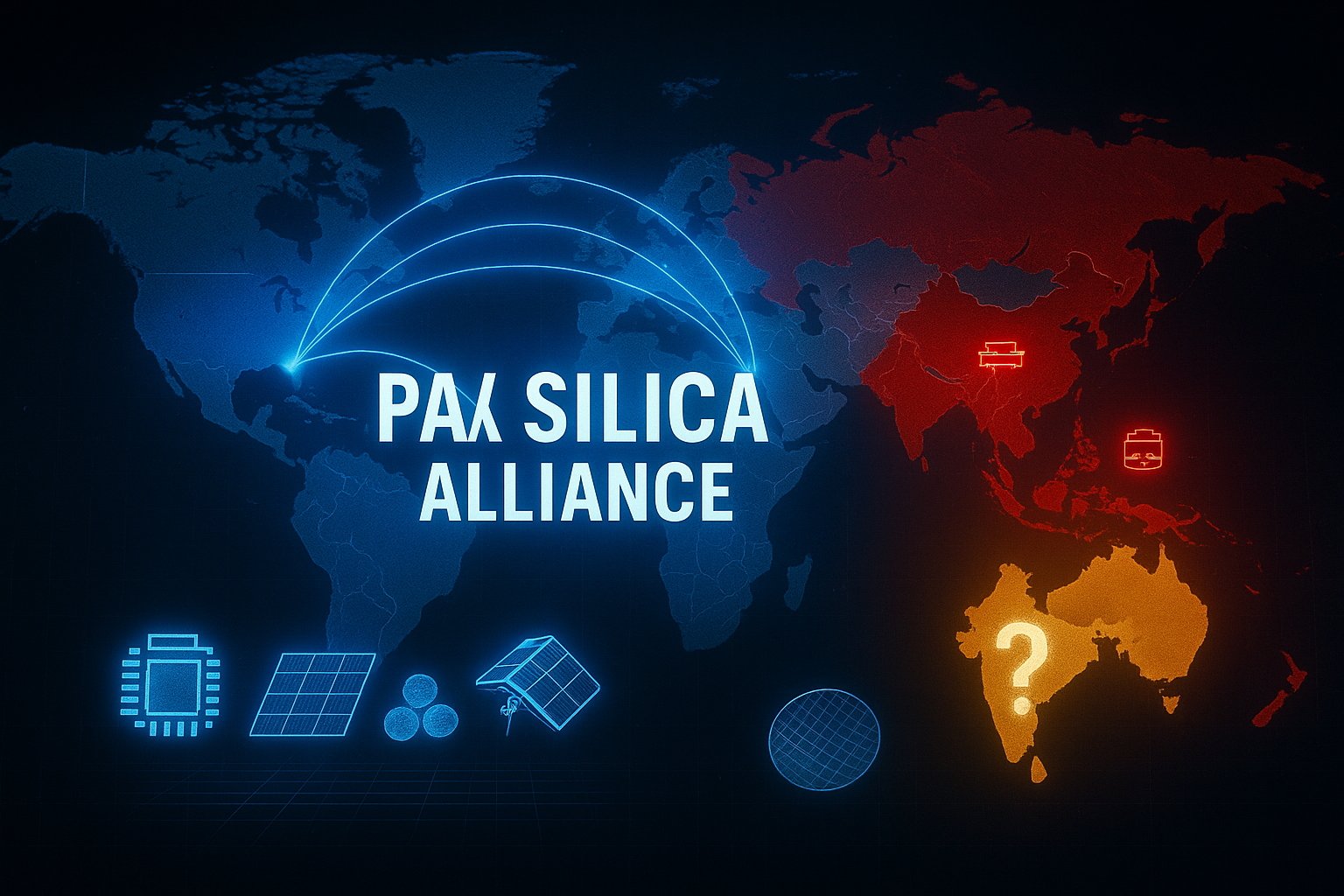
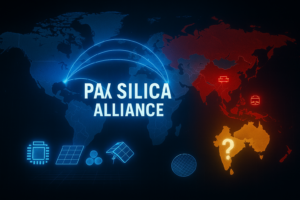
The global race for critical minerals is heating up fast. These minerals power everything from semiconductors and solar panels to electric vehicles and advanced defense systems. In this rapidly changing landscape, the United States has announced a new strategic coalition called “Pax Silica.”
However, one major development has caught global attention.
India is not part of this new alliance.
This exclusion has raised serious questions about geopolitics, supply chains, and India’s role in the future of critical mineral security.
This article explains what Pax Silica is, why it matters, and what India’s absence could mean.
What Is Pax Silica?
Pax Silica is a newly formed US-led coalition focused on critical minerals that are essential for modern technology.
The term “Pax” historically refers to peace through dominance or cooperation, while “Silica” symbolizes the foundation of modern digital economies, especially chips and clean energy technologies.
The core idea behind Pax Silica is simple:
👉 Peace through economic and technological cooperation.
Instead of military alliances, this coalition focuses on securing supply chains that power the modern world.
Why Critical Minerals Matter Today
Critical minerals are not ordinary resources.
They are the backbone of:
-
Semiconductors
-
Solar panels
-
Electric vehicle batteries
-
Wind turbines
-
Defense and aerospace systems
-
Artificial intelligence hardware
Without steady access to these minerals, no country can maintain technological leadership.
This is why Pax Silica is strategically important.
The Main Objective of Pax Silica
The primary goal of Pax Silica is to reduce global dependence on China.
China currently dominates the mining, refining, and processing of many critical minerals. This gives Beijing enormous leverage over global supply chains.
The US and its allies see this as a strategic risk.
Pax Silica aims to:
-
Diversify supply chains
-
Strengthen cooperation among trusted partners
-
Ensure long-term mineral security
-
Reduce geopolitical vulnerabilities
A Coalition Beyond One Mineral
One important aspect of Pax Silica is its broad scope.
Unlike earlier initiatives that focused on specific materials like lithium or rare earth elements, Pax Silica covers multiple critical minerals.
These include:
-
Silicon-related materials
-
Rare earth elements
-
Battery minerals
-
Semiconductor-grade resources
This comprehensive approach makes the coalition more powerful and future-ready.
Countries Included in Pax Silica
While the US has not publicly released a full list, the coalition reportedly includes countries that already have:
-
Strong technological ecosystems
-
Established supply chain partnerships with the US
-
Existing economic and security frameworks
These nations are already working closely with Washington on trade, technology, and industrial policy.
This makes Pax Silica a natural extension of existing cooperation.
India’s Absence Raises Questions
India’s exclusion from Pax Silica has surprised many analysts.
India is:
-
One of the world’s largest economies
-
A major technology hub
-
A key strategic partner of the US in the Indo-Pacific
-
Actively building its semiconductor and clean energy sectors
Yet, it is not part of this alliance.
This raises an important question:
👉 Why was India left out?
Possible Reasons India Was Excluded
There is no official explanation yet, but experts suggest several reasons.
1. Limited Critical Mineral Processing Capacity
While India has mineral resources, it lacks large-scale refining and processing infrastructure compared to other members.
Supply chain readiness is a key factor for inclusion.
2. Policy and Regulatory Challenges
Frequent policy changes, land acquisition issues, and environmental clearances can slow down mining and processing projects.
This may have raised concerns among coalition planners.
3. Strategic Hesitation
The US may prefer to move fast with countries that already have deep operational integration in critical mineral supply chains.
India may be seen as a future partner, rather than a ready one.
What Pax Silica Means for China
Pax Silica is clearly designed to counter China’s dominance.
China controls a significant share of:
-
Rare earth processing
-
Battery material refining
-
Silicon supply chains
By creating an alternative ecosystem, the US hopes to reduce global reliance on China.
This is not just an economic move.
It is a geopolitical strategy.
Ongoing Cooperation Among Member Countries
The video highlights that Pax Silica is not starting from scratch.
Member countries already cooperate on:
-
Technology transfers
-
Supply chain security frameworks
-
Industrial policy coordination
-
Research and development
This makes the coalition stronger and more efficient from day one.
Why This Matters for India
India’s absence from Pax Silica is not just symbolic.
It has real implications.
Impact on Semiconductor Ambitions
India is investing heavily in chip manufacturing. Without access to trusted mineral supply chains, progress could be slower.
Missed Strategic Opportunity
Being part of Pax Silica would have placed India at the center of future technology alliances.
Wake-Up Call for Policy Reform
The exclusion highlights the need for faster reforms in mining, processing, and industrial policy.
Can India Still Join Pax Silica?
The door may not be permanently closed.
India can still position itself as a future member by:
-
Accelerating mineral processing capacity
-
Strengthening supply chain partnerships
-
Offering policy stability
-
Aligning industrial standards with global partners
Strategic alliances evolve, and India’s importance cannot be ignored for long.
Pax Silica and the Future of Global Power
Pax Silica represents a shift in how power is exercised globally.
Instead of tanks and missiles, control over materials and technology defines influence.
Countries that control supply chains will shape the future.
Those left out risk falling behind.
Final Thoughts
Pax Silica is more than an alliance.
It is a statement about the future of global cooperation, technology, and power.
India’s exclusion should be viewed not as a setback, but as a signal.
A signal that:
-
Supply chain strength matters
-
Policy readiness matters
-
Execution matters
If India wants a seat at the table of future global alliances, action is needed now.
The race for critical minerals has begun.
And the world is watching closely.