
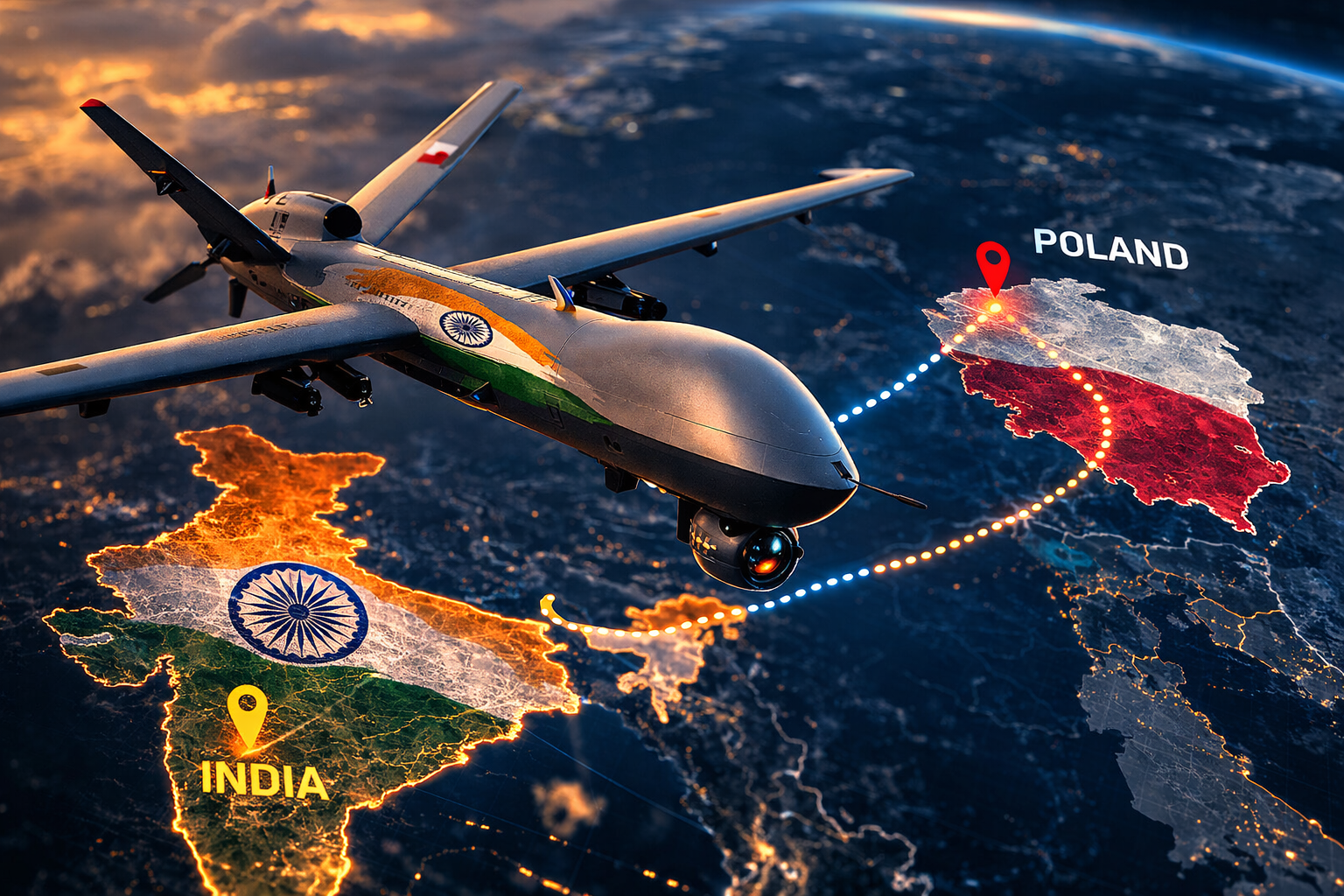
Operation Sindoor changed the way the world looks at modern warfare — and at India. As drones proved decisive on the battlefield, global powers are now scrambling to rethink their defence partnerships. Poland is the latest country turning its eyes toward India, and what it sees is a nation on the verge of becoming a drone powerhouse.
Why Drones Are the New Game-Changer in Modern Warfare
 Not long ago, a multi-million dollar fighter jet was the ultimate symbol of air superiority. Today, a drone costing a few thousand dollars can take one down. That shift is not theoretical — it is happening in real conflicts across the world.
Operation Sindoor brought this reality home. India deployed precision drones that disrupted enemy positions with speed and accuracy that no conventional aircraft could match at the same cost. The global defence community took note immediately.
The economics of drone warfare are impossible to ignore. Governments and militaries that once invested billions in traditional air power are now asking a harder question: why spend so much when drones can deliver equal — or greater — results at a fraction of the price?
Where Does India Stand? Understanding the Tier System
Global drone production is unofficially ranked in tiers. Tier 1 includes the United States, Israel, and China — countries with decades of advanced drone development, massive R&D budgets, and battle-tested technology.
India currently sits in Tier 2, alongside Turkey, Iran, and Ukraine. This is not a criticism — it is a starting point. Turkey’s Bayraktar TB2 went from a domestic project to one of the most talked-about combat drones on the planet within a few years. Iran has used drones strategically in proxy conflicts across the Middle East. Ukraine rapidly built and deployed its own drone fleet under wartime pressure.
India is still in its early stages compared to these peers — but the direction is clear, and the pace is accelerating.
Poland’s Interest: What Operation Sindoor Triggered
Poland is one of Europe’s most serious defence spenders. Sharing borders with both Russia and Belarus, and being a frontline NATO state, Poland does not treat military readiness as a budget line — it treats it as a national priority.
After Operation Sindoor showcased India’s drone capabilities, Polish defence officials and analysts began looking at India not just as an emerging economy, but as a credible defence manufacturing partner. The conversations around co-production, technology transfer, and joint ventures have moved from diplomatic pleasantries to serious discussions.
For Poland, partnering with India offers a distinct advantage: lower production costs, a growing engineering talent pool, and a government that has made defence exports a foreign policy priority. India’s Make in India initiative and the push under iDEX (Innovations for Defence Excellence) have created an ecosystem that Poland wants access to.
India’s Secret Weapon: Entrepreneurs, Not the Government
Here is something the international press often gets wrong about India’s defence rise: it is not being driven by government efficiency. The honest truth is that government support for businesses in India remains inconsistent, bureaucratic, and slow.
What is driving India’s drone growth is the raw capability and hunger of its entrepreneurs. Once Indian startups identified a real market need — especially after conflicts like Operation Sindoor — the speed at which they adapted, built, and shipped was extraordinary.
This pattern is now well-established across Indian industries:
- Identify the gap or the threat
- Build fast with limited resources
- Scale rapidly once the demand is proven
- Gain global recognition through results, not marketing
Indian drone companies like ideaForge, Garuda Aerospace, and Throttle Aerospace Systems are already winning international attention. That recognition is what Poland and other NATO-aligned countries are responding to.
The Startup Opportunity: Why This Moment Is Different
India’s drone sector is not just a defence story. It is one of the most significant startup opportunities of this decade. The demand is coming from multiple directions at once:
- Military procurement for surveillance, strike, and logistics drones
- Agriculture — drone spraying has already transformed farming in parts of Haryana and Punjab
- Logistics and last-mile delivery in tough terrains
- Infrastructure inspection — power lines, pipelines, and railways
- Export partnerships with countries like Poland seeking cost-effective production
The Production Linked Incentive (PLI) scheme for drones, launched in 2021, has already brought over ₹200 crore in investments and created thousands of jobs. But experts argue this is barely scratching the surface of what is possible.
What India Needs to Move From Tier 2 to Tier 1
India’s jump to Tier 1 is not guaranteed — it must be earned. Three things will determine whether the country makes that leap:
1. Consistent Government Policy
Entrepreneurs cannot build long-term businesses on shifting regulations. Clear, stable drone policy — including airspace rules, export norms, and certification pathways — will determine whether Indian startups scale domestically or go abroad.
2. Deep Tech Investment
Most Indian drone companies still depend on imported components — motors, sensors, flight controllers. Building indigenous supply chains for these critical parts will be the difference between assembling drones and truly manufacturing them.
3. Global Partnerships
Poland’s interest is an opportunity, not just a compliment. Joint ventures, technology transfers, and co-production deals will bring capital, expertise, and international credibility to Indian drone companies that are ready to operate at scale.
Final Thoughts: India’s Drone Moment Has Arrived
Operation Sindoor did more than demonstrate military capability — it sent a signal to the world that India is serious about defence manufacturing. Poland’s interest in drone co-production is one of the first major responses to that signal, and it will not be the last.
For Indian entrepreneurs, this is exactly the kind of inflection point that has historically unlocked India’s greatest industrial surges. The smartphone ecosystem, the IT outsourcing boom, the fintech revolution — each began with a gap that Indian talent rushed to fill faster than anyone expected.
Drones are next. The gap is visible, the demand is real, and the world is watching. The only question is: which Indian startups will rise to build the future?