

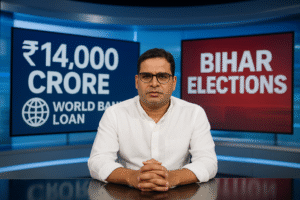
The allegation has triggered discussions across political, media, and public circles, especially because it questions the transparency of pre-poll welfare activities.

In this article, we break down the details, the claims, and the political context—while keeping it simple, factual, and SEO-friendly.
Jan Swaraj’s Performance in the Bihar Elections
Prashant Kishor’s political movement, Jan Swaraj, entered the Bihar elections with major expectations.
Before the polls, Kishor had confidently stated that his party should win at least 160–170 seats. This statement created a wave of optimism among his supporters and boosted the party’s public visibility.
However, the election results told a completely different story.
Jan Swaraj failed to win even a single seat, surprising political analysts and supporters who expected a strong debut.
This gap between expectations and results became a major point of criticism for Kishor’s political credibility.
Kishor’s High Expectations vs Ground Reality
Kishor is known not only as a political strategist but also as someone who understands voter behavior, campaign planning, and social dynamics.
That is why his prediction of winning 160–170 seats became a talking point in Bihar.
But the final outcome revealed that the party could not convert its claims into actual votes.
This discrepancy led many observers to question whether Kishor miscalculated public sentiment or whether the ground-level reach of Jan Swaraj was overestimated.
The disappointing result has now become the backdrop of his latest allegations.
The ₹4,000 Crore Freebies Controversy
Another major claim from the Jan Swaraj camp centers on election spending by the NDA alliance.
According to the party, the NDA government spent a staggering ₹4,000 crores on freebies during the election campaign.
These alleged freebies reportedly included cash transfer schemes, welfare announcements, and benefits distributed just before voting.
Kishor and his party argue that such massive spending had a significant influence on the election outcome.
They also suggest that this spending created an uneven playing field, making it extremely difficult for new political groups like Jan Swaraj to compete.
However, no independent verification of the ₹4,000 crore figure has been presented so far.
Kishor’s Most Explosive Claim: Diversion of ₹14,000 Crore World Bank Loan
At the center of the controversy is Prashant Kishor’s most serious allegation.
He claims that a ₹14,000 crore World Bank loan, allocated to Bihar for developmental projects, was diverted for pre-election cash transfer schemes.
These schemes were reportedly launched just before the elections, raising questions about their timing and intent.
If true, this would be a major misuse of international development funds.
The World Bank usually allocates funds for long-term infrastructure, poverty reduction, and social development—not short-term political gain.
Kishor alleges that the government strategically redirected these funds to influence voters and secure electoral advantage.
But there is a critical issue: Kishor himself has not provided concrete evidence to prove these allegations.
Questions Raised in the Video
The video containing Kishor’s accusations has sparked intense debate. It raises several key questions:
-
Was the World Bank loan truly diverted to election schemes?
-
Why were cash transfer programs launched so close to the election date?
-
Is the allegation politically motivated after Jan Swaraj’s electoral failure?
-
Shouldn’t such a claim be backed by documents, financial reports, or official statements?
-
What responsibility does Kishor hold when making such serious accusations without proof?
The lack of verifiable evidence has allowed both sides to frame the narrative in their favor.
Why the Allegation Matters
Even without proof, the allegation matters because of its scale and impact.
A diversion of ₹14,000 crores—if true—would indicate massive financial irregularities.
Such funds are intended to improve:
-
Education
-
Healthcare
-
Rural development
-
Infrastructure
-
Jobs and livelihood programs
Using them for election spending could severely damage public trust in governance.
World Bank projects also involve strict auditing and monitoring.
If any misappropriation occurred, it could lead to penalties, withdrawal of future loans, or reputational damage for the state government.
This is why Kishor’s allegation is being taken seriously, even though concrete evidence has not been presented.
Political Motives or Genuine Concern?
Some political observers believe Kishor is raising these issues out of frustration after Jan Swaraj’s poor performance.
According to this perspective, the allegations may be part of an attempt to stay relevant in political discourse.
On the other hand, Kishor has claimed that he is highlighting corruption because he believes Bihar deserves better transparency and governance.
Supporters of Jan Swaraj argue that Kishor is raising concerns that mainstream parties ignore.
Both interpretations are shaping the ongoing conversation.
Role of Freebies in Election Politics
The discussion also reflects a broader national debate:
Do freebies influence elections?
And if yes, should they be regulated?
Many political parties across India rely on welfare schemes and pre-poll announcements to secure voter support.
While some programs genuinely help people, others raise ethical concerns when introduced strategically before elections.
Kishor’s claim that ₹4,000 crores were spent on freebies fits into this larger discussion about electoral integrity.
Public Reaction to the Allegations
Public reaction has been mixed.
Some people believe Kishor is exposing a hidden misuse of funds and demanding accountability.
Others feel that he is venting frustration after Jan Swaraj’s electoral failure and is making claims without proof.
Many citizens also question the timing of his statement—why were these allegations not made earlier or backed with documents?
The debate continues to grow on social media, where videos, analysis, and opinion pieces are spreading rapidly.
World Bank’s Expected Response and Verification
If the World Bank loan was truly misused, the organisation is likely to:
-
Audit the loan disbursement
-
Seek clarification from the Bihar government
-
Freeze or alter future funding
-
Demand a public explanation
However, until an official investigation begins, these outcomes are only possibilities.
As of now, there has been no official reaction from the World Bank or any central authority regarding Kishor’s claims.
The Need for Transparency in Election Funding
The controversy highlights a major gap in election financing transparency.
India still faces challenges when it comes to public accountability and disclosure of how funds are used during campaigns.
If pre-poll welfare schemes are being funded through international development loans, the public has a right to know.
Whether Kishor’s allegations are true or not, they underline the need for:
-
Better auditing of public funds
-
Clear separation between welfare policy and election strategy
-
Transparent reporting of government spending
-
Strict norms against misusing foreign loans
These reforms could help prevent future controversies.
Conclusion
Prashant Kishor’s claim that ₹14,000 crore World Bank funds were diverted for Bihar elections is one of the biggest allegations in recent political discourse.
Combined with Jan Swaraj’s own election failure, the ₹4,000 crore freebies claim, and the lack of direct evidence, the issue is both complex and controversial.
While the truth remains unverified, the debate is crucial for the future of election transparency in India.
Bihar’s political landscape continues to evolve, and Kishor’s statements—true or not—have added a new layer to the conversation.
This controversy will likely stay in public discussion until independent agencies or the World Bank offer clarity.