

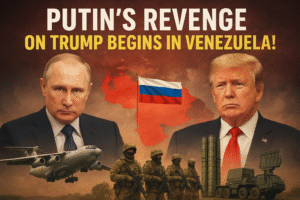

Russia’s Strategic Move: The Beginning of a New Front
The situation in Venezuela is not just a local crisis anymore—it’s evolving into a battleground of influence between Washington and Moscow. According to intelligence sources, Putin’s strategy is to challenge U.S. dominance close to its own backyard.
The move comes after years of rising tension between Donald Trump and Vladimir Putin, where sanctions, oil politics, and NATO expansion created serious friction. Now, Venezuela has become Russia’s ideal ground to demonstrate strength without engaging the U.S. directly.
By sending military hardware and personnel to Venezuela, Putin is sending a clear message — Russia is willing to project power far beyond its borders and retaliate through smart, indirect warfare.
Arrival of Wagner Group Mercenaries in Venezuela
One of the most significant developments is the arrival of the Wagner Group, Russia’s well-known private military contractor. These mercenaries have already been active in Ukraine, Syria, and several African countries, known for executing Moscow’s shadow operations abroad.
Their deployment to Venezuela suggests that Russia is preparing for long-term influence and possibly combat readiness in the region. The Wagner Group’s presence ensures that Russia can operate covertly, supporting Venezuelan forces while denying any official involvement if tensions rise.
For many experts, this marks a dangerous escalation, indicating that Venezuela could soon turn into a military and geopolitical outpost for Moscow in the Western Hemisphere.
Continuous Arrival of Russian IL-76 Cargo Planes
Adding to the growing concern are Russian IL-76 cargo planes, which have been landing frequently at Venezuelan airbases. These large transport aircraft are capable of carrying heavy equipment, armored vehicles, and troops.
Satellite imagery and tracking reports show a steady flow of Russian flights, suggesting an organized and large-scale operation.
The supplies reportedly include ammunition, communication systems, and maintenance equipment for Venezuelan air defense networks. Each landing adds to the suspicion that Russia is building a long-term logistical chain — not just for aid, but for strategic deployment.
For the Trump administration, this is a clear provocation. The U.S. has already imposed sanctions on Venezuela, and the increasing Russian military presence only deepens Washington’s concerns.
Deployment of Advanced Air Defense Systems – S-300 and Radars
One of the most alarming aspects of Russia’s involvement is the deployment of advanced air defense systems, including the powerful S-300 missile batteries and radar systems.
The S-300 is a formidable weapon, capable of tracking and shooting down multiple aircraft and missiles simultaneously. Its presence in Venezuela dramatically alters the balance of power in the region.
Reports suggest that Russian specialists are helping Venezuelan crews operate these systems, turning the country into a fortified anti-aircraft zone.
For the United States, this complicates any future plans for air operations or military intervention. The S-300 effectively gives Venezuela — and indirectly, Russia — a defensive shield against U.S. air superiority.
The inclusion of advanced radar systems also means Russia can monitor U.S. naval and aerial movements throughout the Caribbean and northern South America. It’s a major strategic intelligence advantage for Moscow.
Escalation Risks: The U.S. Response and Trump’s Dilemma
The U.S. has already conducted multiple air and sea operations near Venezuelan waters, often claiming they are aimed at curbing drug trafficking or supporting humanitarian efforts. However, Russia views these as thinly disguised acts of aggression.
With the arrival of Russian forces and weapons, the possibility of direct confrontation between the two superpowers has increased.
For Donald Trump, this creates a dilemma. On one hand, his administration wants to maintain a strong stance against Maduro’s regime and Russian interference. On the other, engaging Russia militarily in the Americas could lead to a dangerous escalation.
Washington now faces a strategic challenge — how to respond without triggering a new Cold War.
Why Venezuela Matters to Russia
Venezuela holds immense geopolitical and economic value for Moscow. It’s not just about challenging the U.S.; it’s about securing energy partnerships, defense contracts, and regional influence.
Russia has long been a supporter of Nicolás Maduro’s government, providing loans, weapons, and oil investments. By strengthening its military ties, Russia ensures access to Venezuela’s vast oil reserves and establishes a strong ally close to U.S. territory.
In addition, Venezuela gives Russia a critical listening post for intelligence gathering across Latin America. The installation of radar systems allows Moscow to monitor U.S. activities throughout the region — a strategic edge similar to what the U.S. has near Russia’s borders.
Putin’s Proxy Warfare: A New Global Strategy
Rather than engaging the U.S. directly, Putin’s revenge strategy revolves around proxy warfare — using allied states and private military groups to counter U.S. power.
This approach mirrors Russia’s tactics in Syria, Libya, and parts of Africa, where it has effectively expanded its influence while avoiding direct military confrontation.
By replicating this model in Venezuela, Russia not only tests U.S. resolve but also demonstrates its ability to operate globally, challenging American hegemony on multiple fronts simultaneously.
For Moscow, this is a long-term chess game, and every move is meant to undermine Washington’s dominance without crossing the line into open conflict.
The Bigger Picture: Rising Global Tensions
The developments in Venezuela are part of a larger geopolitical realignment. Russia, China, Iran, and North Korea are increasingly coordinating to counterbalance U.S. influence worldwide.
Venezuela now stands as a symbol of this global resistance. By hosting Russian military assets, it becomes a platform for demonstrating multipolar power — a direct challenge to the unipolar world order dominated by Washington.
For Trump and future U.S. leaders, managing this emerging bloc will require careful diplomacy, strong alliances, and strategic patience.
Conclusion
The unfolding scenario in Venezuela shows that Putin’s revenge on Trump is not about words—it’s about action. Through the Wagner Group, IL-76 supply missions, and the deployment of S-300 systems, Russia has firmly planted its flag in the Western Hemisphere.
This move is more than symbolic — it represents a bold shift in Russia’s global posture, turning Venezuela into the next major flashpoint in U.S.–Russia relations.
As tensions rise, one thing is clear: the new Cold War is no longer confined to Europe or the Middle East — it’s now knocking on America’s southern doorstep.