

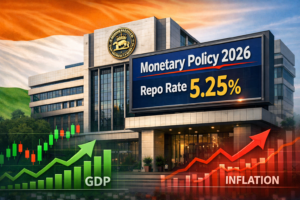

This policy is especially important because it comes right after the Union Budget announcement.
Investors, home loan borrowers, businesses, and bank customers were expecting big changes.
But the Reserve Bank of India (RBI) surprised many by keeping the repo rate unchanged at 5.25%.
So what does this mean for your loans, EMIs, inflation, and India’s growth?
Let’s break it down in simple words.
What is RBI Monetary Policy?
The RBI Monetary Policy is the central bank’s strategy to control:
-
Inflation
-
Interest rates
-
Money supply
-
Economic growth
The policy is decided by the Monetary Policy Committee (MPC).
It directly affects:
-
Home loan EMIs
-
Car loans
-
Personal loans
-
Savings interest
-
Business investments
In short, it impacts everyone.
Repo Rate 2026: No Change at 5.25%
The biggest highlight of the policy is simple.
👉 Repo rate remains at 5.25%.
There is no cut and no hike.
What is Repo Rate?
Repo rate is the interest rate at which banks borrow money from the RBI.
If repo rate falls → Loans become cheaper → EMIs go down
If repo rate rises → Loans become expensive → EMIs go up
Since the rate is unchanged, EMIs will remain the same for now.
Why Did RBI Not Reduce the Repo Rate?
Many people expected a rate cut.
A lower repo rate would have:
-
Reduced EMIs
-
Increased spending
-
Boosted demand
But the RBI chose a cautious approach.
Reasons behind this decision:
-
Inflation risks still exist
-
Global economic uncertainty
-
Oil price volatility
-
Need for financial stability
The RBI wants to control inflation first, then focus on rate cuts later.
This shows that stability is more important than short-term relief.
Impact on Home Loan Borrowers
If you have a home loan, you might feel disappointed.
Since the repo rate is unchanged:
-
EMIs will not decrease
-
Loan interest stays the same
-
No immediate savings
However, there is also good news.
Rates are not increased, so there’s no extra burden.
Borrowers can plan finances without sudden surprises.
RBI Focus on Inflation Control
Inflation is one of the biggest challenges for the economy.
When prices rise too fast:
-
Household expenses increase
-
Savings reduce
-
Purchasing power falls
The RBI’s main goal is to keep inflation under control.
Why controlling inflation matters?
Stable inflation means:
-
Affordable food and fuel
-
Better savings
-
Stronger economy
-
More investments
That’s why the RBI avoided a rate cut for now.
Too much liquidity can push prices higher.
GDP Growth Rate Revised Upward
Now comes the positive side of the story.
The RBI has increased India’s growth forecast.
New GDP projection:
👉 7.3% growth for the current financial year
This is a strong number compared to many global economies.
What does this mean?
Higher growth means:
-
More jobs
-
Better business performance
-
Higher income levels
-
Stronger market confidence
India continues to be one of the fastest-growing major economies in the world.
This is great news for investors and entrepreneurs.
Support for Bank Customers
The RBI also announced measures to help bank customers.
These steps aim to:
-
Improve banking services
-
Protect customer interests
-
Strengthen financial security
Banks are being encouraged to:
-
Offer better transparency
-
Resolve complaints faster
-
Provide smoother digital banking
This improves the overall customer experience.
Focus on Urban Cooperative Banks
Another key highlight is support for Urban Cooperative Banks (UCBs).
These banks serve:
-
Small businesses
-
Local traders
-
Middle-class families
Strengthening them means:
-
Better credit access
-
More small business loans
-
Stronger local economies
This move helps grassroots financial growth.
How This Policy Affects Different Groups
Let’s see who benefits and how.
Home Loan Borrowers
No EMI reduction yet, but no increase either.
Businesses
Stable rates mean predictable borrowing costs.
Investors
Higher GDP growth boosts confidence in markets.
Bank Customers
Better protection and services expected.
Small Businesses
More support through cooperative banks.
Overall, the policy focuses on balance and stability.
Why Understanding RBI Decisions is Important
Many people ignore monetary policy updates.
But these decisions directly affect your money.
They influence:
-
Your loan EMIs
-
Fixed deposit returns
-
Job market
-
Property prices
-
Stock market
That’s why understanding repo rate, inflation, and GDP growth is important.
These three indicators shape India’s economy.
Expert View: What to Expect Next?
Economists believe:
-
If inflation falls → Repo rate cuts may happen later
-
If prices rise → RBI may stay cautious
Future policies depend on:
-
Global markets
-
Oil prices
-
Domestic inflation
-
Economic performance
So, rate cuts are possible, but not guaranteed.
Key Takeaways from RBI Monetary Policy 2026
Here’s a quick summary:
-
Repo rate unchanged at 5.25%
-
No EMI relief yet
-
Inflation control remains priority
-
GDP growth raised to 7.3%
-
Support for bank customers
-
Focus on urban cooperative banks
-
Cautious but growth-friendly approach
The RBI is choosing long-term stability over short-term excitement.
Final Thoughts
The RBI Monetary Policy 2026 may not have brought the rate cut many borrowers hoped for.
But it sends a clear message.
India’s economy is growing strong, and stability is the main goal.
By keeping inflation under control and improving financial systems, the RBI is building a solid foundation for future growth.
If inflation cools down in the coming months, rate cuts may follow.
Until then, expect steady and careful decisions.
For now, the focus is simple:
👉 Control prices, support growth, protect customers.
That’s the RBI’s game plan for 2026.
FAQs on RBI Monetary Policy 2026
Q1. What is the repo rate in RBI Monetary Policy 2026?
The RBI has kept the repo rate unchanged at 5.25% to maintain economic stability and control inflation.
Q2. Will EMIs decrease after this policy?
No. Since the repo rate is unchanged, home loan and personal loan EMIs will remain the same.
Q3. Why did RBI not cut the repo rate?
The RBI wants to control inflation and ensure financial stability before reducing interest rates.
Q4. What is India’s GDP growth forecast for 2026?
The RBI has revised GDP growth upward to 7.3%, showing strong economic performance.
Q5. How does monetary policy affect common people?
It impacts loan EMIs, savings interest, inflation, and overall job and business opportunities.