


For a country like India, which imports a large portion of its oil, any instability in the Middle East can create major economic pressure.
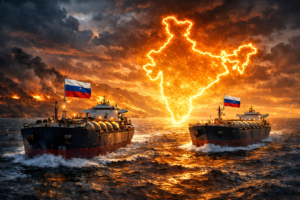
However, in the middle of this crisis, Russia has stepped forward with support. Reports suggest that Russian cargo ships loaded with crude oil are heading towards India after changing their original routes.
This development could have a big impact on India’s energy security, global diplomacy, and oil prices.
Let’s understand the situation in simple terms.
US–Iran War Escalates in the Middle East
The ongoing war between Iran and the United States has quickly become one of the most serious conflicts in the region in recent years.
Recent reports indicate that:
-
More than 900 people have already lost their lives.
-
Thousands more could be affected if the conflict continues.
-
Military strikes and missile attacks are increasing across several areas.
The situation is becoming more dangerous every day.
The Middle East is one of the most important regions for global oil production. When a conflict breaks out here, it directly affects energy markets around the world.
Because of this, countries that depend on imported oil — like India, Japan, and many European nations — start feeling the pressure immediately.
India Is Not Immune to the Conflict
Although the war is happening far from India, its impact is already being felt.
Reports suggest that Indian citizens living or working in affected regions are also facing danger. Some Indians have reportedly become casualties of ongoing attacks.
India has thousands of citizens working across the Middle East in sectors like:
-
Construction
-
Shipping
-
Oil and gas
-
Healthcare
-
Trade
Whenever tensions rise in this region, the safety of Indian nationals becomes a major concern for the government.
Apart from human safety, the bigger challenge for India is energy supply.
India imports more than 85% of its crude oil, and a large portion of that traditionally comes from the Middle East.
If the conflict disrupts oil supply routes, fuel prices in India could rise sharply.
Middle East Supply Shock Raises Global Concerns
The war has already started creating what experts call a “supply shock.”
A supply shock happens when:
-
Oil production slows down
-
Shipping routes become unsafe
-
Export facilities are damaged
-
Countries stop exporting due to war
When supply drops but global demand stays the same, oil prices rise quickly.
This affects everything:
-
Petrol prices ⛽
-
Diesel costs
-
Transportation expenses
-
Food prices
-
Manufacturing costs
In simple words, global inflation increases.
Countries like India must quickly find alternative suppliers to avoid economic disruption.
This is where Russia enters the picture.
Russia Offers to Supply Crude Oil to India
Amid the growing uncertainty in the Middle East, Russia has indicated that it is ready to supply crude oil to India.
This is not entirely surprising.
In recent years, Russia has become one of India’s largest oil suppliers, especially after Western sanctions on Russian energy exports.
Indian refineries began purchasing discounted Russian crude, which helped reduce fuel costs.
Now, with the Middle East facing instability, Russia appears ready to step in again to stabilize India’s oil supply.
Energy analysts say this move could help India:
-
Maintain stable fuel supplies
-
Avoid sudden price spikes
-
Reduce dependency on conflict zones
For India’s energy security, this could be a crucial development.
Russian Cargo Ships Reportedly Heading to India
According to multiple reports, several Russian cargo ships carrying crude oil are already moving toward India.
Interestingly, these ships were originally headed for East Asian destinations.
However, due to shifting market conditions and increasing demand from India, they have diverted their routes.
These ships are expected to arrive in Indian ports soon, potentially supplying large quantities of crude oil.
If confirmed, this would show how quickly global energy markets adapt during geopolitical crises.
Shipping route changes like this are often a sign that energy trade patterns are shifting rapidly.
Why This Matters for India
For India, this development is extremely important.
The country consumes millions of barrels of oil every day to support its growing economy.
Oil is essential for:
-
Transportation
-
Industry
-
Electricity generation
-
Aviation
-
Agriculture
Any disruption in oil supply can cause serious economic problems.
If Russian shipments reach India successfully, they could:
✅ Reduce supply shortages
✅ Stabilize fuel prices
✅ Protect India’s economic growth
✅ Prevent inflation spikes
This is why energy experts are closely watching these developments.
US Warning Creates Diplomatic Tension
However, the situation is not simple.
The United States has previously warned countries about buying large amounts of Russian oil.
Reports suggest that Washington has threatened a 25% tariff if India significantly increases oil purchases from Russia.
This creates a complicated diplomatic situation for India.
On one hand, India needs reliable and affordable energy.
On the other hand, it must maintain strong strategic relations with the United States.
India has often tried to maintain a balanced foreign policy, working with multiple global partners without taking extreme sides.
This situation will likely test that diplomatic balance once again.
India’s Strategic Energy Balancing
India has always focused on diversifying its energy imports.
Instead of depending on a single country, India buys oil from multiple sources, including:
-
Saudi Arabia
-
Iraq
-
United Arab Emirates
-
United States
-
Russia
-
African countries
This strategy helps India remain less vulnerable to regional conflicts.
If Middle Eastern supplies slow down due to the Iran–US war, India can temporarily increase imports from Russia or other producers.
Energy diversification is one of the key pillars of India’s national energy security policy.
Global Oil Market Could Change
The ongoing conflict may lead to long-term changes in global oil trade.
Several things could happen if the war continues:
-
Oil prices may rise globally
-
Shipping routes may shift
-
Countries may increase strategic oil reserves
-
Energy alliances may change
Russia increasing shipments to India could also reshape Asian energy markets.
Other countries like China and Turkey have already increased purchases of Russian oil in recent years.
If India does the same, it could further strengthen Russia–Asia energy partnerships.
What Happens Next?
Right now, the situation is still evolving.
Key developments to watch include:
-
Whether the US–Iran conflict escalates further
-
Whether Russian ships successfully reach Indian ports
-
How the United States responds diplomatically
-
Whether global oil prices continue rising
If the war continues for a long period, energy markets worldwide will face serious disruption.
For India, securing stable oil supplies will remain a top national priority.
Conclusion
The ongoing US–Iran war in the Middle East has already caused major geopolitical and economic concerns.
With over 900 deaths reported and the possibility of thousands more, the conflict is becoming increasingly dangerous.
India, despite being geographically distant from the battlefield, is not immune to the consequences.
Energy supply disruptions and the safety of Indian citizens in the region remain serious concerns.
In this tense environment, Russia’s readiness to supply crude oil and the diversion of cargo ships toward India could provide temporary relief.
However, the situation also raises important diplomatic questions, especially considering the US warning of potential tariffs on Russian oil purchases.
How India navigates this challenge will play a key role in shaping its energy security, foreign policy, and economic stability in the coming months.
One thing is certain: the global energy landscape is changing rapidly, and countries must adapt quickly to protect their interests.