

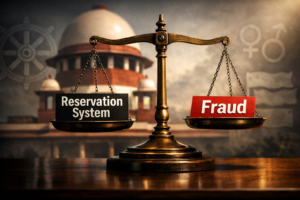

This ruling is being seen as historic, as it directly addresses misuse of the reservation system and sets a strong legal precedent for future cases involving religious conversion and minority status claims.
Background of the Case
The case originated from Haryana, where individuals belonging to upper-caste Hindu communities sought to avail reservation benefits meant for religious minorities.
Their argument was based on conversion to Buddhism, which is recognized as a minority religion in India.
The petitioners claimed that once they embraced Buddhism, they became eligible for minority reservation benefits in education and employment.
This claim triggered a legal debate on whether religious conversion alone can change a person’s eligibility under India’s reservation framework.
Supreme Court’s Strong Observation
The Supreme Court did not mince words while examining the matter.
The bench clearly stated that bypassing the constitutional reservation system through conversion is not permissible.
The court went on to flag this practice as a “new type of fraud”, indicating that the judiciary views such attempts as a serious misuse of affirmative action policies.
According to the court, reservation benefits are not meant to be loopholes but tools for social justice and upliftment.
Role of the Chief Justice
During the hearing, the Chief Justice of India questioned the legitimacy of such claims.
The court asked a direct question:
Can individuals from socially and educationally forward upper-caste communities suddenly claim minority benefits solely based on religious conversion?
This question became the core of the case.
The bench emphasized that historical disadvantage, not just religious identity, is a crucial factor in determining reservation eligibility.
Understanding Minority Reservation in India
In India, reservation policies are designed to support communities that have faced long-term social, educational, and economic discrimination.
Minority reservations are meant to protect religious and linguistic minorities who are vulnerable or underrepresented.
However, the Supreme Court clarified that minority status does not automatically grant reservation benefits, especially when the claimant does not suffer from social backwardness.
Debate on Religious Conversion Rights
The petitioners argued that freedom of religion, guaranteed under Article 25 of the Constitution, allows individuals to convert and enjoy all benefits associated with their new faith.
This argument opened a wider debate.
While the Constitution protects religious freedom, the court highlighted that reservation benefits are policy-driven, not faith-driven.
Conversion cannot be used as a shortcut to access benefits meant for historically marginalized groups.
Why the Court Called It a “Fraud”
The Supreme Court expressed concern that such practices could:
-
Undermine the entire reservation framework
-
Deprive genuine beneficiaries of their rightful opportunities
-
Encourage misuse of constitutional safeguards
-
Create unfair competition in education and public employment
By calling it a “new type of fraud,” the court sent a clear warning that manipulating identity for personal gain will not be tolerated.
Impact on Reservation Policy
This ruling is expected to have a far-reaching impact on how reservation claims are evaluated across India.
Authorities may now apply stricter scrutiny to claims based on religious conversion.
State governments and institutions may also revise guidelines to ensure that conversion-based claims are not misused.
The judgment strengthens the idea that reservation is about social justice, not legal technicalities.
Historic Nature of the Judgment
Legal experts are calling this decision historic for several reasons:
-
It closes a potential loophole in reservation laws
-
It reinforces the original intent of affirmative action
-
It protects the interests of genuinely disadvantaged communities
-
It establishes a strong precedent for future cases
The ruling sends a message that constitutional protections cannot be weaponized for unfair advantage.
Political and Social Reactions
The judgment has sparked discussions across political and social platforms.
Some groups have welcomed the decision, calling it a necessary safeguard against misuse.
Others argue that the ruling could discourage genuine religious conversions.
However, the Supreme Court clarified that conversion itself is not under question, but using it to exploit reservation benefits is.
What This Means for Future Cases
Going forward, courts are likely to examine:
-
The social background of the claimant
-
Whether the person has faced historical discrimination
-
The intent behind conversion
-
The actual purpose of seeking reservation benefits
This ruling makes it clear that identity-based benefits cannot be claimed in isolation from social realities.
Conclusion
The Supreme Court’s decision to flag minority reservation claims by upper-caste converts as a “new type of fraud” marks a critical moment in India’s legal and social landscape.
It reinforces the principle that reservation is a tool for empowerment, not exploitation.
By drawing a firm line between religious freedom and reservation misuse, the court has upheld the spirit of the Constitution and protected the integrity of India’s affirmative action system.
This judgment will likely guide courts, governments, and institutions for years to come.