

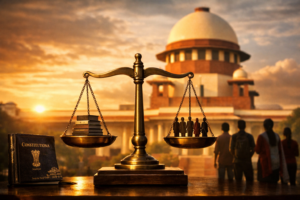

In 2026, the Supreme Court of India delivered an important judgment that clarified a long-standing confusion around reservation, merit, and the idea of “double benefit.”
This article explains the Supreme Court decision, the Rajat Yadav vs Union of India case, and why the court said “there is no double benefit” for SC, ST, and OBC candidates.
Why Reservation Exists in India
Reservation is not a charity or a political favor. It is a constitutional tool for social justice.
Historical Background
For centuries, certain communities in India were:
-
Denied education
-
Excluded from public institutions
-
Restricted from economic opportunities
The Constitution of India recognized this inequality and introduced affirmative action to ensure equal opportunity, not equal outcome.
Justice Means Equality of Opportunity, Not Blind Equality
The Supreme Court reiterated an important principle:
Justice does not mean treating unequal people equally.
SC, ST, and OBC communities started from a historically disadvantaged position. Reservation exists to correct this imbalance.
Providing the same starting line to everyone does not create fairness. Reservation helps level the playing field.
The Political Narrative Around Reservation
One of the biggest misconceptions discussed in the video is:
“If SC/ST/OBC get reservation, General category loses seats.”
The Supreme Court called this idea misleading and politically driven.
Reservation is often framed as a zero-sum game, but the court made it clear that social justice does not operate on loss and gain logic.
Understanding the “Open Category” Confusion
A key part of the 2026 ruling focused on the misunderstanding around the Open Category.
What Is the Open Category?
-
The Open Category is not a separate social group
-
It is open to everyone, including SC, ST, and OBC candidates
-
There is no quota called “General quota”
This clarification became central in the Rajat Yadav vs Union of India case.
Rajat Yadav vs Union of India: The Core Case
The case challenged how seats were being allocated when SC, ST, or OBC candidates scored higher than general category candidates.
The Key Question
Should a reserved category candidate who scores higher than a general candidate be forced to take a reserved seat?
The Supreme Court’s answer was NO.
Supreme Court’s Clear Stand: Merit Comes First
The court ruled:
-
If an SC/ST/OBC candidate qualifies on merit
-
And scores higher than a general category candidate
-
That candidate must be selected in the open category
This ensures that merit is rewarded, not penalized.
What Does “No Double Benefit” Actually Mean?
The phrase “double benefit” is often misunderstood.
What the Court Clarified
-
SC/ST/OBC candidates do not get two seats
-
They compete like everyone else in the open category
-
Reservation applies only if they need it
If they qualify without reservation, they don’t consume reserved seats
So, there is no extra advantage, only fairness.
Why This Decision Protects Merit
Many critics argue reservation kills merit. The Supreme Court strongly rejected this claim.
How Merit Is Preserved
-
High-scoring SC/ST/OBC candidates are rewarded
-
Reserved seats remain available for those who need support
-
General category seats are filled purely by rank
This creates a balanced system that respects both merit and social justice.
Does This Harm General Category Students?
The Supreme Court clearly stated that:
Reservation for one group does not automatically harm another.
General category students compete in:
-
A larger pool
-
With historically advantaged access to education
-
Without social exclusion barriers
The judgment emphasized that social context matters.
Reservation Is Not Poverty Alleviation Alone
Another important point highlighted in the video is that:
Reservation is about social exclusion, not just economic weakness.
Discrimination is often:
-
Caste-based
-
Structural
-
Generational
Even financially stable SC/ST/OBC individuals may face social barriers.
Legal and Ethical Dimensions of the Judgment
The Supreme Court balanced:
-
Constitutional morality
-
Equality under Article 14
-
Social justice under Articles 15 and 16
The ruling reinforces the idea that equality must be substantive, not merely formal.
Why This Judgment Matters in 2026
This decision is important because:
-
It reduces confusion around reservation rules
-
It prevents misuse of the “general vs reserved” narrative
-
It strengthens faith in constitutional values
The court positioned reservation as a solution, not a problem.
Breaking the “Us vs Them” Narrative
The video strongly argues that reservation debates are often politicized.
The Supreme Court urged society to move away from:
-
Emotional outrage
-
Social media misinformation
-
Vote-bank narratives
Instead, the focus should be on unity and inclusion.
Reservation and Social Equity
True social equity means:
-
Equal access to opportunity
-
Fair competition
-
Protection against historical injustice
Reservation is not permanent privilege. It is a corrective mechanism.
Final Thoughts
The 2026 Supreme Court decision on reservation is a landmark clarification.
Key takeaways:
-
Open category is not a separate quota
-
Merit-based SC/ST/OBC candidates must not lose seats
-
There is no double benefit in reservation
-
Social justice and merit can coexist
Understanding reservation through a legal and ethical lens helps reduce social division.
This judgment reminds India that justice is not about competition between communities, but about fairness for all.
Frequently Asked Questions (FAQ)
Q1. Can SC/ST/OBC candidates apply for general seats?
Yes. The open category is open to everyone.
Q2. Does this judgment remove reservation?
No. It strengthens fair implementation.
Q3. What is “no double benefit”?
It means candidates cannot claim both merit and reserved seats.