 The political climate in West Bengal has once again turned intense after new revelations from the Special Intensive Revision (SIR) Survey conducted by the Election Commission. The findings have sparked widespread debate, deep concern, and a fresh wave of controversy across the state.
This article breaks down the latest updates, local reactions, and the possible regional impact.
What Is the Special Intensive Revision (SIR) Survey in West Bengal?
The Election Commission carries out the SIR survey to verify voter lists, identify discrepancies, and ensure transparency in the electoral roll.
This year’s survey in West Bengal became a hot topic because:
-
Authorities focused on border-connected districts
-
A massive verification drive was launched
-
Teams checked documents, residency status, and voter eligibility
-
Several booths were flagged for unusually high migrant-population patterns
The objective was simple: clean up the voter list and ensure only genuine Indian citizens remain registered.
However, what came out of this survey shocked the entire nation.
Previous Warnings: Creator’s Earlier Video Now Going Viral
The creator of the report had earlier released a video warning about large-scale demographic changes in West Bengal.
Viewers are now referring back to that earlier video because:
-
It discussed mass infiltration from Bangladesh
-
It highlighted political misuse of illegal migration
-
It predicted future conflicts related to voter manipulation
-
It mentioned that several districts were facing “identity dilution”
With the new SIR survey updates emerging, people are revisiting the earlier video for deeper context.
New SIR Survey Findings: The Alarming 90% Claim
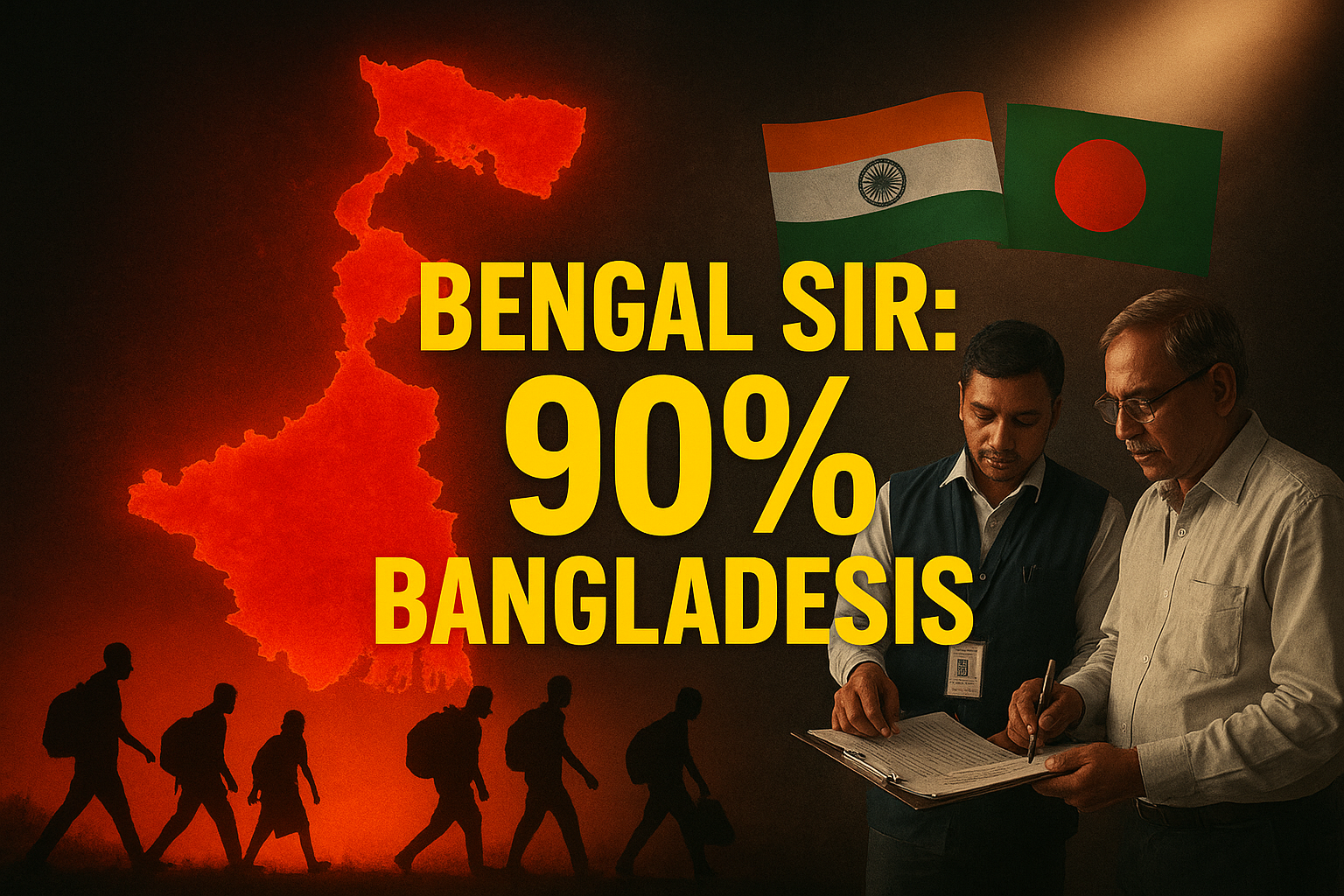
The biggest shock came when survey officials reportedly discovered that up to 90% of residents in certain Bengal localities were actually Bangladeshis.
This sparked instant outrage for multiple reasons:
-
How did such a large number enter and settle undetected?
-
Why were they allegedly allowed to register as voters?
-
What was the political motivation behind keeping them in the list?
-
How does such a demographic shift affect national security?
While the figure is still being widely debated, the claim has generated serious political heat.
Even critics who typically question such surveys agree…
Something unusual is happening in the border districts.
Ground Reality: What Local Residents Are Saying
As the survey continued, reporters and content creators visited several locations to speak directly with residents.
Many locals expressed intense frustration, saying things like:
-
“We are scared. Our identity is disappearing.”
-
“Why are outsiders getting more benefits than us?”
-
“Every year new people arrive, but no one questions them.”
-
“Our entire neighborhood has changed.”
Some elderly residents claimed that long-term infiltration has altered the culture, language, and daily life in multiple districts.
A few even accused political leaders of deliberately supporting illegal settlers for vote-bank advantages.
Why the 90% Figure Became the Center of Debate
The moment the “90% Bangladeshis” claim emerged, it created:
-
Political tension
-
Social media storms
-
Heated TV debates
-
Government pressure
-
Counter-statements from parties
Opposition parties called the claim “exaggerated,” while supporters of the survey insisted that the number reflects ground reality in specific pockets.
However, one thing is clear:
There is a deep demographic shift happening along the Bengal–Bangladesh border.
India’s Crackdown: What the Government Is Planning
Following the revelations, several key measures are being discussed:
1. Increased Border Security
More BSF personnel may be deployed in high-risk zones to prevent cross-border movement.
2. A Complete Re-verification of Voter Lists
Authorities could remove thousands of illegal names from electoral rolls.
3. Stronger Document Scrutiny
A stricter verification process for Aadhaar, ration cards, and voter IDs is expected.
4. Fencing and Technology Upgrades
Thermal cameras, drones, and sensors could be introduced along sensitive border stretches.
5. Possible Statewide NRC-Style Verification
This remains a major topic of discussion and could intensify political battles.
Political Implications: A Storm Brewing in West Bengal
The SIR survey results have triggered:
-
Massive criticism of ruling party policies
-
Accusations of “vote bank politics”
-
Claims that infiltration was ignored for decades
-
A push for stricter national citizenship verification
Political leaders from different parties are now using the situation to target each other.
The controversy is expected to play a major role in upcoming elections.
Why the Border Region Is the Most Affected
Experts point to several reasons behind the alarming situation:
-
Bengal shares a 2,217 km long border with Bangladesh
-
Many areas remain porous and difficult to monitor
-
Lack of economic opportunities on the other side
-
Smuggling networks and illegal migration routes
-
Political support systems helping migrants settle
Because of these factors, border districts like North 24 Parganas, South 24 Parganas, Murshidabad, Nadia, and Malda often see high infiltration numbers.
Local People Fear Losing Their Identity
One major concern among locals is cultural displacement.
Residents say:
-
Festivals have changed
-
Market shops are run by outsiders
-
Languages spoken on the streets are shifting
-
Traditional communities feel “outnumbered”
Many claim their hometowns no longer feel like the Bengal they grew up in.
Economic Impact: Who Suffers the Most?
Illegal migration affects:
▶ Local Workers
Wages drop because migrants work for lower pay.
▶ Housing
Rents rise as population density increases.
▶ Government Schemes
Benefits meant for Indian citizens allegedly get diverted.
▶ Law and Order
Police claim rising incidents in border regions are linked to illegal settlements.
This is why the government views the issue as not just political, but economic and security-related.
Bangladesh’s Possible Reaction
The creator also discusses how these revelations might impact Bangladesh.
Possible outcomes include:
-
Diplomatic discussions between both countries
-
Pressure on Bangladesh regarding border control
-
Concerns within Dhaka about mass migration accusations
-
Potential tension over security cooperation
Analysts believe Bangladesh will closely watch how India handles the situation.
Regional Consequences for the Future
If the infiltration numbers continue rising, experts fear:
-
More demographic pressure on Bengal
-
Growing ethnic and cultural imbalance
-
A long-term political transformation
-
Increase in border-related violence
-
Migration spreading into other Indian states
Many believe India must act quickly to prevent deeper instability.
Why the SIR Survey Is a Turning Point
This survey has become one of the biggest revelations in recent years regarding demographic changes in Eastern India.
Key takeaways:
-
It exposed a major infiltration trend
-
It raised questions about voter list misuse
-
It alarmed local communities
-
It pushed the government toward tough action
-
It brought international attention to the region
For the first time, the scale of the issue has been publicly highlighted.
Conclusion
The Shocking Details of the Bengal SIR Survey have opened the country’s eyes to a reality many had feared for years. Claims that up to 90% of residents in certain areas are Bangladeshis have triggered a nationwide debate.
As India prepares for a major crackdown and West Bengal faces rising tensions, the situation is expected to escalate further in the coming months.
This is a developing story, and the implications will likely reshape political, social, and regional dynamics for years.