
The U.S.–China trade war was supposed to change the global economic order.
Former U.S. President Donald Trump believed heavy tariffs on Chinese goods would weaken Beijing, bring factories back to America, and create millions of U.S. jobs.
What happened instead shocked the world.
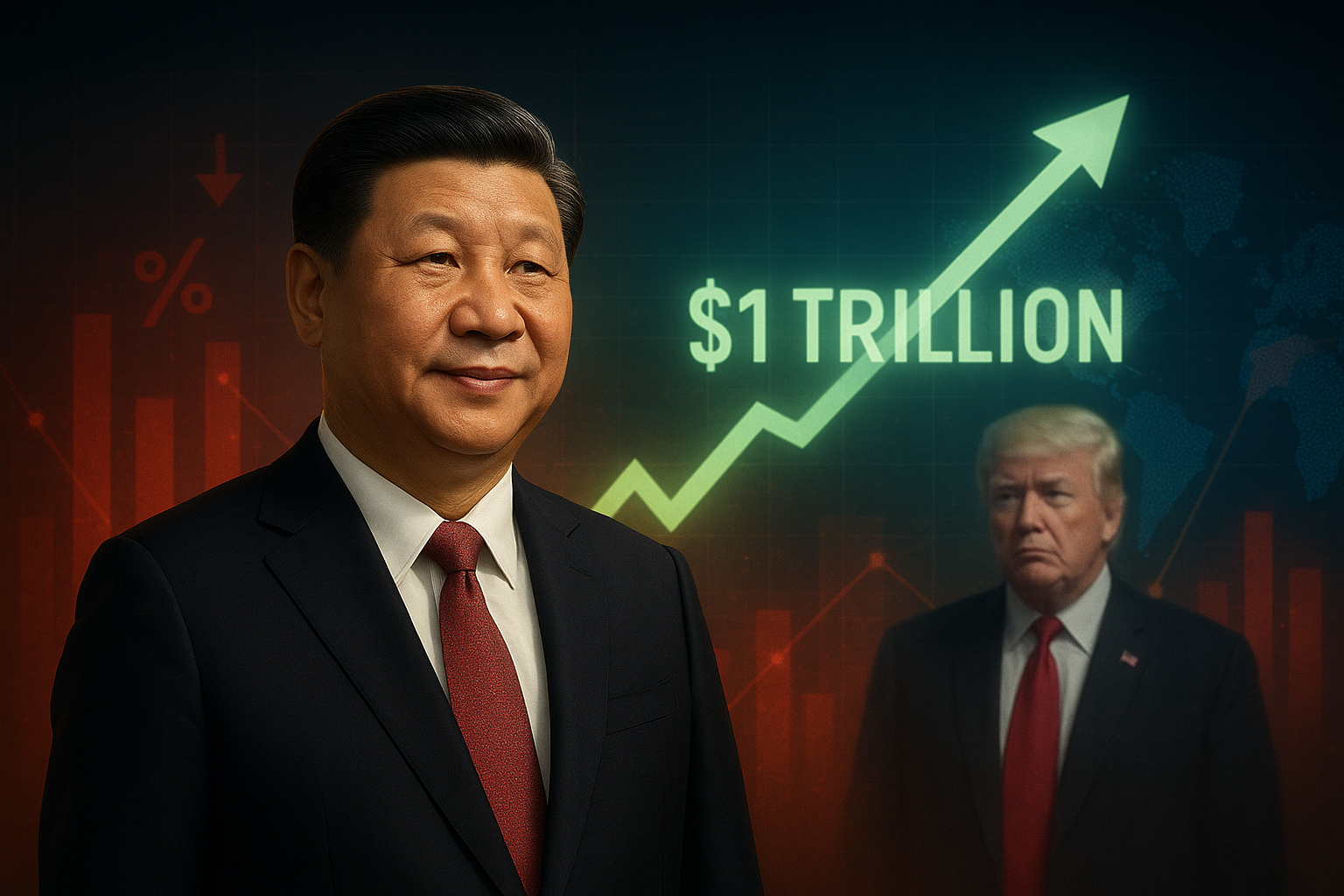
China recorded a historic trade surplus of over $1 trillion, strengthened its global influence, and quietly rewired global manufacturing in its favor. This is the story of how Xi Jinping outplayed Donald Trump in one of the most expensive economic battles in modern history.
What Was Trump’s Trade War Strategy?
Donald Trump launched the trade war in 2018 with a clear goal.
He wanted to punish China for what he called unfair trade practices.
The main tools were tariffs.
The U.S. imposed high tariffs on hundreds of billions of dollars worth of Chinese goods.
Trump believed this would:
-
Force companies to leave China
-
Push manufacturing back to the U.S.
-
Reduce America’s trade deficit
-
Create American factory jobs
On paper, it sounded tough and decisive.
In reality, global economics doesn’t work that simply.
The Big Miscalculation by the U.S.
Trump assumed China was fully dependent on exporting finished goods directly to the U.S.
That assumption turned out to be wrong.
China was not just a factory.
It was the brain of the supply chain.
While the U.S. focused on tariffs, China focused on strategy.
And that difference changed everything.
China’s Trillion-Dollar Trade Surplus Shock
Despite years of U.S. tariffs, China achieved something unprecedented.
It posted a record trade surplus exceeding $1 trillion.
This number stunned economists and policymakers.
Instead of collapsing, China’s export machine became stronger.
Why?
Because China adapted faster than the U.S. anticipated.
The tariffs didn’t kill Chinese trade.
They reshaped it.
How China Outsmarted Tariffs
China did not fight the trade war head-on.
It took a smarter route.
The strategy was simple but powerful.
Manufacture Core Components at Home
China kept high-value manufacturing inside its borders.
This included:
-
Semiconductors
-
Electronics parts
-
Machinery components
-
Battery technology
These components generate the most profit.
China ensured it controlled them.
Outsource Final Assembly Abroad
Instead of exporting finished products directly to the U.S., China changed the final step.
Assembly was shifted to countries like:
-
Vietnam
-
Mexico
-
Malaysia
-
Thailand
-
Indonesia
Once assembled, the products were no longer labeled “Made in China.”
They entered the U.S. from third countries.
Tariffs avoided.
Supply chains intact.
Why This Strategy Worked So Well
This move allowed China to achieve three big goals.
First, Chinese factories stayed busy.
Second, Chinese companies kept control over technology and design.
Third, tariffs lost their impact.
The U.S. paid higher prices, but China kept earning.
It was a textbook example of strategic flexibility.
The Myth of Jobs Returning to America
One of Trump’s biggest promises was the return of manufacturing jobs.
That never happened at scale.
Instead of moving to the U.S., companies moved to cheaper Asian countries.
Why?
Because manufacturing in the U.S. is expensive.
High wages.
Strict regulations.
Higher production costs.
Businesses chose efficiency over patriotism.
China understood this reality better than Washington.
Rising Costs for American Consumers
U.S. tariffs did not hurt China alone.
They hurt American consumers.
Prices increased for:
-
Electronics
-
Appliances
-
Furniture
-
Industrial inputs
Many U.S. companies absorbed losses or passed costs to customers.
Meanwhile, Chinese exporters found new routes.
The pain was uneven.
America felt it more directly.
China’s Growing Diplomatic Power
The trade war was not just economic.
It was political.
China used diplomacy as a weapon.
Beijing strengthened ties with:
-
ASEAN nations
-
Africa
-
Latin America
-
Middle Eastern economies
Through trade deals and infrastructure projects, China expanded influence.
While the U.S. focused inward, China went global.
Belt and Road Helped China Win
China’s Belt and Road Initiative played a silent role.
Ports, railways, and trade corridors built earlier became valuable during the trade war.
They allowed faster redirection of exports.
China didn’t panic.
It planned.
The U.S. Strategy: Why It Failed
The U.S. trade war failed for several reasons.
No Global Coalition
America acted largely alone.
China maintained strong trade ties with other economies.
Without allies, U.S. pressure weakened.
Underestimating China’s Adaptability
China had decades of experience navigating sanctions and trade barriers.
It adapted quickly.
The U.S. response was reactive, not strategic.
Tariffs Without Industrial Policy
Tariffs alone don’t rebuild manufacturing.
You need:
-
Skills training
-
Infrastructure
-
Long-term industrial planning
China had these.
The U.S. did not.
Xi Jinping’s Long-Term Vision
Xi Jinping approached the trade war with patience.
He focused on:
-
Self-reliance
-
Domestic consumption
-
High-tech industries
China reduced dependence on the U.S. market.
That shift made tariffs less effective over time.
Trump wanted quick wins.
Xi played a long game.
Who Really Benefited from the Trade War?
The results are now clear.
China emerged stronger.
Its trade surplus hit historic highs.
Its global influence expanded.
Its supply chain dominance deepened.
The U.S. gained political headlines but lost economic leverage.
Lessons from the Trillion-Dollar Shock
The trade war offers powerful lessons.
Economic wars are not won by slogans.
Global supply chains are complex.
Tariffs alone cannot reshape the world economy.
China understood this reality.
The U.S. ignored it.
Final Thoughts
“The trillion-dollar shock” is not just about numbers.
It’s about strategy.
Donald Trump tried to force change through pressure.
Xi Jinping used patience, planning, and adaptability.
In the end, China didn’t just survive the trade war.
It won it.
And the global economy is still feeling the impact today.