

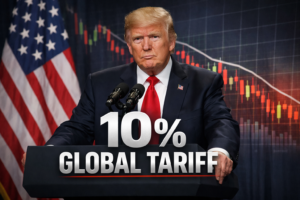

Supporters say the move strengthens American trade power. Critics warn it could raise prices for everyday Americans and increase global tensions.
In this article, we break down what the new 10% global tariff means, how it connects to India and Pakistan tensions, and why experts believe American consumers may feel the biggest impact.
What Is the New 10% Global Tariff?
Trump’s new proposal would impose a 10% tariff on all imported goods entering the United States. Unlike targeted tariffs aimed at specific countries or products, this would apply broadly across global trade partners.
A tariff is essentially a tax placed on imported goods. When companies import products into the U.S., they pay this tax to the government.
The goal, according to Trump, is to protect American industries and generate revenue.
However, economists argue the situation is more complicated.
Supreme Court Ruling and Trade Authority
The Supreme Court ruling that preceded Trump’s announcement clarified certain presidential powers over trade policy.
While the exact legal implications are still being debated, Trump appears to see the ruling as support for stronger executive action on tariffs.
This has allowed him to confidently propose a broad-based 10% global tariff as part of his economic and foreign policy strategy.
Trump’s Claim: Tariffs Prevent Wars
One of the most controversial parts of Trump’s announcement involves foreign policy.
The speaker in a recent video questioned how Trump would prevent future conflicts between India and Pakistan. Trump has previously suggested that tariffs can be used as leverage to prevent wars.
He claimed that threats of economic penalties can push countries toward peace.
Trump recently stated that his tariff threats have successfully deterred wars in the past. In his remarks, he referenced escalating numbers of fighter jets supposedly involved in near-conflicts, suggesting his economic pressure stopped military action.
Supporters view this as strong negotiation tactics.
Critics argue that the connection between tariffs and peace is not supported by clear evidence.
India and Pakistan Concerns
India and Pakistan have a long history of tension, especially regarding Kashmir.
The question raised in the video was direct:
How exactly would tariffs stop future military conflicts between these two nuclear-armed neighbors?
Trade between the United States and both countries is important but not dominant enough to fully control their military decisions.
Experts in international relations suggest that regional security issues are far more complex than trade policy alone.
While economic pressure can influence behavior, it rarely acts as a simple switch that turns war on or off.
Do Tariffs Really Help the U.S. Economy?
Trump argues that tariffs bring money into the U.S. government.
Technically, that is true.
When importers pay tariffs, the money goes to the U.S. Treasury.
But the bigger question is: Who actually pays for tariffs?
Who Pays the Price?
Despite common political messaging, tariffs are not paid by foreign governments.
They are paid by American companies that import goods.
Most of those companies pass the cost on to consumers.
That means higher prices at stores.
If a product imported from overseas costs 10% more due to a tariff, retailers often raise prices to maintain profit margins.
In simple terms, American consumers pay more.
How Tariffs Affect Everyday Americans
A 10% global tariff could impact:
-
Electronics
-
Clothing
-
Groceries
-
Cars
-
Construction materials
-
Household goods
Many products sold in the U.S. rely on global supply chains.
Even items labeled “Made in America” often use imported parts.
When tariffs increase costs along the supply chain, the final price goes up.
This can lead to inflation.
The Revenue Argument
Trump’s position is that tariffs generate revenue for the U.S. government.
In theory, this revenue could help reduce deficits or fund public programs.
However, critics argue that while the government collects the tariff revenue, consumers bear the financial burden.
So while the Treasury gains income, households may lose purchasing power.
Economists often describe tariffs as a hidden tax on consumers.
The Complexity of Global Trade
International trade is not simple.
Modern supply chains connect dozens of countries in the production of a single product.
For example, a smartphone may be:
-
Designed in the U.S.
-
Built with parts from South Korea
-
Assembled in Vietnam
-
Using rare minerals from Africa
A blanket 10% tariff affects every stage of this process.
Businesses may struggle to adjust quickly.
Some companies may shift production to avoid tariffs.
Others may simply raise prices.
Potential Economic Consequences
Experts warn that broad tariffs can trigger:
-
Retaliation from other countries
-
Trade wars
-
Higher consumer prices
-
Slower economic growth
-
Stock market volatility
If other nations respond with tariffs on American exports, U.S. farmers and manufacturers could suffer.
This happened during previous trade disputes.
Agricultural exports were particularly affected during earlier U.S.-China tariff battles.
Political Strategy or Economic Risk?
Supporters believe Trump’s tariff strategy is bold and necessary.
They argue it pressures foreign governments to negotiate better trade deals.
They also say it encourages companies to bring manufacturing back to the United States.
Critics believe the strategy oversimplifies global economics.
They argue that rebuilding domestic manufacturing takes years, not months.
In the short term, consumers and small businesses may face higher costs.
Tariffs and National Security
Trump often frames tariffs as a national security tool.
He suggests economic strength equals global influence.
However, many economists say that strong alliances, stable trade relationships, and diplomatic engagement are equally important for national security.
Using tariffs as a constant threat could strain relationships with allies.
Market Reaction
Financial markets tend to react quickly to tariff announcements.
Investors worry about uncertainty.
When trade rules change suddenly, businesses delay investment decisions.
Uncertainty can slow economic growth.
Markets generally prefer predictable trade policy.
The Debate Over Consumer Impact
The core debate remains simple:
Are tariffs a smart tool to protect America,
or a hidden tax that hurts American families?
The video critique argues that Trump misunderstands or oversimplifies the economic impact.
It emphasizes that tariffs do not magically transfer wealth from foreign governments to the U.S.
Instead, the costs flow through the system and land on American buyers.
What Happens Next?
If implemented, the 10% global tariff would likely face:
-
Legal challenges
-
Congressional debate
-
International responses
-
Business lobbying efforts
Trade policy is rarely straightforward.
It involves legal, economic, and diplomatic factors.
The Supreme Court ruling may clarify presidential authority, but the broader consequences remain uncertain.
Final Thoughts
Trump’s announcement of a new 10% global tariff has reignited debate over trade policy, national security, and economic fairness.
He argues tariffs prevent wars, strengthen negotiation power, and boost government revenue.
Critics counter that tariffs raise prices for American consumers and risk damaging the U.S. economy.
The concerns about India and Pakistan highlight a bigger question:
Can economic pressure alone prevent military conflict?
History suggests global politics are far more complex.
As the debate continues, one thing is clear.
Any major tariff policy will directly affect businesses, consumers, and international relations.
The real impact of this proposed 10% global tariff will depend on how it is implemented, how other countries respond, and how American markets adapt.
For now, Americans are left weighing the promise of economic strength against the risk of higher costs at home.
The conversation is far from over.