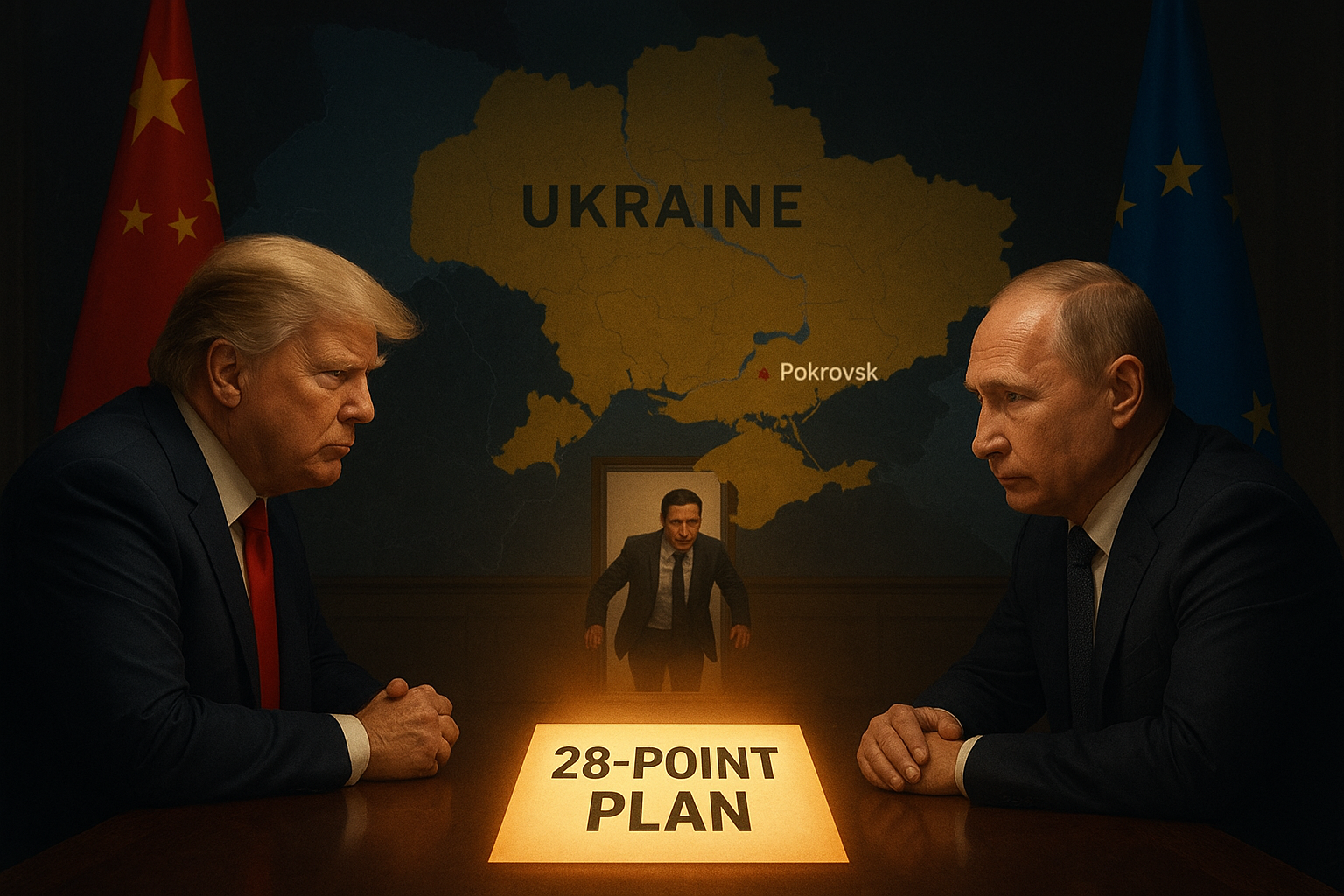
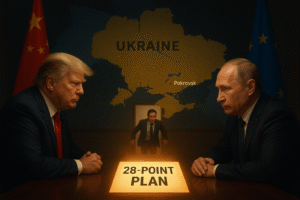
 A major geopolitical storm is brewing after the fall of Pokrovsk to Russian forces. As Ukraine struggles to stabilize its frontline, a shocking leak has emerged — a secret 28-point plan allegedly connected to former U.S. President Donald Trump. The plan, revealed by Axios, suggests a sweeping strategy that goes far beyond Ukraine. It appears to reshape European security, freeze the war, and potentially strike a deal with Russia.
These developments come at a time when Ukrainian President Volodymyr Zelensky is urgently traveling to Turkey and preparing for critical talks with the U.S. The timing of the leak, the fall of Pokrovsk, and renewed global reactions have raised serious concerns in China, the EU, and across NATO.
Let’s break it down in simple, clear language.
Zelensky Rushes to Turkey: What’s Behind the Visit?
Ukrainian President Volodymyr Zelensky recently flew to Turkey to meet President Recep Tayyip Erdoğan.
This visit is not routine. It comes at a moment when:
-
Ukraine has lost Pokrovsk, one of its last major strongholds in Donetsk.
-
Ukrainian troops are increasingly frustrated with the leadership.
-
Russia is gaining momentum on the battlefield.
-
Western aid has slowed down.
According to early reports, Zelensky’s agenda in Turkey is not just about drones or defense agreements. He is expected to discuss:
-
A possible ceasefire framework
-
Future negotiations involving the U.S.
-
Military support, especially from NATO-linked suppliers
-
Humanitarian routes and reconstruction planning
This meeting is crucial because Turkey has remained one of the few NATO members capable of talking to both Russia and Ukraine. Erdoğan has positioned himself as a mediator before, and now Zelensky urgently needs diplomatic backing.
Zelensky’s Political Trouble After Pokrovsk Falls
The fall of Pokrovsk has shaken Kyiv’s political landscape.
Why Pokrovsk Matters
-
It was a strategic hub for supply routes.
-
It served as a defensive buffer for central Ukraine.
-
Losing it allows Russia to push deeper into Ukrainian territories.
Inside Ukraine, the morale of soldiers is reportedly declining. Military commanders have publicly questioned the government’s strategy. Some Ukrainian analysts say Zelensky’s government is under its most severe pressure since the start of the war.
For the first time, dissent is not just online — it’s within the military ranks. This makes Zelensky’s trip even more urgent.
The Alaska Summit: Where This Story Begins
To understand the leaked plan, we must go back to the unexpected meeting between Vladimir Putin and Donald Trump at the Alaska summit.
Though initially downplayed, this meeting reportedly included:
-
Discussions about a new European security architecture
-
Possible steps to end the Ukraine conflict
-
Ideas to reduce NATO–Russia friction
-
Talks about energy routes and economic stability
Sources claim that this summit quietly laid the foundation for what is now being called the “28-Point Europe Security Plan.”
While Trump is not the current U.S. president, the idea that he could return to office in the future has made European leaders uneasy. Russia, meanwhile, sees any Trump-led discussion as an opportunity for a more favorable negotiation environment.
Axios Leak: The Secret 28-Point Plan Explained
Axios recently published details of a leaked 28-point document that outlines a U.S.–Russia framework related not just to Ukraine but to the entire European continent.
This plan is described as “historic” and “unprecedented” for several reasons:
-
It does not focus solely on Ukraine.
-
It proposes a Gaza-style freeze on conflict lines.
-
It includes territorial concessions.
-
It introduces a reconstruction mechanism for Ukraine.
-
It attempts to create a long-term security balance between Russia and NATO.
Here’s the simplest breakdown of what the plan reportedly includes:
1. Freeze Current Territorial Lines
This is the most controversial part.
The plan would freeze the war exactly where it stands today, meaning:
-
Russia keeps control over the territories it has captured.
-
Ukraine loses legal claim to key regions unless future negotiations change it.
-
A demilitarized buffer zone may be created.
For Ukraine, this is seen as a painful defeat.
For Russia, it would mean locking in all gains since 2022.
2. Reconstruction Fund for Ukraine
The plan includes a Western-led reconstruction mechanism, which may involve:
-
EU funding
-
U.S. investments
-
World Bank support
-
Limited Russian contributions tied to sanctions relief
The idea parallels the Gaza reconstruction planning involving regional and global powers.
3. New European Security Framework
The document reportedly discusses a complete reshaping of Europe’s security, including:
-
Reduced NATO troop deployment near Russian borders
-
New monitoring zones
-
Joint U.S.–Russia dialogue forums
-
Protection guarantees for smaller European states
This is why the EU is nervous.
A U.S.–Russia deal without Europe at the table could dramatically change geopolitical balance.
4. China’s Concerns Over the Plan
China is reportedly unhappy with this plan for two major reasons:
A Russia–US deal could weaken China’s influence.
Beijing benefits from Moscow’s dependence on China during the Ukraine war. If Russia makes a compromise with the U.S., China’s leverage could drop.
The Gaza-style freeze threatens China’s long-term vision.
China has been positioning itself as a mediator in global conflicts. If the U.S. shows it can independently negotiate major agreements, China’s role as an international power could be undermined.
5. EU’s Fears About Being Side-lined
The European Union fears:
-
A U.S.–Russia deal may ignore EU interests.
-
Security commitments in Europe could be rewritten.
-
Eastern European states may be left vulnerable.
-
Negotiations could lead to increased Russian influence.
Several European leaders have already expressed concern privately that Washington might “cut a deal” with Moscow without broader NATO consultation.
Why the Plan Is Compared to Gaza
Analysts say the plan resembles the Gaza conflict freeze, where:
-
Hostilities stop but no final resolution is reached.
-
Territorial control remains unchanged.
-
International actors monitor ceasefire lines.
-
Reconstruction happens without full peace.
This means the Ukraine war may not “end” — it may just pause indefinitely.
What Happens Next?
With Pokrovsk lost and Ukraine weakened, the timing of this leak is critical. It signals three key things:
-
The West is quietly preparing for a post-war Ukraine.
-
Russia is negotiating from a position of strength.
-
The U.S. is exploring a long-term strategic deal — possibly outside NATO’s framework.
Zelensky’s meetings in Turkey and upcoming talks with U.S. representatives suggest Ukraine is trying to avoid being cornered into an unfavorable agreement.
Conclusion
The leak of Trump’s secret 28-point Ukraine plan has shaken global politics. As Russia advances, Ukraine struggles with internal dissent, and world powers reposition themselves, a dramatic shift in European security seems possible.
The fall of Pokrovsk, Zelensky’s rapid diplomatic moves, China’s concerns, and the EU’s fears all point to one reality:
A major geopolitical realignment could be underway — and Ukraine is at the center of it.
Whether the plan becomes real policy or remains a leaked document will depend on the next few months of military, political, and diplomatic developments. But one thing is clear:
The world is watching closely.