

Trump Vs Germany: Why the US Is Withdrawing Troops From Europe
The decision that is reshaping NATO, alarming Europe, and redefining America’s role as the world’s policeman.
A Decision That Shocked Europe
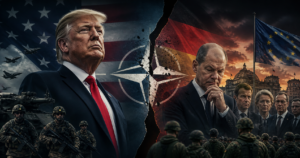

European leaders scrambled. German officials voiced concern. NATO allies held emergency consultations. But for Trump, the message was simple: America’s military protection is no longer unconditional.
This single decision has forced Europe to face a reality it has avoided for decades.
Why Europe Never Built Its Own Defense
To understand why this move hit so hard, you have to go back to World War II.
After the devastation of WWII, European nations made a quiet but consequential choice. Instead of investing heavily in their own military capabilities, they leaned on the United States — specifically on the NATO alliance — to provide security.
The logic was understandable at the time. Europe was rebuilding. Economies were in ruins. Rebuilding infrastructure, education systems, and democratic institutions took priority over defense spending.
The US agreed to station troops across Europe, particularly in Germany, as a guarantee of protection — especially against the growing Soviet threat during the Cold War.
This arrangement worked for decades. Europe thrived. Germany became an economic powerhouse. And the US military presence became so normalized that it faded into the background.
But it created a dangerous dependency.
The Post-WWII Division of Germany
To fully grasp why US troops are in Germany in the first place, a brief history lesson is necessary.
After Germany’s defeat in 1945, the country was divided into four occupation zones, each controlled by one of the Allied powers — the Soviet Union, United Kingdom, France, and the United States.
The Western zones eventually merged to form West Germany, while the Soviet zone became East Germany.
US troops were initially deployed for a very specific purpose: denazification — dismantling Nazi institutions, prosecuting war criminals, and preventing the re-emergence of fascist ideology.
But as the Cold War deepened, the mission changed. US troops stayed not just to denazify Germany, but to act as a buffer against Soviet expansion into Western Europe.
Germany became the frontline of a geopolitical standoff that lasted nearly 50 years.
From Denazification to Deterrence
When the Berlin Wall fell in 1989 and the Soviet Union collapsed in 1991, the original justification for stationing troops in Germany effectively disappeared.
Yet the troops remained.
Over time, the US military presence in Germany evolved into something else entirely — a symbol of American global power, a forward operating base for missions across Europe, the Middle East, and Africa, and a political signal to both allies and adversaries.
Germany, for its part, never felt the urgent need to build up its own military. With the US umbrella in place, why spend the money?
This is exactly the mindset Trump found infuriating.
Trump’s New Condition: Praise and Alignment
Trump’s approach to the NATO alliance broke sharply from decades of American foreign policy.
Previous US administrations — Democrat and Republican alike — viewed NATO as a cornerstone of global stability. The mutual defense clause (Article 5) was treated as sacred.
Trump saw it differently.
In his view, the United States was being taken advantage of. European nations were spending far below the NATO-agreed defense target of 2% of GDP, while enjoying full American protection.
But Trump went further than just demanding higher contributions.
His position suggested that US security guarantees were not just about financial fairness — they were transactional. Countries that aligned with American interests, praised US leadership, and cooperated with Washington’s agenda would receive protection. Those that didn’t? Not so much.
This fundamentally changed the nature of the alliance. For the first time, European leaders had to consider the possibility that American military backing was conditional — not automatic.
Germany in the Crosshairs
Germany became the focal point of this tension for several reasons.
First, Germany hosts the largest number of US troops in Europe — around 35,000 personnel, based at key installations like Ramstein Air Base and US Army Garrison Stuttgart.
Second, Germany had long been criticized for its low defense spending. For years, Berlin struggled to even reach the 2% NATO target that it had formally agreed to.
Third, Germany’s strong trade relationship with China and its historical dependence on Russian energy (via Nord Stream pipelines) put it at odds with Trump’s geopolitical priorities.
From Trump’s perspective, Germany was the perfect example of everything wrong with the old NATO model — a wealthy country that relied on American military might while pursuing economic policies that clashed with US interests.
What a US Withdrawal Would Actually Mean
If the US significantly reduces or withdraws its troop presence from Germany, the consequences would be far-reaching.
For Germany and Europe:
- A forced reckoning with defense spending and military readiness
- Greater pressure to build a unified European defense force
- Increased vulnerability during any transition period
- A psychological blow to NATO’s credibility
For the United States:
- Loss of critical strategic bases used for global military operations
- Reduced influence in European political affairs
- A signal to adversaries that American commitments are negotiable
For NATO:
- A fracture in the alliance’s unity
- Renewed questions about Article 5’s enforceability
- Pressure on every member nation to reassess their own security strategies
Is Europe Finally Waking Up?
The irony of Trump’s pressure campaign is that it may actually push Europe to do what decades of diplomacy could not — take its own defense seriously.
Germany has already announced significant increases in defense spending. The EU has begun early-stage discussions about a more autonomous European defense framework. Countries like Poland, Finland, and the Baltic states — sitting closest to Russia — have dramatically increased their military budgets.
Trump’s shock therapy, whatever its motives, is producing results that NATO defense hawks have wanted for years.
The Bigger Picture: America Reasserting Itself
At its core, the troop withdrawal threat is not just about Germany or Europe.
It is about the United States redefining its role in the world.
For over 70 years, America operated as the globe’s default security provider — intervening in conflicts, stationing troops abroad, and maintaining alliances that required enormous financial and military commitment.
Trump’s doctrine challenges that model head-on. In his framing, the US should project power on its own terms, not out of obligation to aging post-WWII arrangements.
Whether that leads to a safer world — or a more chaotic one — remains the central debate of our time.
Conclusion
The US-Germany troop standoff is more than a diplomatic dispute. It is a stress test for the entire post-WWII international order.
Europe built its prosperity on a foundation of American security guarantees. Trump has cracked that foundation — deliberately — to force a rebalancing.
Germany and Europe now face a choice: build genuine strategic independence, or find a way to meet America’s new demands.
Either way, the era of unconditional US military protection in Europe appears to be over.
And the world is adjusting — whether it is ready to or not.