

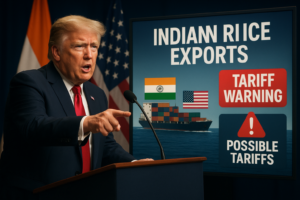

Trump’s latest warning—that he could impose new tariffs on Indian rice—comes at a time when geopolitical events and global supply chains are already sensitive. In this article, we break down everything you need to know about the issue, why Trump is targeting Indian rice, the role of global politics, and how rising basmati demand in the U.S. shapes the story.
What Triggered Trump’s Warning on Indian Rice?
Donald Trump recently said that India is “dumping cheap rice” into the U.S. market, making it harder for local farmers to compete.
This is not the first time Trump has accused India of unfair trade practices, but his remarks on rice signal a new area of focus.
Indian rice—especially basmati—has seen growing popularity in the U.S. over the last decade. Americans have increasingly adapted to global cuisines, and Indian rice brands have become household names. With more Indian immigrants and rising demand for Asian food, the U.S. market for basmati has expanded faster than expected.
Trump’s key accusations include:
-
India is exporting rice at lower prices.
-
U.S. farmers are losing competitive advantage.
-
India is using trade benefits unfairly.
While experts disagree on whether this constitutes actual “dumping,” Trump’s comments have created significant buzz.
Trump Hints at New Tariffs on Indian Rice
During his speech, Trump suggested that he may impose additional tariffs on Indian rice if elected again.
This threat is particularly important because the U.S. already imposes some of the highest tariffs on Indian goods, especially on items like steel, textiles, and certain agricultural products.
If tariffs increase further:
-
Indian basmati may become more expensive in American stores.
-
Small and mid-size rice exporters in India could be affected.
-
Indian consumers living in the U.S. may see price hikes on rice.
His comments reflect long-standing tensions between the two countries whenever trade issues are discussed. Trump’s earlier term was marked by several disputes with India over tariffs and trade balances.
A History of Trump’s Negative Trade Views Toward India
Trump has often stated that India treats the U.S. “very unfairly” in trade.
During his presidency, he repeatedly expressed dissatisfaction with what he saw as India’s high import tariffs, including on:
-
Motorcycles (Harley-Davidson example)
-
Agricultural products
-
Electronic goods
-
Medical devices
In return, the United States also introduced tariffs on several Indian exports. This created a cycle of retaliation and counter-retaliation that shaped Indo-U.S. trade under Trump.
So, his recent rice-related comments fit a familiar pattern:
-
Highlight India’s trade surplus with the U.S.
-
Accuse India of unfair practices
-
Threaten tariffs to gain negotiating leverage
With the possibility of another Trump administration, Indian exporters worry that the U.S. market could become more restrictive.
Is Geopolitics Influencing Trump’s New Stand?
Some analysts suggest that Trump’s criticism may also be linked to recent geopolitical developments—especially Vladimir Putin’s visit to India.
The timing is noteworthy:
-
Russia and India strengthened strategic ties recently.
-
The U.S. has been uncomfortable with India’s continued engagement with Russia.
-
Trump may be signaling displeasure indirectly through trade threats.
Historically, global political movements often influence trade decisions. If Trump’s view is shaped by India’s closeness with Russia on energy, defense, or diplomacy, the rice tariff issue may be part of a bigger message.
Indian Basmati Rice Is Increasingly Popular in the U.S.
Despite Trump’s warning, the reality on the ground is quite different.
Indian basmati rice exports to the U.S. are rising, not declining.
Why?
Because basmati is a specialty product with high demand. Its fragrance, grain length, and non-sticky texture make it attractive to American consumers, chefs, and restaurants.
Reasons for Rising U.S. Demand for Indian Basmati:
-
Growing popularity of Indian and Middle Eastern cuisine.
-
More health-conscious consumers choosing low-GI foods.
-
Expansion of Indian restaurants in major U.S. cities.
-
Increased availability through Walmart, Costco, Target, and online stores.
Even if tariffs increase, experts believe American buyers will continue to prefer basmati because there is no perfect substitute grown in the U.S.
This consumer preference makes India a dominant player in this niche market.
How Much Rice Does India Export to the U.S.?
India exports several types of rice to the United States, including:
-
Basmati rice (premium variety)
-
Non-basmati white rice
-
Specialty rice varieties
Although the U.S. is not India’s biggest rice customer (countries like UAE, Saudi Arabia, and Iran buy more), America is still a high-value market.
The U.S. market is crucial because:
-
Buyers pay more for quality rice.
-
Indian brands gain global recognition.
-
Indian companies get access to a premium retail ecosystem.
Indian exporters fear that rising tariffs could hurt profits but not necessarily demand.
What Would Higher Tariffs Mean for Consumers?
If Trump imposes new tariffs, several effects are possible:
1. American Consumers May Pay More
Rice prices could go up 10–25% depending on tariff size.
2. Indian Grocery Stores Will Feel the Pressure
Small Indian and Asian supermarkets may have to raise prices or stock fewer brands.
3. Restaurants Could Be Affected
Indian, Pakistani, Afghan, and Middle Eastern restaurants rely heavily on Indian basmati rice.
Higher costs may force them to increase menu prices.
4. U.S. Farmers Might Not Benefit Much
American farmers do not produce basmati-quality rice, so the buyer shift won’t necessarily boost domestic production.
Tariffs may reduce choices without significantly helping American farms.
Why Trump’s “Dumping” Claim Is Controversial
Trump’s allegation that India is dumping rice is debated among trade experts.
Key points:
-
Dumping occurs when a country sells goods abroad at lower prices than at home.
-
Indian basmati rice in the U.S. often sells at higher prices than in India.
-
Indian exporters face high logistics and compliance costs.
-
Demand, not government subsidies, is driving export growth.
Because basmati is a premium product, many economists argue that dumping does not apply.
India’s Likely Response: What Could Happen Next?
India typically takes a diplomatic yet firm stance when the U.S. threatens tariffs.
Past experience shows India may:
-
Request negotiations through trade channels.
-
Highlight basmati’s unique category status.
-
Seek exemptions if tariffs target specific rice types.
-
Emphasize mutual benefits of stable agricultural trade.
Both countries understand that stable ties are good for business, technology collaboration, and geopolitics.
It is unlikely that India will escalate the issue unless tariffs become excessively high.
Will Trump’s Warning Actually Hurt Indian Exporters?
The short answer: It depends.
Possible Negative Impacts:
-
Higher taxes could reduce exporter profit margins.
-
Smaller companies may struggle with rising costs.
-
Importers may delay large shipments until policies become clear.
Possible Positive or Neutral Impacts:
-
High U.S. demand for basmati remains steady.
-
American buyers have limited alternatives.
-
Indian exporters may adapt by focusing on premium pricing.
In the long term, India’s strong brand value in basmati could help it withstand tariff-related challenges.
Conclusion
Trump’s statement—“India is dumping rice into the U.S.”—has stirred up a new wave of debate in global trade circles. His hint at new tariffs on Indian rice adds uncertainty to Indo-U.S. trade relations already shaped by years of friction.
However, despite political noise, the bigger picture remains clear:
-
Indian rice, especially basmati, continues to rise in popularity in the United States.
-
Tariffs may slow down the market but are unlikely to stop the love Americans have developed for Indian rice.
-
Geopolitical factors—including Russia-India ties—may be playing a behind-the-scenes role in Trump’s remarks.
-
The trade landscape may shift, but India’s position in the global rice market remains strong.
As the U.S. moves toward future elections and India strengthens global alliances, the rice trade may become an unexpected symbol of bigger political battles.