


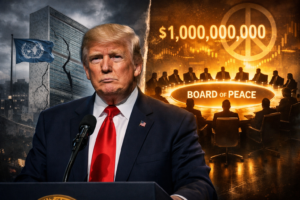
Former U.S. President Donald Trump has once again sparked a global debate with a bold geopolitical proposal. This time, it is not about tariffs or elections, but about reshaping global governance itself.
Trump has proposed the creation of a new international body called the “Board of Peace.” Backed by a massive $1 billion budget, this initiative could fundamentally challenge the relevance of the United Nations (UN).
According to Trump, the world needs a new system—one that reflects modern power dynamics rather than outdated post–World War II structures.
This proposal has triggered serious discussions among diplomats, analysts, and global institutions.
What Is Trump’s “Board of Peace”?
The Board of Peace is envisioned as a selective global body made up of the world’s most influential and financially powerful nations.
Unlike the UN, where each member state has a voice regardless of economic strength, Trump’s model emphasizes financial contribution as the basis of influence.
In simple terms:
-
More money = more power
-
Less contribution = less influence
This approach marks a sharp departure from the UN’s founding principles.
Why Trump Believes the UN Is Failing
Trump has long criticized the United Nations, calling it inefficient, outdated, and ineffective.
According to him, the UN has not adapted to global changes since it was formed after World War II.
Key criticisms include:
-
Bureaucratic delays
-
Weak enforcement of resolutions
-
Disproportionate influence by a few permanent members
-
Failure to prevent or resolve modern conflicts
Trump argues that today’s geopolitical landscape is vastly different from 1945, yet the UN still operates under the same framework.
No Major Reform Since World War II
The United Nations was established in 1945 when the world was recovering from the devastation of World War II.
At that time:
-
The U.S. and Europe dominated global politics
-
Many current nations did not even exist
-
Economic and military power was concentrated in a few regions
Despite globalization, technological revolutions, and new power centers like China and India, the UN structure has barely changed.
This stagnation, Trump argues, has made the UN less effective in addressing modern crises.
How the Board of Peace Would Work
The proposed Board of Peace would consist of a small group of powerful countries selected primarily based on financial strength and global influence.
Key features include:
-
Membership based on contribution, not equality
-
Faster decision-making
-
Stronger enforcement mechanisms
-
Centralized peace-building authority
Unlike the UN General Assembly, this body would not include nearly 200 nations.
Trump believes a smaller, richer, and more decisive group would deliver results faster.
$1 Billion Budget: Power Through Money
One of the most striking aspects of Trump’s proposal is the $1 billion annual budget.
This funding would:
-
Support peacekeeping operations
-
Rebuild post-conflict regions
-
Strengthen governance systems
-
Coordinate international aid
Trump argues that money is the real driver of influence, and nations willing to pay should lead.
Critics, however, see this as turning global peace into a pay-to-play system.
Focus on Gaza: The Starting Point
Trump has suggested that the Gaza conflict could be the first testing ground for the Board of Peace.
The idea is to:
-
Stabilize the region
-
Oversee reconstruction
-
Coordinate security arrangements
-
Establish long-term governance mechanisms
According to Trump, the UN has repeatedly failed to bring lasting peace to Gaza.
He believes a new body with financial muscle and political authority could succeed where others have failed.
A Permanent Alternative to the UN?
What makes this proposal especially controversial is Trump’s long-term vision.
He does not see the Board of Peace as a temporary solution.
Instead, he envisions it evolving into a permanent alternative to the United Nations.
Over time, Trump believes:
-
Countries may shift loyalty away from the UN
-
Funding could dry up for existing UN agencies
-
Global decision-making could move to the new board
If realized, this would mark the biggest shift in global governance since 1945.
Impact on Smaller and Developing Nations
One major concern is how this new system would affect smaller and poorer countries.
Under the UN:
-
Every country gets a vote
-
Smaller nations have diplomatic visibility
Under the Board of Peace:
-
Influence depends on financial contribution
-
Poor nations may be sidelined
-
Global inequality could increase
Many analysts warn that this could marginalize the Global South and weaken international cooperation.
Supporters vs Critics
Supporters Say:
-
The UN is slow and ineffective
-
Financial contributors deserve more say
-
Smaller bodies work faster
-
Real power should reflect real influence
Critics Say:
-
Peace should not be sold
-
Global equality will be destroyed
-
Rich nations will dominate decisions
-
The UN’s legitimacy cannot be replaced
This sharp divide shows how disruptive the proposal truly is.
Legal and Diplomatic Challenges
Creating a new global body is not simple.
Challenges include:
-
International recognition
-
Legal authority
-
Conflict with existing treaties
-
Resistance from UN permanent members
Countries like China and Russia are unlikely to support a system that weakens the UN, where they already hold veto power.
Could the UN Actually Decline?
While the UN will not disappear overnight, Trump’s proposal highlights a growing reality.
Many nations are frustrated with:
-
Endless resolutions
-
Limited enforcement
-
Political deadlocks
If a powerful alternative gains traction, the UN’s influence could slowly erode.
The Board of Peace may not replace the UN immediately, but it could reshape global power dynamics.
What This Means for the World
Trump’s “Board of Peace” is more than a policy idea.
It represents:
-
A challenge to multilateral equality
-
A shift toward financial dominance
-
A test of post-war global institutions
Whether the idea succeeds or fails, it has already reignited the debate on how global peace should be managed in the 21st century.
Conclusion
Donald Trump’s proposal for a $1 billion Board of Peace is one of the most radical ideas in modern international politics.
By questioning the relevance of the United Nations and proposing a money-driven alternative, Trump has opened a global conversation about power, reform, and fairness.
The future of global governance may depend on whether the world chooses equality or efficiency, tradition or transformation.
One thing is clear: the debate over the UN’s future is far from over.
Q: What is Trump’s Board of Peace?
A: It is a proposed global body funded by $1 billion, giving influence to powerful nations based on financial contribution.
Q: Is Trump trying to replace the UN?
A: Trump envisions the Board of Peace as a long-term alternative that could reduce the UN’s global role.
Q: Why is Gaza important in this plan?
A: Gaza is expected to be the first testing ground for peace-building under the new framework.