
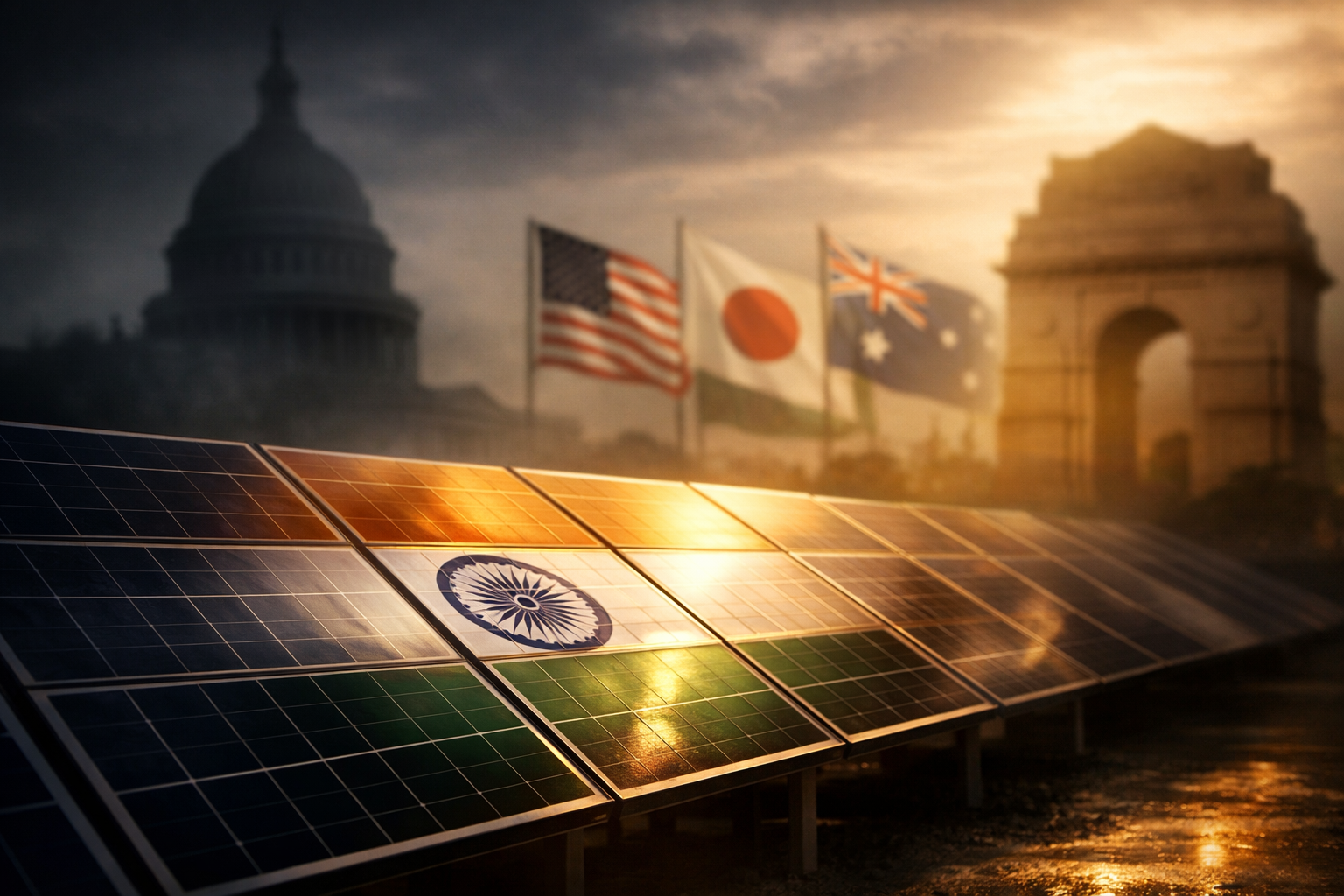
 The United States’ decision to withdraw from the International Solar Alliance (ISA) has sparked a serious global debate. Is this move an isolated policy shift, or part of a larger pattern of America’s retreat from multilateral institutions?
More importantly, many experts are now asking a critical question:
If the U.S. can exit the ISA, could alliances like QUAD be next?
This article breaks down the issue in simple terms, explores India’s growing leadership role, and examines what America’s withdrawal means for global politics.
What Is the International Solar Alliance (ISA)?
The International Solar Alliance was launched in 2015 during the Paris Climate Conference.
It was jointly initiated by India and France.
The main goal of the ISA is simple but powerful:
to promote solar energy adoption in developing and tropical countries.
The alliance focuses on:
-
Affordable solar power
-
Clean energy access
-
Climate-friendly development
-
Financial and technical cooperation
The ISA headquarters is located in Gurugram, India, highlighting India’s central role.
Why Did the US Quit the ISA?
The U.S. withdrawal from the ISA aligns with a broader trend of American unilateralism in foreign policy.
Former U.S. President Donald Trump openly criticized the ISA.
He reportedly called the alliance “unnecessary and wasteful.”
This statement reflects a larger shift in U.S. priorities during the Trump era, where:
-
Multilateral agreements were seen as burdens
-
Global commitments were viewed through a cost-first lens
-
“America First” dominated decision-making
The exit from ISA followed similar withdrawals from:
-
The Paris Climate Agreement
-
WHO funding commitments
-
Other international cooperative frameworks
A Pattern of American Global Retreat
The ISA exit is not an isolated event.
It fits into a broader pattern of the U.S. stepping back from global leadership roles.
Key characteristics of this trend include:
-
Preference for bilateral deals over multilateral institutions
-
Reduced commitment to climate initiatives
-
Skepticism toward global governance bodies
This has raised alarms among allies and developing nations alike.
Many now question whether the U.S. is willing to sustain long-term global partnerships.
Why ISA Matters Beyond Solar Energy
While ISA focuses on solar power, its importance goes far beyond energy.
For India, the ISA is a strategic diplomatic tool.
It allows India to:
-
Lead the Global South
-
Shape climate and development narratives
-
Offer alternatives to Western-dominated institutions
-
Build influence through cooperation, not coercion
ISA strengthens India’s soft power in Asia, Africa, and Latin America.
It also positions India as a bridge between developed and developing nations.
India’s Leadership in the Global South
The ISA is a symbol of India’s emerging global leadership.
India is not just a participant—it is a driver.
With France as a key partner, India:
-
Designs policy frameworks
-
Mobilizes climate finance
-
Supports capacity building
-
Promotes affordable technology
This leadership role contrasts sharply with America’s withdrawal.
As the U.S. steps back, India is stepping forward.
Affordable Energy for Developing Nations
One of ISA’s core missions is energy justice.
Millions of people in developing countries still lack reliable electricity.
ISA addresses this gap by:
-
Reducing solar project costs
-
Encouraging public-private partnerships
-
Supporting small island and African nations
-
Enabling clean energy transitions without heavy debt
For these countries, the ISA is not “wasteful.”
It is essential.
How France and India Filled the Leadership Gap
After the U.S. exit, France and India doubled down on their commitment.
France provides:
-
Technical expertise
-
Financial backing
-
European diplomatic support
India contributes:
-
Policy vision
-
Institutional leadership
-
Ground-level implementation experience
Together, they have ensured the ISA continues to grow despite U.S. withdrawal.
What Does This Mean for Global Climate Action?
America’s exit sends a troubling signal.
Climate change is a global problem that needs collective solutions.
When a major power withdraws:
-
Momentum slows
-
Funding gaps widen
-
Trust erodes
Developing nations may feel abandoned by those historically responsible for emissions.
This weakens global climate cooperation at a critical moment.
Is QUAD the Next Casualty?
The big geopolitical question remains:
Could QUAD be next?
QUAD includes:
-
United States
-
India
-
Japan
-
Australia
It focuses on:
-
Indo-Pacific security
-
Supply chain resilience
-
Technology cooperation
-
Strategic balance against China
While QUAD is security-focused, doubts are growing.
If U.S. commitment depends on changing administrations, allies may feel uncertain.
Trust Deficit in US Alliances
The ISA withdrawal highlights a growing trust deficit.
Allies now ask:
-
Will the U.S. stay committed long-term?
-
Will policies reverse every four years?
-
Can multilateral agreements survive domestic politics?
These concerns apply directly to QUAD.
Stability is crucial for alliances to work.
India’s Strategic Calculus
India is watching carefully.
While India values QUAD, it is also:
-
Strengthening ties with Global South nations
-
Leading independent multilateral platforms like ISA
-
Pursuing strategic autonomy
ISA proves that India can lead without U.S. participation.
This gives India leverage and confidence.
A Multipolar World Is Taking Shape
America’s retreat is accelerating the shift toward a multipolar world.
In this world:
-
Power is more distributed
-
Leadership comes from cooperation
-
Emerging economies shape global agendas
Platforms like ISA represent this transition.
They show that global governance no longer revolves around one country.
Conclusion: Retreat or Realignment?
The U.S. exit from the International Solar Alliance is more than a policy decision.
It reflects a deeper shift in how America views global responsibility.
While Washington steps back, India is stepping up.
The future of alliances like QUAD will depend on consistency, trust, and shared vision.
One thing is clear:
Global leadership is no longer guaranteed—it must be earned.
Why did the US quit the International Solar Alliance (ISA)?
The United States exited the International Solar Alliance after former President Donald Trump criticized the body as unnecessary and wasteful. The move reflects a broader shift toward American unilateralism and reduced participation in multilateral climate initiatives.
What is the significance of ISA for India?
The ISA allows India to lead the Global South by promoting affordable solar energy, strengthening diplomatic influence, and positioning itself as a key player in global climate governance beyond traditional Western institutions.
Is the QUAD alliance at risk after the ISA exit?
While QUAD is primarily a strategic and security alliance, the U.S. withdrawal from global agreements like ISA raises concerns about long-term American commitment to multilateral partnerships.
➡️ These short answers increase chances of featured snippets and People Also Ask rankings.