

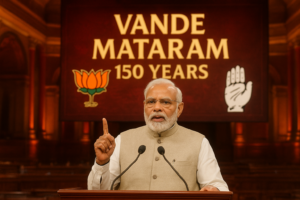

Recently, Prime Minister Narendra Modi triggered a fresh round of discussion after initiating a parliamentary debate on Vande Mataram. His speech reignited political arguments, emotional reactions and cultural questions around the status of the national song.
In this article, we break down the entire controversy in simple language — why the two largest political parties are fighting, what PM Modi said, how history shapes this debate and why the issue matters today.
What Is the Debate About?
The current dispute revolves around how Vande Mataram should be treated:
-
Is it purely a national song?
-
Is it a symbol of nationalism that must be respected by everyone?
-
Should it be mandatory in schools and public events?
-
Or should it remain optional to avoid hurting sentiments of some communities?
The BJP and Congress stand on two very different sides of these questions, which is why the issue keeps returning to the political spotlight.
PM Modi’s Big Statement in Parliament
Prime Minister Narendra Modi opened a parliamentary debate on Vande Mataram to highlight its national importance. He described the song as:
-
A symbol of India’s cultural heritage
-
A reflection of civilizational pride
-
A source of inspiration during the freedom struggle
-
A piece of literature that shaped Indian nationalism
Modi argued that controversies around the national song arise only because some political parties hesitate to embrace India’s cultural roots.
His speech challenged political opponents to acknowledge Vande Mataram as not just a song but a pillar of India’s national identity.
Why BJP Considers Vande Mataram Non-Negotiable
According to BJP leaders, Vande Mataram is deeply tied to the idea of Indian nationalism.
Here’s what the BJP’s stance typically includes:
1. Rooted in India’s Civilizational Ethos
The party believes the song represents India’s ancient cultural values, celebrating the motherland as divine.
2. Symbol of the Freedom Struggle
Freedom fighters often chanted Vande Mataram during protests and marches.
It became a motivational slogan during:
-
The Swadeshi Movement
-
Quit India Movement
-
Anti-British resistance in Bengal
3. A Unifying National Symbol
For the BJP, the song is not religious but patriotic — a national mantra that binds all Indians together.
4. Should Be Respected Like the National Flag
Many BJP leaders argue that respecting Vande Mataram is equivalent to respecting the nation itself.
Congress’s View: A More Selective Approach
Congress does not reject Vande Mataram, but its approach is different from the BJP.
1. Respect the Song, But Not Mandatory
Congress leaders say the national song should be respected but not imposed, especially where it may cause discomfort to specific communities.
2. Historical Sensitivity
Some Congress leaders emphasize that during the freedom struggle, certain Muslim organisations objected to parts of the song for religious reasons.
3. Focus on Constitutional Values
Congress prefers promoting the constitutional idea of India, where patriotism is broad and inclusive — not tied to a single symbol.
Because of these differences, BJP often accuses Congress of being “soft” on nationalism, while Congress claims BJP wants to “politicize culture.”
Why PM Modi Reopened This Issue
PM Modi’s speech was strategic and symbolic.
1. 150 Years of Vande Mataram
The year marks 150 years since Bankim Chandra Chattopadhyay wrote the song in 1875. Modi used the milestone to remind the nation of its historical importance.
2. Cultural Assertion
The government is focusing on cultural heritage, traditional values and national identity. Vande Mataram fits perfectly into this narrative.
3. Political Messaging
Modi wants to corner Congress by suggesting the party cannot wholeheartedly support national symbols due to “vote-bank politics.”
4. Emotional Connect Before Elections
Nationalism, cultural pride and heritage often become strong emotional issues during election periods. This debate adds to that momentum.
Historical Figures in the Debate: Nehru and Jinnah
The conversation around Vande Mataram always returns to two historical personalities:
1. Mohammad Ali Jinnah
Jinnah, who later founded Pakistan, opposed the mandatory use of Vande Mataram. He argued that certain lines of the song conflicted with Islamic beliefs.
His opposition is often used today to suggest that rejecting Vande Mataram aligns with Jinnah’s ideology.
2. Jawaharlal Nehru
India’s first Prime Minister, Jawaharlal Nehru, struck a middle ground.
-
Nehru supported the first two stanzas of Vande Mataram, which were non-religious and purely patriotic.
-
He did not want to hurt the sentiments of religious minorities.
-
He balanced patriotism with cultural sensitivity.
Today, BJP leaders sometimes cite Nehru’s selective approach as evidence that Congress lacks cultural confidence.
Congress counters by saying Nehru ensured national unity by avoiding unnecessary conflict.
Why Vande Mataram Still Matters Today
Even after 150 years, the song remains relevant for multiple reasons:
1. It Defines India’s Cultural Identity
India’s identity is built on centuries of literature, poetry and spiritual philosophy. Vande Mataram is part of that heritage.
2. It Symbolizes Freedom and Sacrifice
The song was sung in prisons, public rallies and protests during British rule.
It carries the memories of thousands of patriots.
3. It Shapes Modern Political Narratives
In today’s political landscape, symbols matter. Songs, slogans and historical events become talking points for parties trying to define nationalism.
4. It Influences Education and Youth
Debates around cultural symbols shape the next generation’s understanding of India’s identity.
BJP-Ruled States Making Vande Mataram Mandatory
The video discussed in your input also mentions growing cultural and educational initiatives promoting the national song.
Several BJP-governed states have:
-
Introduced mandatory recitation in schools
-
Included the song in morning assemblies
-
Made it compulsory in government events
-
Organized cultural festivals celebrating its history
These initiatives aim to strengthen patriotic values among students and the public.
However, critics argue that compulsion is unnecessary and may create divisions instead of unity.
Why Congress Opposes Mandatory Recitation
Congress does not oppose the song itself, but it questions enforcement.
Their concerns include:
-
Forcing patriotism does not encourage genuine respect
-
Students should learn national values through understanding, not pressure
-
India’s diversity must be protected
-
Cultural symbols should unite, not divide
Congress leaders say the BJP is using Vande Mataram as a political tool rather than a cultural treasure.
Public Reaction: Divided Yet Emotional
Indians across social media and television debates have shown mixed reactions.
Many Support BJP’s View
They believe:
-
National symbols must be respected
-
Vande Mataram represents India’s essence
-
Opposition to it is unpatriotic
Others Support Congress’s Caution
They feel:
-
Patriotism cannot be forced
-
Respect should come from love, not pressure
-
India’s diversity should be preserved
The debate reflects India’s diversity itself — different opinions, yet a shared emotional connection to the country.
Conclusion: Why This Debate Will Continue
The fight between BJP and Congress over Vande Mataram is not about a song alone. It is about:
-
What nationalism means
-
How culture should be preserved
-
How political parties use history
-
How India defines its identity in modern times
PM Modi’s speech has reignited an old debate that blends history, politics, culture and emotion. And given the symbolic power of Vande Mataram, this debate will not end anytime soon.
Whether one sees it as mandatory or optional, one thing is certain — Vande Mataram will always remain a powerful part of India’s national soul.