
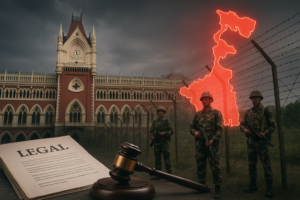
 Securing India’s borders has always been a national priority, especially along sensitive international frontiers like the India–Bangladesh boundary. Recently, a major development has stirred political and administrative debates across West Bengal. The Calcutta High Court has strongly reprimanded the West Bengal government for refusing to provide land required to the Border Security Force (BSF) for completing border fencing work.
A video discussion by presenter Aniruddh highlights the full controversy, past incidents, and the deeper implications of the state government’s stand. This article breaks down the issue in simple, SEO-friendly language.
What Is the Controversy About?
The central topic revolves around border fencing along the sensitive West Bengal–Bangladesh boundary. The BSF has been trying to finish fencing in several stretches, especially in areas vulnerable to:
-
Illegal migration
-
Cattle smuggling
-
Human trafficking
-
Infiltration of criminals
-
Cross-border terror networks
However, according to the video, the West Bengal government has refused to grant the BSF access to certain land parcels, thereby delaying the completion of the fencing project.
This has now reached the doors of the Calcutta High Court, which has taken serious note of the matter.
Calcutta High Court Questions State Govt’s Intentions
In a significant observation, the Calcutta High Court directly questioned the West Bengal government for opposing the land transfer needed for fencing.
The court asked:
-
Why is the state government objecting to a national security project?
-
What are the reasons behind refusing land to the BSF?
-
Is the refusal driven by administrative concerns or political motives?
The judges expressed surprise and concern, stating that fencing the border is crucial for preventing cross-border illegal activities. The court has demanded a clear explanation and justification from state officials.
This judicial push has intensified the spotlight on the state government’s role.
Land Acquisition: A State Subject but National Security At Stake
One of the central points in this issue is that land acquisition is a power held by state governments.
This means:
-
The central government cannot directly acquire land in West Bengal for border fencing.
-
The BSF cannot proceed without state-level permission.
-
Any delay or refusal by the state government directly affects national security operations.
According to Aniruddh’s analysis, the fencing project has been stuck for years due to a lack of cooperation from the West Bengal administration. The High Court’s intervention now puts legal pressure on the state to justify its stance.
Past Incidents: Bangladesh Officials Trying to Stop Fencing Work
The video highlights multiple past incidents where even Bangladesh officials attempted to halt Indian fencing work.
Some examples mentioned:
-
A retired Bangladeshi Army General reportedly visited border areas and asked Indian authorities to stop fencing activity.
-
Local Bangladeshi political leaders have objected to fencing at certain points along the border.
-
Such interventions have created confusion, tension, and delays.
These incidents underscore why India needs clear, uninterrupted control over its own side of the border. The more the fencing is delayed, the more the border remains vulnerable to illegal activities.
How Much of the West Bengal–Bangladesh Border Is Still Unfenced?
West Bengal shares a very long and porous border with Bangladesh.
Key points:
-
Total India–Bangladesh border: 4,096 km
-
Portion shared with West Bengal: over 2,200 km
-
This makes West Bengal the largest border-sharing state with Bangladesh.
Despite years of work, several hundred kilometres of this border are still unfenced, especially in riverine and densely populated areas.
Aniruddh promises to explain in the video:
-
Which stretches are still open
-
Why those stretches are so difficult to fence
-
How delays increase smuggling, infiltration, and illegal trade
The High Court’s intervention becomes even more significant because unfinished fencing has serious national security implications.
Why Is Border Fencing So Important?
Every security expert agrees that the West Bengal–Bangladesh border is one of India’s most sensitive. According to the video and multiple reports, the absence of fencing leads to:
1. Illegal Immigration
Large numbers of undocumented individuals cross the border through unfenced or loosely guarded stretches.
2. Cattle & Goods Smuggling
West Bengal is one of the biggest hotspots for cross-border smuggling networks.
3. Human Trafficking
Women and children are trafficked through porous border stretches into both countries.
4. Infiltration of Criminal Networks
Fake currency rackets, drug syndicates, and anti-national groups exploit gaps in fencing.
5. Security Threats
Unfenced borders pose risks during international tensions or political unrest.
This is why the High Court emphasised that border security cannot be compromised by administrative delays.
Why Is the State Government Opposing the Fencing Work?
The West Bengal government has not provided a clear explanation publicly, but the video suggests several possible reasons:
1. Political Positioning
Fencing and BSF operations often become political issues within the state.
2. Land Rights & Compensation
Local landowners may resist land acquisition, and the government may not want to confront them.
3. Administrative Conflicts with Centre
There has been ongoing tension between the state government and the central government on policing powers and BSF jurisdiction.
4. Vote Bank Concerns
Illegal migration and border populations are sensitive political topics in Bengal.
The High Court is now demanding transparent answers instead of assumptions.
What Happens Next? Court’s Involvement Changes Everything
With the High Court stepping in, several outcomes are expected:
✔ State Government Must File a Detailed Response
The court has asked the government to explain why they refused land to the BSF.
✔ Pressure to Allow Fencing Work
If the court finds the refusal unjustified, it may direct the state to release the land.
✔ Boost for BSF’s Border Security Plans
A favourable order could accelerate fencing in critical stretches.
✔ Political Debate Will Intensify
Opposition parties may use this issue to question the state government’s commitment to national security.
✔ Bangladesh Factor Will Be Re-examined
India may review its diplomatic approach if foreign officials continue interfering in boundary projects.
People Living Along the Border Want Security
The most affected are the residents of border villages. They face:
-
Frequent cross-border crime
-
Safety concerns at night
-
Smuggling pressure from criminal networks
-
Loss of livelihood due to insecure surroundings
Many villagers have repeatedly requested fencing to protect their homes, cattle, and farms.
Conclusion: High Court’s Warning Puts Spotlight Back on Border Security
The Calcutta High Court’s warning to the West Bengal government has opened a crucial debate on border security, governance, and national interest.
Key takeaways:
-
The BSF needs land to finish fencing.
-
The state government has blocked the process.
-
The High Court has demanded answers.
-
Past interference by Bangladeshi officials complicates matters.
-
Large portions of the border remain open and vulnerable.
-
The issue directly affects India’s security and common citizens.
As Aniruddh highlights in his video, the coming weeks will reveal how the state responds and what the High Court ultimately orders.
If the fencing is completed, it will strengthen India’s eastern frontier for decades to come.