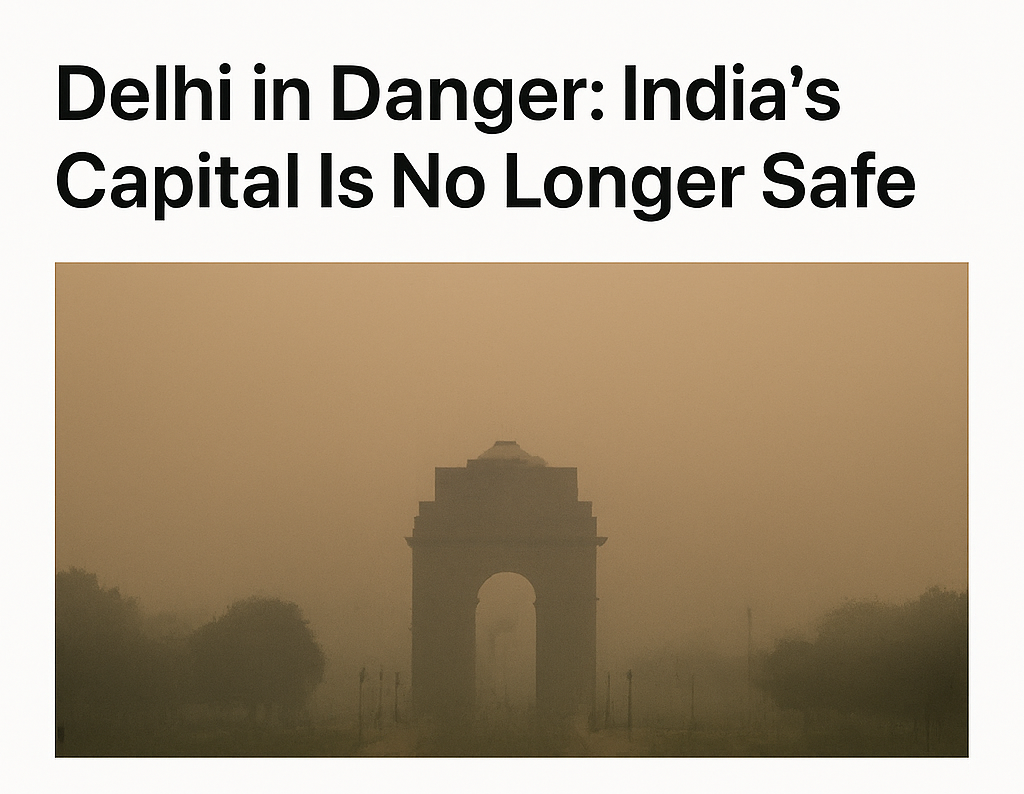
 Delhi, once a symbol of culture, power, and pride, is now facing one of the worst environmental and livability crises in its history. Over the years, the city has struggled with pollution, population pressure, and declining living standards. Today, the situation has become alarming enough that many residents are no longer proud of living in the national capital—rather, they feel a growing urge to leave it.
This blog breaks down the reasons why Delhi is becoming unsafe, unlivable, and dangerous for millions of people.
A City Moving From Pride to Panic
There was a time when Delhiites proudly declared, “This is the heart of India.”
Beautiful wide roads, greenery, historical monuments, and modern infrastructure made Delhi one of the most desirable cities to live in.
But the situation has changed drastically.
The video highlights a clear shift in public sentiment.
People are now saying something completely different:
“We want to escape Delhi.”
This sentiment reflects a deeper problem.
Delhi’s livability index has declined sharply due to pollution, rising health issues, overcrowding, and environmental stress. Instead of being a city of opportunity, Delhi is turning into a city of concern.
Delhi: A Toxic Gas Chamber
The term used in the video—“toxic gas chamber”—is no exaggeration.
Every year, as winter approaches, Delhi’s air quality drops to hazardous levels.
But this time, the situation appears even worse.
Why the Air Is So Dangerous
Delhi’s Air Quality Index (AQI) often crosses 400, 500, and even 800 in some areas.
This level of pollution is not just harmful—it is deadly.
Doctors have compared breathing Delhi’s air to smoking multiple cigarettes a day.
Children, senior citizens, and people with lung or heart problems are the worst affected.
Common effects include:
-
Breathlessness
-
Coughing and irritation
-
Reduced lung capacity
-
Increased asthma attacks
-
Higher risk of stroke and heart disease
-
Long-term cancer risk
When a city’s air becomes poisonous, the people living in it inevitably suffer.
Delhi today is experiencing exactly that.
Health Risks Rising at an Alarming Speed
Delhi’s pollution is not merely an environmental problem; it is now a public health emergency.
Hospitals are reporting:
-
More respiratory cases
-
Sudden spikes in lung infections
-
Longer recovery time
-
Increased intake of asthma medication
Children are growing up with weakened lungs.
Working adults are constantly exposed to pollutants during daily commute.
Even indoor air purifiers can no longer fully protect residents.
The city’s toxic air is making life harder, riskier, and more stressful for everyone.
Demographic Changes: Delhi’s Population Is Evolving
One of the interesting insights from the video is that Delhi’s population is not expected to decrease soon.
People still continue to move to the capital for jobs, business, and education.
However, the composition of the population is changing.
Many long-time residents, especially middle- and upper-class families, are choosing to relocate to cleaner cities such as:
-
Noida
-
Gurgaon
-
Dehradun
-
Chandigarh
-
Bangalore
At the same time, new migrants are moving in for opportunities.
This means Delhi will remain densely populated, but the kind of people living here will shift.
This demographic transition is a result of deteriorating conditions, not natural growth.
It shows a harsh reality:
People with the means to leave Delhi are already leaving.
Why Delhi Is So Polluted: Key Contributing Factors
Delhi’s pollution problem does not come from a single source.
It is a deadly mix of various factors that combine to create extreme air toxicity.
The video highlights the biggest contributors, and here is a breakdown:
1. Stubble Burning
This is one of the most widely discussed causes.
Farmers in Punjab and Haryana burn crop residue during the harvest season.
The smoke travels directly towards Delhi due to wind patterns.
Although this issue is seasonal, its impact is massive.
In peak months, stubble burning contributes up to 40% of Delhi’s total pollution.
2. Biomass Burning
Biomass burning includes:
-
Wood
-
Cow dung
-
Garbage
-
Crop waste
This type of burning happens across rural and semi-urban areas around Delhi.
It adds continuous layers of smoke and particulate matter to the atmosphere.
Biomass burning accounts for nearly 20–25% of Delhi’s pollution.
Combined with stubble smoke, it forms a dangerous mix.
3. Vehicle Emissions
Delhi has millions of vehicles on the road.
Cars, bikes, trucks, and buses continuously release:
-
Nitrogen dioxide
-
Carbon monoxide
-
Particulate matter (PM2.5 & PM10)
Even electric vehicle adoption has not grown fast enough to reduce this impact significantly.
4. Construction Dust
Delhi is always under construction—roads, metro expansion, bridges, buildings, and flyovers.
Dust from these sites spreads across the city, making the air even more toxic.
5. Weather Conditions
Winters in Delhi trap pollution closer to the ground.
Low temperatures and slow wind speed reduce the dispersion of pollutants.
Delhi’s Livability: Declining Year After Year
Pollution is just one part of the problem.
Delhi’s overall quality of life is decreasing rapidly.
Rising population pressure
More people mean:
-
More waste
-
More traffic
-
More strain on infrastructure
Delhi’s systems are unable to keep up with this growth.
Water scarcity
Despite being on the banks of the Yamuna, Delhi faces water shortages every summer.
Garbage management crisis
Landfills such as Ghazipur have turned into mountains of waste.
These sites release toxic gases and worsen the city’s air quality.
Noise pollution
Constant honking, traffic, and construction noise add to mental stress.
Safety concerns
Increasing crime rates in some areas have added yet another layer of worry.
Delhi is struggling on multiple fronts, making everyday life difficult and unsafe for residents.
Should People Stay in Delhi? A Hard Question
The video raises an important question:
“Is it worth staying in such a polluted city?”
While Delhi still offers opportunities, better connectivity, and economic advantages, the health risks are rising so quickly that many families are reconsidering their future in the capital.
No one wants their children to grow up inhaling poison.
No one wants chronic health issues because of polluted air.
No one wants a life full of stress and anxiety caused by environmental decline.
The desire to leave Delhi is not emotional—it is logical.
A Call for Awareness and Action
India cannot afford to lose its capital city to pollution.
The video urges viewers to:
-
Stay aware
-
Stay informed
-
Demand action
-
Prioritize health over convenience
Simple steps can help reduce the personal risk:
-
Use N95 masks outdoors
-
Install indoor air purifiers
-
Avoid morning walks during high AQI days
-
Keep plants indoors
-
Monitor AQI daily
But these are temporary solutions.
Real change must come from policy reforms, environmental planning, and regional cooperation.
Conclusion: Delhi’s Future Is at a Crossroads
Delhi is in danger—not because of politics or economics—but because of the air people breathe every day.
The city that was once admired is now struggling for survival.
People are losing hope, and the desire to escape is growing stronger.
However, awareness can lead to action, and action can bring change.
To save Delhi, the government, citizens, and neighboring states must work together.
Without urgent steps, India’s capital may become increasingly unlivable in the years to come.
Delhi’s future is in our hands.
The question is: Are we ready to act before it’s too late?
1. Why is Delhi considered unsafe now?
Delhi is unsafe mainly because of extreme air pollution, overcrowding, and rising health problems caused by toxic air. These factors reduce the city’s overall livability.
2. What is causing the pollution crisis in Delhi?
Major contributors include stubble burning, biomass burning, vehicle emissions, construction dust, and winter weather patterns that trap pollutants.
3. How does Delhi’s pollution affect health?
Pollution increases risks of asthma, lung infections, heart disease, reduced lung capacity, and long-term illnesses like cancer.
4. Are people leaving Delhi because of pollution?
Yes. Many families with financial means are relocating to cities like Noida, Gurgaon, Dehradun, and Chandigarh due to worsening air quality.
5. Can Delhi’s air quality improve?
Improvement is possible with strict environmental policies, reduction in stubble burning, better waste management, and cleaner transportation systems.