

India–China Trade Reaches Record $155 Billion in 2025 Despite Political Tensions
India–China trade has touched a historic milestone.

This new high shows one clear reality.
Economic dependence between India and China remains strong, even when diplomatic relations stay complicated.
While governments talk about restrictions and self-reliance, businesses continue to trade at an increasing pace.
This contrast makes the India-China trade relationship both interesting and complex.
Let’s understand what’s happening and what it means for India’s economy.
India–China Trade Hits All-Time High
Bilateral trade between India and China has grown steadily over the last few years.
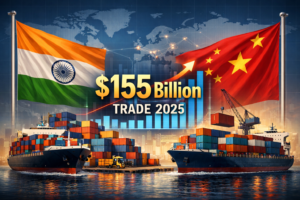
In 2025, total trade volume crossed $155 billion, the highest ever recorded between the two countries.
This growth comes as a surprise to many observers.
Especially because India and China have faced:
-
Border tensions
-
Military standoffs
-
Diplomatic disagreements
-
Calls for reducing dependence on Chinese goods
Yet trade numbers continue to climb.
This shows how deeply connected the two economies have become.
Even when politics creates friction, business continues.
Why Is Trade Still Growing?
The main reason is simple.
India depends heavily on Chinese imports.
China is one of the world’s largest manufacturing hubs.
It produces goods at lower costs and massive scale.
Indian industries rely on these supplies to keep production running.
Without Chinese components, many sectors in India would slow down or become expensive.
Because of this, imports from China remain strong year after year.
India Faces a Massive Trade Deficit
Although trade is increasing, there is a serious problem.
India is buying much more than it sells.
This has created a large trade deficit with China.
A trade deficit happens when imports are higher than exports.
In simple words:
India spends more money on Chinese goods than it earns from selling products to China.
This imbalance hurts India’s economy in the long run.
It puts pressure on domestic manufacturing and foreign exchange reserves.
India’s Exports to China Remain Weak
India’s exports to China reached only $19.75 billion in 2025.
This figure increased by just 9.7% from the previous year.
Compared to total trade of $155 billion, this is very small.
It clearly shows that India is not exporting enough value-added products.
Most of India’s exports include:
-
Raw materials
-
Iron ore
-
Cotton
-
Chemicals
-
Semi-finished goods
These products generate lower profits.
They do not create strong economic growth like high-tech exports do.
This limits India’s earnings from trade.
What Does India Import From China?
A major reason for the deficit is the type of goods India imports.
China supplies high-value, technology-based products.
These are expensive and difficult to replace.
Key imports from China include:
Electronics
Smartphones, computer parts, and consumer gadgets.
Most Indian electronics brands rely on Chinese components.
Telecom Equipment
Network devices, routers, and telecom hardware.
These are essential for India’s growing digital infrastructure.
Solar Panels
China dominates the global solar panel market.
India imports a large portion for renewable energy projects.
Machinery
Industrial machines and heavy equipment used in factories.
These machines support manufacturing across India.
Because these products are costly and necessary, imports remain high.
This directly contributes to the trade imbalance.
Political Tensions vs Economic Reality
One of the most striking things about this trade growth is the timing.
India and China have had several political disputes.
There have been border clashes and diplomatic tensions.
India has also talked about reducing Chinese influence in critical sectors.
The government introduced:
-
Restrictions on Chinese apps
-
Investment checks
-
Import monitoring
-
“Make in India” initiatives
Yet trade has still reached record levels.
This shows that economic dependence is stronger than political disagreements.
For now, business needs outweigh political concerns.
Why India Cannot Cut Imports Quickly
Many people ask:
Why doesn’t India simply stop buying from China?
The answer is not that easy.
Building local manufacturing takes time.
India needs:
-
Technology
-
Skilled labor
-
Infrastructure
-
Capital investment
Replacing Chinese imports overnight would increase costs for Indian consumers and businesses.
Prices of electronics, machinery, and solar equipment could rise sharply.
This could slow down economic growth.
So India must reduce dependence gradually, not suddenly.
The Push for Self-Reliance
India has already started taking steps.
The government launched programs like:
Make in India
Encourages local manufacturing and foreign investment.
Production Linked Incentive (PLI) Scheme
Supports domestic industries with financial incentives.
Semiconductor Manufacturing Plans
Focus on building chip manufacturing capacity inside India.
Renewable Energy Manufacturing
Boosts local solar panel production.
These efforts aim to reduce import dependence over time.
But results will take years, not months.
Until then, trade with China will remain strong.
Impact on Indian Businesses
Many Indian companies benefit from Chinese imports.
Cheap raw materials and components reduce production costs.
This helps businesses stay competitive.
But there is also risk.
Overdependence on one country can create supply disruptions.
For example:
If relations worsen or supply chains break, industries may suffer.
That’s why diversification is important.
India is trying to import more from countries like:
-
Vietnam
-
Taiwan
-
South Korea
-
Japan
This strategy reduces risk while maintaining supply.
Opportunities for India
The trade deficit is a challenge.
But it is also an opportunity.
India can focus on exporting more value-added products.
Some promising sectors include:
-
Pharmaceuticals
-
IT services
-
Chemicals
-
Engineering goods
-
Textiles
-
Renewable energy equipment
If India increases exports in these areas, the deficit can shrink.
Better exports mean stronger economic growth.
What the $155 Billion Trade Means for the Future
The record trade figure sends a clear message.
India and China are economically linked.
Even if politics create friction, trade continues.
In the short term, imports will likely remain high.
In the long term, India aims to become more self-reliant.
The future may look like this:
-
Reduced dependence on Chinese imports
-
Stronger domestic manufacturing
-
Higher exports
-
More balanced trade
But reaching this stage will take consistent policy support.
Final Thoughts
The India–China trade story is full of contrasts.
On one side, political tensions and border issues.
On the other side, record economic cooperation.
In 2025, bilateral trade touched $155 billion, the highest ever.
However, India still faces a large trade deficit.
Imports of electronics, telecom equipment, solar panels, and machinery dominate.
Exports remain limited to raw and semi-finished goods, reaching just $19.75 billion.
This imbalance needs attention.
India must boost local manufacturing and high-value exports.
Only then can trade become more balanced.
Until that happens, China will continue to play a major role in India’s economy.
The numbers clearly show one thing.
Politics may divide countries.
But trade often connects them stronger than ever.